

Only God knows what would happen in the next 25 years or so (up to the next Jubilee year in 2050). Will the SSPX and Rome officially “reconcile”? Will the Papacy fully and unabashedly defend Catholic dogma and safeguard the Traditional Latin Mass? It remains a mystery to us for now.
As I ponder about my recent experiences in Rome for the SSPX Jubilee in August 2025, I cannot help but feel awe, gratitude and a strong conviction of why the SSPX chose to be present in Rome at this very juncture in the first place.
Admittedly, the Jubilee celebrations that took place last week (August 19 to 21)in Rome was a tangible testimony of the priestly fraternity’s desire to be as “Roman” as much as “Catholic”.
During the three-day Jubilee celebrations along with thousands of fellow Catholics from around the world who attended SSPX chapels,I acutely felt the reality of being both “Roman”and “Catholic”, not simply because of the weight of history that Rome, the Eternal City, itself represented.
Certainly, Rome’s majestic basilicas, legions of martyrs, bands of virgins, and uneven cobblestone streets continue to etch indelible memories, but more importantly, it was the gravitas of Rome as a center of Catholic pilgrimage that impressed me greatly. The SSPX pilgrims, along with other pilgrims in general, flocked to Rome from every corner of the globe, each carrying their own culture, background, language, and sometimes national flags.
In Rome, differences of nationality, culture, and vernacular among the SSPX pilgrims did not seem to matter too much, as pilgrims were united by the Catholic Faith and the desire for solid Catholic dogma and reverent liturgical worship as epitomized in the Holy Sacrifice of the Mass (1962 Missal).
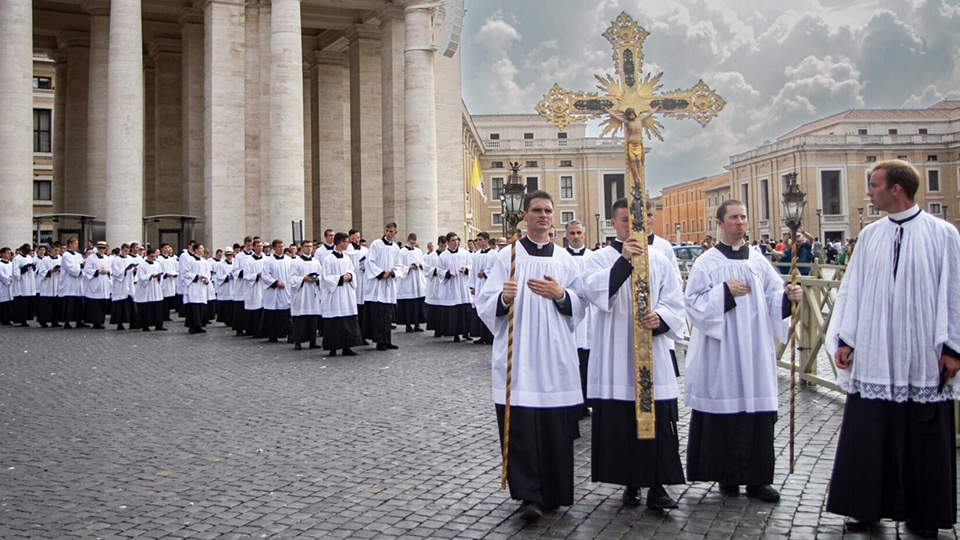
While I had expected a certain splendor when it came to witnessing the various prayers and liturgical ceremonies conducted by SSPX clergy, my first-hand experiences exceeded expectations. Seeing throngs of clergy and religious donned in traditional cassocks and religious habits respectively, along with the heavenly echoes of Gregorian chant, I found myself in close contact not simply with the externals of aesthetic beauty (i.e. the “smells and bells”), but a step closer to encountering transcendental beauty itself. Undoubtedly, the crux of the Jubilee celebrations was the Holy Sacrifice of the Mass. Listening to timeless spoken and sung Latin prayers during the various SSPX Masses celebrated all around Rome, from the Basilica of St. Mary Major to St. Vitalis and Companions, to the public Solemn High Mass celebrated by Don Davide Pagliarani at Calle Oppio near the Colosseum, felt like a type of homecoming, even though I was thousands of miles away from my native land of Singapore, nestled in a pagan and Muslim-dominated region of Southeast Asia, I was still very much at home in Catholic Rome, amidst the wafts of incense and otherworldly Gregorian chants.
Notably, Don Pagliarani’s multi-lingual sermon during the Solemn High Mass on August 20 struck me immensely. Apart from my native language of English, I knew enough French to realize that the French version of his sermon was not a verbatim translation of the English one. (For those who are curious to find out more about Don Pagliarani’s sermon, check out Fr. Jean-Michel Gomis’ commentary on Don Pagliarani’s sermon here.)
For one, Don Pagliarani declared that the presence of the SSPX in Rome is of particular importance because “Rome is a city of martyrs”, and these martyrs preferred to die instead of offending Our Lord Jesus Christ by denying the Catholic Faith. Alluding to the heroic witnesses of the bands of martyrs, Don Pagliarani stated that the SSPX was in Rome to profess Our Lord Jesus Christ in the same way the martyrs of Rome did centuries ago. To defend the Catholic Faith is not merely to defend an opinion, rather, it is to defend Our Lord Jesus Christ , who is the Way, the Truth, and the Life. Hence, the SSPX was in Rome not to ask for “privileges” or “favors”, but to ask for the Faith in its entirety from God and from the Catholic Church, the very Faith that gives all of us eternal life.
Subsequently, Don Pagliariani reiterated (in English) the significance of establishing and maintaining the Social Kingship of Our Lord Jesus Christ as part of living out our Catholic Faith. The desire to promote and establish the Social Kingship of Jesus Christ has been the modus operandi of Archbishop Lefebvre (from his years in Africa as a missionary to his role as the founder of the SSPX and defender of the Traditional Latin Mass and Catholic dogma).In like manner, various Catholic media outlets, including The Remnant, have been laboring for years to defend traditional Catholic dogma and liturgy.
As a lifelong student of history, I was edified to hear from the prelate that the “sense of history” is to submit all peoples and things to Our Lord Jesus Christ, who is our Everything, as the Apostle St. Paul stated in his letter to the Corinthians, that “God may be all in all”. All things should revolve around Our Lord Jesus Christ, as He is the center of all the world’s events, given that “history” is, after all, HIS story.
How then, can Catholics receive the graces and strength to establish (and reestablish) the Social Kingship of Our Lord Jesus Christ? The answer lies in the Holy Sacrifice of the Mass, which is the renewal of the Passion and Crucifixion of Our Lord Jesus Christ. As Fr Gomis rightly pointed out, it is the Holy Sacrifice of the Mass that is the source of grace, the source of the Kingship of Our Lord Jesus Christ, and the means of improving one’s spiritual life.
Furthermore, the grand procession from Calle Oppio to the Lateran Basilica unsurprisingly attracted the curious attention of many passers-by, some who probably had no or infrequent contact with Catholicism. Truly, the public procession was a defining moment reminding me that the Catholic Faith is not meant only for interior and private devotion, but rather, for boldly proclaiming Our Lord Jesus Christ in the public arena, so that all may know and love Him. In particular, I was moved by the public witness of the Catholic Faith provided by the young families who came with their several children, as well as by the seminarians and religious who mirrored God’s peace and joy in their vocations.
Sure enough, the Jubilee celebrations were not without its fair share of hiccups. For one, the mother of a friend of mine lost her belongings in the huge crowd, causing her (presumably) much distress. The unforgiving Roman sun, packed Jubilee programs, dehydration, definitely stretched our patience to the limit. Yet these inconveniences, however small they were, became part of pilgrims’ oblation to God the Father, while begging him to grant necessary and sought-after graces, through the Blessed Virgin Mary.
Even though the Jubilee celebrations in Rome have since ended, I look back upon these memories with wistfulness as well as a reinvigorated love for the Traditional Latin Mass and dogma. The vitality of the Catholic Faith, the beauty of Catholic Tradition (as shown in the Holy Sacrifice of the Mass), as well as the universal nature of the Church (“Catholic” meaning “universal”) all served to give me the realization that my daily life must radiate the faith and holy joy that I was privy to in Rome, for the long haul.
Only God knows what would happen in the next 25 years or so (up to the next Jubilee year in 2050). Will the SSPX and Rome officially “reconcile”? Will the Papacy fully and unabashedly defend Catholic dogma and safeguard the Traditional Latin Mass? It remains a mystery to us for now.
Till then, may all Catholics live out their God-intended missions, as fully as they should, under the banner of Jesus Christ the King, through His most Holy Mother Mary.