
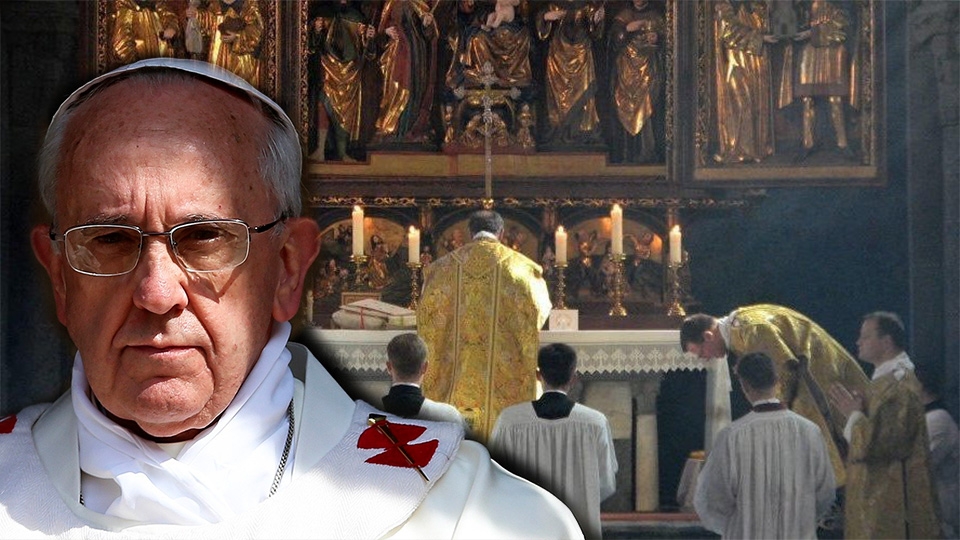

On July 1, the feast of the Most Precious Blood of Jesus (in the 1962 Liturgical calendar), Rome-based journalist Diane Montagna published a bombshell report disclosing that most bishops were not in favor of the suppression of the Traditional Latin Mass (TLM) under “Traditionis Custodes”. Rather, these bishops felt that amending Pope Benedict XVI’s motu proprio “Summorum Pontificum” (that liberalized the celebration of the Tridentine Mass according to the 1962 Missal) would do “more harm than good.”
Regarding the Vatican’s “overall assessment of the consultation of bishops” that was purported to have “prompted” Pope Francis to revokePontificum”, Montagna published the following on her Substack page:
“The previously undisclosed text, which forms a crucial part of the official report by the Congregation for the Doctrine of the Faith on its 2020 consultation of bishops concerning ‘Summorum Pontificum’, reveals that ‘the majority of bishops who responded to the questionnaire stated that making legislative changes to Summorum Pontificum would cause more harm than good. ‘The overall assessment directly contradicts, therefore, the stated rationale for imposing ‘Traditionis Custodes’ and raises serious questions about its credibility. When, on July 16, 2021, Pope Francis promulgated ‘Traditionis Custodes’, he said the responses to the questionnaire ‘reveal a situation that preoccupies and saddens me and persuades me of the need to intervene.’ ‘Regrettably,’ he said in an accompanying letter to the world’s bishops, ‘the pastoral objective of my Predecessors … has often been seriously disregarded. An opportunity offered by St. John Paul II and, with even greater magnanimity, by Benedict XVI … was exploited to widen the gaps, reinforce the divergences, and encourage disagreements that injure the Church, block her path, and expose her to the peril of division.’ He told the bishops that he was ‘constrained’ by their ‘requests’ to revoke not only ‘Summorum Pontificum’ but ‘all the norms, instructions, permissions and customs’ that preceded his new decree. However, what the Vatican’s overall assessment reveals is that the ‘gaps’, ‘divergences’, and ‘disagreements’ stem more from a level of nescience, prejudice and resistance of a minority of bishops to ‘Summorum Pontificum’ than from any problems originating from adherents to the traditional Roman liturgy.”
Various clergy and liturgical scholars have since condemned the implementation of “Traditionis Custodes” that gave rise to the suppression of many TLMs in dioceses worldwide. For example, Professor Massimo Viglione called the motu proprio a “declaration of war” of “the ecclesiastical hierarchy against the Holy Mass of all time.”
Proponents of “Traditionis Custodes” claimed that restrictions on the TLMs were crucial to avoid divisions allegedly facilitated by some traditionalist communities who reportedly rejected the changes brought about by Vatican II, but in reality, many bishops, as well as cardinals and lay faithful—including those who do not regularly celebrate nor attend the TLM—have expressed their support for the TLM.
Likewise, Cardinal Raymond Burke also critiqued “Traditonis Custodes”, stating:
“It must be remembered that, from a theological point of view, every valid celebration of a sacrament, by the very fact that it is a sacrament, is also, beyond any ecclesiastical legislation, an act of worship and, therefore, also a profession of faith. In that sense, it is not possible to exclude the Roman Missal, according to the UA, as a valid expression of the lex orandi and, therefore, of the lex credendi of the Church. It is a question of an objective reality of divine grace which cannot be changed by a mere act of the will of even the highest ecclesiastical authority.”
Similarly, Cardinal Gerhard Müller lambasted “Traditionis Custodes” as a document that was “questionable in content and form”.
Under the pontificate of Leo XIV, the Faithful Advocate, an apostolate originating from the American diocese of Charlotte, where Bishop Michael Martin’s clampdown on TLMs ignited widespread backlash, began a letter-writing campaign calling on parishes and Catholics across the US to write to the new pontiff “asking him to abrogate ‘Traditionis Custodes’ and protect the Sacred Liturgy worldwide.”
An excerpt of a sample general letter posted on the website of Faithful Advocate reads:
“We respectfully ask Your Holiness to abrogate Traditionis Custodes, since suppressing the Traditional Latin Mass risks alienating devoted Catholics, stifling spiritual growth within the universal Church, and undermining the unity it seeks to promote. In a spirit of pastoral care and unity, we appeal to you to restore the rights of these communities within the Archdiocese of Detroit, and those many that exist throughout the world, to celebrate the Traditional Latin Mass within their parish churches, and to guarantee, by the abrogation of ‘Traditionis Custodes’, that future generations will have full access to all the rich blessings that flow from the traditional liturgy.”
Strikingly, for Catholics who love and attend the TLM, Montaga’s recent findings vindicate long-held beliefs that the restrictions as a result of “Traditionis Custdoes” were not merely unpopular (among the world’s bishops, let alone among Catholic laity) but also too heavy-handed and divisive.
With Pope Leo XIV making Church unity a focal point of his papacy amid constall calls for reconciliation, the new pontiff is uniquely poised to act authoritatively to address liturgical rifts in light of “Traditionis Custodes” and Montagna’s July 1 report.
Proponents of “Traditionis Custodes” claimed that restrictions on the TLMs were crucial to avoid divisions allegedly facilitated by some traditionalist communities who reportedly rejected the changes brought about by Vatican II.
Nonetheless, Montagna’s July 1 report refuted claims of widespread episcopal support for these TLM restrictions. Many bishops, as well as cardinals and lay faithful—including those who do not regularly celebrate nor attend the TLM—have expressed their support for the TLM.
For instance, Singapore’s Cardinal William Goh, who was elected cardinal by the late Pope Francis himself, recently urged for the lifting of restrictions on the TLM, saying that Catholics who attend the TLM “are not doing anything wrong or sinful”.
“We already have different rites such as the Syro-Malabar one. We can very well accept different ways of celebrating the Eucharist and therefore I believe that we should not suffocate those who prefer the Tridentine rite,” Cardinal Goh declared.
With Pope Leo XIV making Church unity a focal point of his papacy amid constall calls for reconciliation, the new pontiff is uniquely poised to act authoritatively to address liturgical rifts in light of “Traditionis Custodes” and Montagna’s July 1 report.
For starters, listening to urgent calls from around the world, including requests from eminent Church prelates like Cardinal Burke who value the TLM, granting greater autonomy to local bishops with regard to permitting the TLM within their dioceses, as well as instructing that the full contents of the official survey/report by the Congregation for the Doctrine of the Faith on its 2020 consultation of bishops concerning “Summorum Pontificum” be made public, would be a step in the right direction towards true Church unity.
Mary, Mater Ecclesiae, ora pro nobis.