
Friday, July 26, Feast of Saint Anne (Eve of the Pilgrimage)
Undulating and picturesque landscapes of España Verde in Spain’s Asturias region greeted me once I was en route from the airport to the capital of Oviedo. As I had flown into the Asturian region all the way from concrete and urban Singapore, I found these mountainous views a welcome respite. Strikingly, the mist-shrouded Asturian mountains only served to add layers of mystery to the surrounding verdant foliage, the latter which was already dappled with bright sunlight and soaked with centuries of war-torn history centered around the Spanish Reconquista.
And, lo and behold, I was to be a participant in a “new Reconquista”, for I had signed up as a pilgrim of the 2024 Nuestra Señora de la Cristiandad pilgrimage (July 27-29, Saturday-Monday) to the shrine of Our Lady of Covadonga.
According to the organizers, this pilgrimage “is organized by a group of faithful lay Catholics devoted to the celebration of the Holy Mass according to the extraordinary form of the Roman rite,” also known as the Traditional Latin Mass or the Tridentine Mass.
Besides, the organizers declared that they hope to “contribute to the restoration of the spirit of Christendom” and “Christian social order, which is only possible if we commit ourselves to the restoration of everything in Christ, beginning with those of us who are on pilgrimage, our families, and the various spheres of society in which we find ourselves.”
Notably, organizers singled out the “Holy Sacrifice of the Mass, basis of the christian life” as the primary means of “restoring all things in Christ”, as Saint Pius X stated.
Given my pathetic grasp of Spanish, I opted to join the pilgrimage chapter of Our Lady of Walsingham with a bunch of like-minded pilgrims from the United Kingdom, some of whom I already knew.
While traveling from the airport to Oviedo, my mind was initially occupied by the sudden Vatican announcement in early July prohibiting the customary celebration of Traditional Latin Mass in the historic Basílica de Santa María la Real de Covadonga, a celebration that was supposed to have taken place at the end of the pilgrimage.
Although the pilgrimage organizers gracefully accepted the Vatican ruling with tact and resignation, I could not help but muse about the significance of such a decree, especially in wake of recent reports that speak about greater Vatican restrictions on the Apostolic Roman Rite.
Thankfully, I was not to remain too melancholic for long, given the friendly greetings from other pilgrims whom I had met on the bus from the airport to Oviedo. It dawned upon me that the Our Lady of Walsingham chapter comprised some thirty-odd people, most of whom were first-time pilgrims to the shrine of Our Lady of Walsingham.
Furthermore, two Marian Franciscan friars from the Family of Mary Immaculate and St Francis, clothed in their trademark gray religious habits, graced the English pilgrimage chapter. I was to be edified by their contemplative approach to prayer and ardent devotion to the Blessed Virgin Mary as the days went by.
Two Marian Franciscans, and a lay pilgrim, in all smiles, before the start of the pilgrimage
Upon arrival in Oviedo, we were all famished. Fortunately, our chapter lunch on the eve of our pilgrimage was marked with delightful camaraderie and a wide assortment of mariscos (seafood/shellfish) and pescados (fish). Who ever said meatless Fridays were dreary and tasteless affairs in Spain?
Subsequently, I joined a few pilgrims from my chapter for a tour of the beautiful Oviedo Cathedral.
Altarpiece of the Oviedo Cathedral with scenes depicting the Life of Our Lord Jesus Christ
The majestic Oviedo Cathedral basking in the afternoon sun.
As an aspiring devotee to the Holy Face of Our Lord Jesus Christ, I was excited to visit the Cámara Santa, or Holy Chamber, that houses numerous important relics of Christiendom, including the Sudarium of Oviedo, a bloodstained shroud that covered the Sacred Head of Jesus after his Crucifixion and Death.
Blood-stained Sudarium of Oviedo above the Arca Santa (“Holy Ark”)
What a marvelous way to begin our Mass-centered pilgrimage by meditating on the Dolorous Passion of our God and Savior! After all, didn’t the Sacrifice on Calvary and the dramatic spectacle of the crucified God culminate in the shedding of His Most Precious Blood?
The pilgrims in my chapter were to be even more spoiled by the privilege of attending Holy Mass in honor of Saint Anne (July 26) by Fr Byrne, a diocesan priest from the United Kingdom, at the Saint Barbara’s Chapel in the Oviedo Cathedral.
Saint Barbara’s Chapel in the Oviedo Cathedral, right before the Holy Mass in honor of Saint Anne
Again, what a way to begin the pilgrimage to the shrine of the Virgin Mary in Covadonga by exulting Her own Mother! After all, wasn’t Saint Anne the instrument of the Immaculate Conception of the august Mother of God?
Following another repast of delectable Spanish nosh, most of us headed back to our various accommodations to catch much-needed sleep before our expedition the next day.
July 27, Saturday, Feast of Our Lady on Saturdays (Day 1 of Pilgrimage)
The first rays of the morning sun witnessed scores of energized pilgrims congregating for the pilgrims’ blessing by the Archbishop of Oviedo. Despite having far fewer pilgrims than the annual pilgrimage to Our Lady of Chartres, the atmosphere in the Oviedo Cathedral Plaza when dawn broke, was, to say the least, electrifying. For many uninitiated onlookers, the sight of so many chattering pilgrims in the Plaza was definitely a worthy conversation starter. A Dutch couple who was holidaying in Oviedo asked some pilgrims in my chapter what the fanfare was all about, and eventually received detailed explanations plus (Miraculous Medals) in return.
I shall let the following pictures tell the story.
Pilgrims streaming into the Oviedo Cathedral anticipating the blessing by the Archbishop
Pilgrims waiting to start their uphill (literally and figuratively) expedition!
Banner of “Our Lady of Walsingham” Chapter
A Spanish pilgrim ready for another Reconquista with the cry, “¡Viva, Cristo Rey!”
These Polish pilgrims present the Polish flag adorned with the symbol of the Blessed Virgin Mary, Queen of Poland.
I managed to snap this shot in the crowded Oviedo Cathedral, but was unfortunately unable to capture the moment of the Archbishop’s blessing.
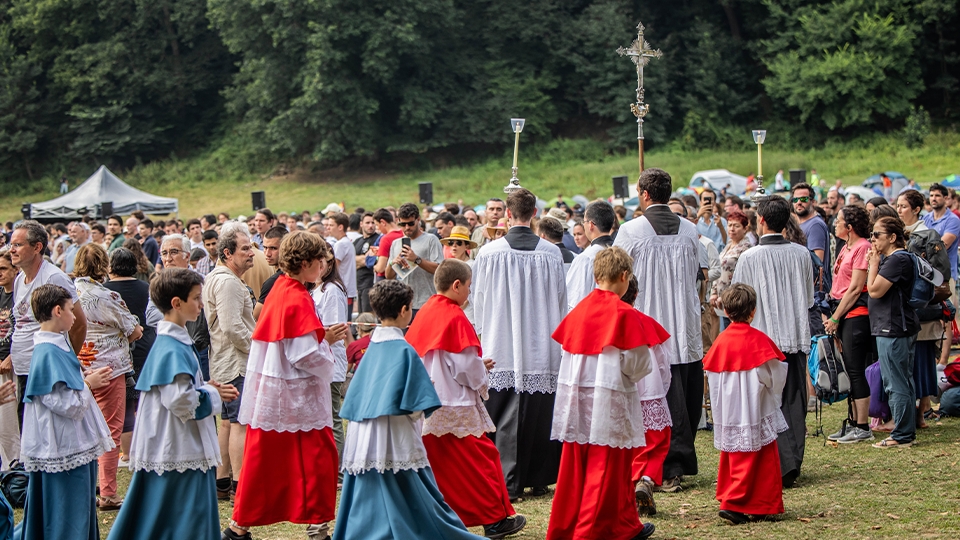
Following the Archbishop’s blessing and short sermon exhorting pilgrims to work for the Reign of Our Lord Jesus Christ and for Christendom, pilgrims headed out of Oviedo, chapter by chapter, singing Marian hymns and reciting Ave Marias in honor of the Holy Mother of God.
For starters, I heard one Spanish chapter sing the touching hymn “Oh María madre mia” interspersed with chants of “¡Viva, Cristo Rey”, while the French sang their characteristic Marian hymn (as they usually do in Chartres), “Chez nous soyez reine”, holding flags, banners, and crosses and heading out of Oviedo towards the Asturian countryside.
Not to be outdone, the English chapter sang “Immaculate Mary” and “Faith of our Fathers” with great vigor and fervor, whereas the Germans began reciting their Rosaries, proclaiming their battle cry on the side of the Holy Virgin, against the forces of hell.
By embracing the Devotion to the Sacred Heart of Jesus, we can establish the Reign of Christ the King in our hearts.
Throngs of pilgrims leaving Oviedo
After many Rosaries, hymns, miles of walking (around 20 miles approximately), and friendships forged amid the oscillating terrain, many of us heaved a sigh of relief upon arriving at our campsite to settle down and prepare for the Votive Mass in honor of the Blessed Sacrament. Night eventually fell and sleep certainly did not elude many a weary pilgrim.
July 28, Sunday, Tenth Sunday after Pentecost
Pilgrims were awakened by a reveille around 530 a.m., rising groggily from their sleeping bags and tents. Yet amid the morning shuffle, I managed to see numerous priests, or alter Christuses, already immersed in celebrating candlelit Holy Masses on makeshift altars.
Candlelit Masses going on simultaneously.
Undaunted by the dim lighting, this priest painstakingly reads the text of the readings of the day.
“It’s the Mass that matters!”
Breakfast that day was simple with the options of chocolate milk and/or coffee. One of the organizers told me that they were unable to prepare bread for pilgrims as there were some issues with electricity when they were about to do so. Ah, yet another opportunity for some mortification!
Apparently, this day was to be the most challenging day of walking. Undaunted by the blisters that had already formed on the soles of my feet, I joined my chapter’s Rosary recitation as we set off again deeper into the Asturian countryside. Leafy fields, grazing cows, juicy Asturian apples as snacks, along with the crisp surrounding air, were some of the God-given indulgences to us pilgrims under the increasingly sweltering weather and daunting hike.
After what seemed like an eternity sweating under the relentless heat, we approached our lunch stop at the Sanctuary of la Virgen de la Cueva, or the Virgin of the Cave. I proceeded to the nearby glistening river to soak my blistered soles, while pondering if I should take a break from walking or not.
La Virgen de la Cueva
Eventually, I decided against walking that afternoon as my blisters were making it impossible to walk a few yards, let alone miles. Nonetheless, the other pilgrims in my chapter were more persevering in continuing the arduous hike. During my rest, I managed to meet and make some new friends, most of whom were similarly “wounded” after miles of walking. I had a memorable exchange with a French lady from the thriving diocese of Toulon in France (with regular Traditional Latin Mass) who praised Archbishop Marcel Lefebvre (despite not attending Masses at the Society of Saint Pius X) for his fight in upholding the Catholic Faith in the tumultuous years after the Second Vatican Council.
Time passed after my animated conversation with this French lady, and eventually all pilgrims taking a rest were driven to the second campsite, where we were soon fortified by the scenes of other pilgrims making their way on foot to the same location. Here, pilgrims gathered for a Solemn High Mass with scenic mountains in the backdrop. It is rare that I attend Sunday Masses in the evening, as generally I am a “morning person” when it comes to sanctifying the Lord’s Day. However, attending the Holy Sacrifice of the Mass under the gentler evening sun was certainly welcomed by many exhausted and even dehydrated pilgrims.
Solemn High Mass, Tenth Sunday after Pentecost
29th July, Monday, Mass of Our Lady of Covadonga, Feast of Saint Martha
The third pilgrimage Mass in honor of Our Lady of Covadonga at our campsite (due to Vatican restrictions), was nonetheless still a grand spectacle to behold, with hymns and supplications permeating the air.
As much as I would have liked to walk alongside my chapter, God would have it otherwise, as I could barely stand, let alone stroll, due to unusual pains I felt at my feet. I was sent to the medics, who then stated that I most likely had an infection. The next thing I knew, my left foot was bandaged up, while a kind-hearted pilgrim gave me a hiker’s pole for me to balance while walking.
What surprised me was the pilgrimage organizers’ meticulous care in tending to pilgrims who were feeling sick or injured. They had priests giving Catechism lessons on the Holy Mass to us (mostly in Spanish though), while young children were entertained by simple ball games. One pilgrim remarked that the sacrifice I had to make (involuntarily) was not to walk with my other pilgrims. Indeed, she was right.
However, the Blessed Virgin Mary, being a loving and solicitous Mother as she always has been, had more things in store for me. After someone drove me and a few other pilgrims to the final destination, the Shrine of the Virgin Mary of Covadonga, I hobbled around and managed to arrive at the Santa Cueva de Covadonga (“Holy Cave of Covadonga”), entering the chapel in honor of the Virgin Mary of Covadonga, locally known as “La Santina”.
While waiting for my fellow pilgrims to arrive at the Covadonga Cathedral on foot, I managed to finish my day’s Rosaries at the Sanctuary of La Santina, contemplating the historical events that transpired at this hallowed site and the powerful intercession of God’s Holy Mother.
After all, while fighting the Moors, Don Pelayo asked the Blessed Virgin Mary for protection. Never disappointing those who seek Her help, Our Lady enabled the Spanish to emerge victorious in their battles with the Moors in the first battle in the mountains of Covadonga.
“So, this was where the Spanish Reconquista all began,” I mused.
Our Lady of Covadonga, known as La Santina.
Shrine of Our Lady of Covadonga
Shrine of Our Lady of Covadonga (from a different angle)
Spanish pilgrims marching towards the Covadonga Cathedral, chanting in jubilation.
As pilgrims mounted the final stretch of the journey towards the Covadonga Cathedral, their jubilant songs and chants grew louder and more intense.
“¡Viva Cristo Rey!”
“¡Viva la Virgen Maria!”
“Laudate Maria!”
“¡Viva España Católica!”
In obedience to the Vatican directive, we did not have the Holy Mass at the Covadonga Cathedral. Instead, pilgrims sung the Te Deum, participated in the Benediction of the Most Holy Sacrament, as well as did a Consecration to the Blessed Virgin Mary.
A Marian Franciscan in an audience with the Blessed Virgin Mary, his Queen and Mother.
Tears welled up in my eyes as I heard Spanish pilgrims sing the glorious hymn to Our Lady of Covadonga, titled, “Bendita la Reina” (see lyrics below).
“Bendita la Reina de nuestra montaña,
que tiene por trono la cuna de España
y brilla en la altura más bella que el sol.
Es Madre y es Reina. Venid peregrinos,
que ante ella se aspiran amores divinos
y en ella está el alma del pueblo español.
Dios te salve, Reina y Madre
del pueblo que te corona
y entre cánticos que entona
te da el alma y corazón.
Causa de nuestra alegría,
vida y esperanza nuestra,
bendice a la patria y muestra
que sus hijos tuyos son.
Como la estrella del alba
brilla anunciando la gloria
y es el pórtico tu gruta
del templo de nuestra historia.
Ella es el cielo y la patria,
y el heroísmo y la fe.
Y besa el alma de España
quien llega a besar su pie.
¡Virgen de Covadonga, virgen gloriosa!
flor del cielo que aromas nuestra montaña,
tú eres la más amante, la más hermosa.
¡Reina de los que triunfan, Reina de España!
Nuestros padres sus ojos a ti volvieron,
y una patria adivinó,
con tu nombre en los labios por ti lucharon,
con tu amor en las almas, por ti vencieron.”
We can only pray for better days when the Traditional Latin Mass can be restored to its rightful status in Rome, and in other parts of the world, including La Santina’s sanctuary. And the Blessed Virgin Mary is the best person to turn to in our pilgrimage on this earth as well as in our efforts towards the restoration of Christendom, for “her ways are beautiful, and her paths are peace” (Proverbs 3:17).
Dios te salve, Maria!