
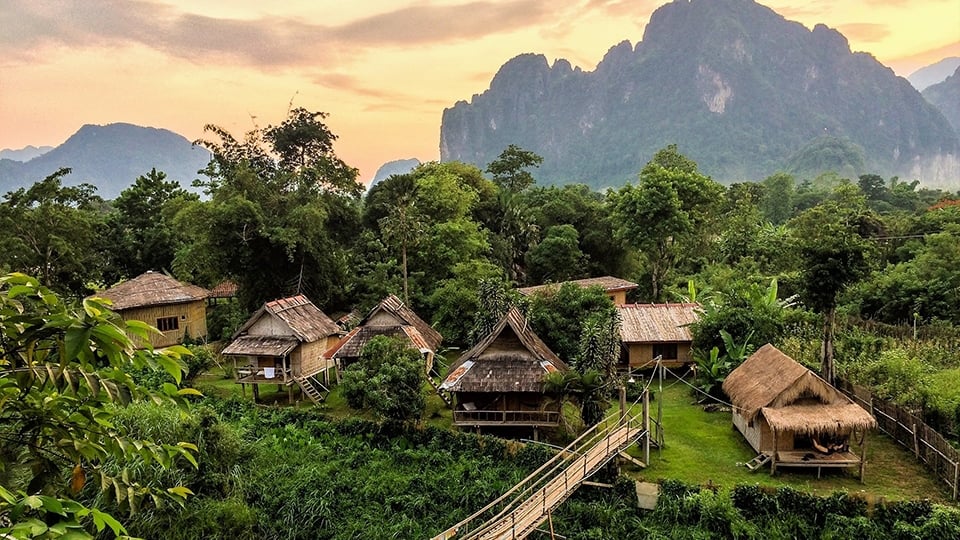

When I was a college student doing an exchange program in Thailand’s Northeastern Isaan province years ago, I was very keen on exploring neighbouring Laos. Blessed with undulating mountains, and traversed by the Mekong delta as well as acres of rice paddies, the photographs of Laos beckoned the intrepid adventurer in me to visit.
“What an idyllic country,” I wistfully thought, as I tried to look at tickets for buses to the Thai-Laotian border.
However, some of my Thai Catholic friends whom I spent considerable time with cautioned me against making the trip. They told me “horror stories” of how they were forced to remove crucifixes and other Catholic sacramentals at the Laotian side of the border. My mom, being the concerned parent she has always been, also advised me against that expedition.
I could not help but feel a chill down my spine as I recalled how obedience to my mom’s advice against traveling to Laos years ago could very well have saved me from suffering the same fate as many Laotian Christians.
After more research, I realized I took living in religiously-free (though dominantly Buddhist) Thailand for granted. Though I was unable to attend regular Traditional Latin Masses there (except for a couple of times in the Thai capital Bangkok six hours away by coach), I could freely pray my Rosary at the local Novus Ordo Catholic parish near where I lived, and even volunteer at the Infant Jesus School located in Khon Kaen.
On the other hand, Laos, officially the Lao People’s Democratic Republic (LPDR), is a Marxist-Leninist country. According to the BBC, Laos has been one of the world’s few openly communist states since 1975. The communists that came to power in the Pathet Lao sought to undermine whatever vestiges of Christianity that the Missionaries of Paris Foreign Missions (MEP) left behind in the country.
A Freedom House Report in 2021 described Laos as following:
“Laos is a one-party state in which the ruling Lao People’s Revolutionary Party (LPRP) dominates all aspects of politics and harshly restricts civil liberties. There is no organized opposition and no truly independent civil society. News coverage of the country is limited by the remoteness of some areas, repression of domestic media, and the opaque nature of the regime.”
Adding, the same 2021 Freedom House report stated:
“In October, reports revealed that four Lao Christians had been jailed for several months for planning Christian funeral rites. That same month, a group of Lao Christians were evicted from their homes; they fled into a forest because they would not renounce their faith.”
Strikingly, most of Laos’ population (67%) is Buddhist, while Catholics comprise a little less than 1% of the population, and Protestants about 2%, FSSPX News stated. Nonetheless, the godless nature of Laos’ communist regime has prompted authorities to persecute Christians in the country for years.
Anti-Christian persecution observed throughout 2023 had a surprising breadth: 25 churches were the target of attacks, compared to “only” four the previous year; 65 Christians were imprisoned, compared to 18 in 2022. And nothing seems to indicate a change in the trend in violence since the start of 2024.
The Voice of the Martyrs posited in an article that Laos’ communist regime, “in conjunction with Buddhist monks, persecutes Christians, with the exception of the government-controlled Lao Evangelical Church.”
As per a damning 2022 article by ReligionUnplugged.com , an evangelical pastor in southern Laos known as Seetoud was “ found mutilated, tortured and brutally murdered, according to police and local and national evangelical leaders.”
Elaborating, the same article read:
“Sources close to the police investigation told ReligionUnplugged.com they believe See — he went by one name — was killed because of his faith during a time of rapid growth in Laotian churches. The number of baptisms is causing tension in communities distrustful of a religion they see as foreign.”
Additionally, Morning Star News reported:
“Christian leaders said Pastor Seetoud’s body was severely disfigured and showed signs of torture. The search party found Pastor Seetoud’s Bible near his body and his motorcycle nearby on the road.”
Notably, Christian leaders cited by Morning Star News said Pastor Seetoud was likely killed because of his religion, with provincial police authorities suspecting “local officials at the district level killed him”.
Likewise, news outlet Radio Free Asia (RFA) ran an article detailing how some villagers in northwestern Laos drove “15 families and a pastor out of their village because of their Christian beliefs”.
When 15 families in Mai village in Luang Namtha province became Christians, their neighbours grouped together and ousted them and their pastor from town, RFA reported.
The captivating photographs of Laos I came across as a student concealed the painful realities that lay therein; that hundreds, if not thousands of believers of Our Lord Jesus Christ were under the heavy yoke of a Marxist government.
Continuing, RFA documented how the persecution of Christians in other parts of Laos was not uncommon:
“In other parts of Laos, authorities have not only failed to protect Christians from persecution, in several cases they were the source of it. In August 2022, authorities from Luang Prabang province’s Xieng Ngeun district confiscated the ID, passport, and village registration cards of an ethnic minority Christian family, saying the documents would be returned only if they renounce their faith. A Christian from northern Laos who requested anonymity for security reasons said that local level authorities all over the northern region have conducted a campaign against Christians, so the situation in Luang Namtha is not surprising. ‘Authorities would buy necessities to help the poor, but they would only give them out if the Christians would renounce their faith,’ the source said. ‘They would say that Christianity is a foreign religion, the religion of Westerners who are our enemies, even though the Christians do not agree that they are our enemies.’”
Another part of the RFA article revealed:
“Similar incidents targeting Christians have occurred. In the southern part of the country. Between 2020 and 2021, 15 people from seven families were evicted from villages in Saravane province.”
Besides, citing the Christian NGO Open Doors, FSSPX News reported in March 2024 that Laos “jumped from the 31st to the 21st place among the most hostile countries in the world for Christians”.
The FSSPX article further elaborated, stating:
“Anti-Christian persecution observed throughout 2023 had a surprising breadth: 25 churches were the target of attacks, compared to “only” four the previous year; 65 Christians were imprisoned, compared to 18 in 2022. And nothing seems to indicate a change in the trend in violence since the start of 2024. Many Christians who were driven from their homes must now flee and live far from their villages. In March 2023, authorities stopped the construction of a church when a cross visible on the exterior was planned. The building was destroyed with stones, just like the houses of Christians. The faithful finally had to flee into the rice fields.”
As I read more of these somber stories, it dawned upon me that the captivating photographs of Laos I came across as a student concealed the painful realities that lay therein; that hundreds, if not thousands of believers of Our Lord Jesus Christ were under the heavy yoke of a Marxist government. I could not help but feel a chill down my spine as I recalled how obedience to my mom’s advice against traveling to Laos years ago could very well have saved me from suffering the same fate as many Laotian Christians.