
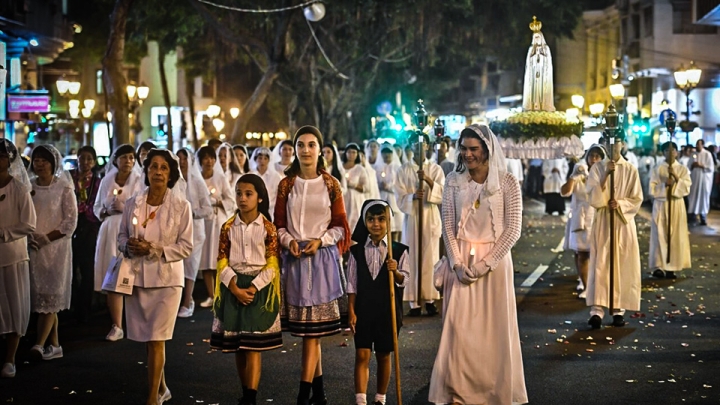

The feast of Mary’s Immaculate Conception on December 8 every year features prominently in Catholic teachings as well as holds a special place in the Catholic imagination — the truth that the Blessed Virgin Mary was conceived without sin, radiating as the dawn of mankind’s salvation as the Mother of our Lord and Redeemer Jesus Christ.
In few places in traditionally pagan Asia has this Marian dogma been celebrated with such ardent fervor as in Macao, China’s “pearl on the palm”, and an area boasting of a unique combination of Portuguese and Chinese influences. This small territory, redolent with centuries of missionary zeal and Marian piety, continues to declare the omnipotence of God and marvels of Divine Grace as exemplified in the person of the Blessed Virgin Mary, the Immaculate Mother of God.
Macao’s Christian Past
Christianity first arrived in Macao in the 16th century, as Portuguese Catholic missionaries made the area a launchpad for evangelization in East Asia.
Strikingly, the missionaries referred to Macao as the “Cidade do Nome de Deus de Macau” – “City of the Name of God” – and to this day, Macao’s most defining landmark is the façade of Saint Paul’s, originally the Catholic Church of Mater Dei.
The city’s skyline, festooned by the ruins of Saint Paul’s and featuring an image of the Blessed Virgin Mary, continues to remind Catholics and non-believers in the city alike that God’s grace remains even amid an ephemeral world.
In Macao’s Catholic consciousness, this truth of Mary’s “fullness of grace” resonates with great significance. The city’s skyline, festooned by the ruins of Saint Paul’s and featuring an image of the Blessed Virgin Mary, continues to remind Catholics and non-believers in the city alike that God’s grace remains even amid an ephemeral world.
Similarly, Mary’s Immaculate Conception reminds Macao’s Catholics that while sin and decay may exist and even seem to flourish in this fallen world of ours, grace abounds even more, epitomized in Mary, “full of grace”. Mary, untouched by sin, embodies the image par excellence of what God intended humanity to be — a creature radiant and replete with grace.
Till today, the Blessed Virgin Mary, as the Immaculate Conception, remains a gentle maternal figure that oversees Macao, as testified by Her presence in the city’s cathedral.
Every December 8, Macao comes alive with Marian fervor. Parishes organize novenas preceding the feast, with fresh flowers adorning images of the Blessed Virgin Mary and the faithful united in reciting the Holy Rosary.
Elaborating on Macao’s Christian heritage, New Advent detailed:
“At the end of sixteenth century Christianity was making rapid progress at Macao, which city had become an important centre of missionary activity in the Far East. Here the Jesuits, the pioneers in this field, established the two great colleges of St. Paul and St. Joseph; the former — famous in missionary annals as “a seminary of martyrs” — was the principal college of the Province of Japan; the latter, of the Vice-Province of China. The Franciscan and Dominican friars, the Poor Clares, and the Augustinians soon had convents at Macao, the last-named founding the hermitage of Nossa Senhora da Penha (Our Lady of the Peak). Other churches dating from this golden age of religion in Macao are the Cathedral, the Santa Casa de Misericordia, the hermitage of Nossa Senhora de Guia, the sanctuary of St. James at the mouth of the harbour, and the parish churches of St. Anthony and St. Lawrence.”
Likewise, in his publication, “O Culto de Maria em Macau” that explores the trajectories of Marian devotion in Macao, author Manuel Teixeira depicted Marian devotion in Macao by “assigning chapters to the churches and chapels dedicated in honour of the Virgin Mary, religious institutes that invoke her patronage, Macao schools, Marian confraternities, Marian congregations, Legion of Mary, Marian feasts, devotions to the Immaculate Conception, Our Lady of Fatima, Stella Maris, miracles attributed to Mary, legends, the defunct church of Our Lady of Refuge, Marian devotion in Malacca, Marian literature, Marian bibliography, and Macau fortresses dedicated to the Virgin Mary.”
Following Pope Pius IX’s solemn declaration of the dogma of the Immaculate Conception in 1854, Macao’s Catholics started to commemorate the feast with Holy Masses, grand processions, and fervent prayers.
Following Pope Pius IX’s solemn declaration of the dogma of the Immaculate Conception in 1854, Macao’s Catholics started to commemorate the feast with Holy Masses, grand processions, and fervent prayers. Until today, Marian devotion, such as devotion to Mary’s Immaculate Conception, resonates immensely with many in the city that also prides itself as the “Cidade da Virgem” (the “City of the Virgin”).
Amid Macao’s swift modernization and increasing influence from the Chinese Communist Party (CCP), devotion to Mary’s Immaculate Conception remains a firm bastion and symbol of enduring Catholic faith among many locals in the city.
Undoubtedly, celebrating Mary’s Immaculate Conception in Macao is an opportune moment to marvel at the triumph of God’s grace over sin. The Solemnity of the Immaculate Conception unravels Mary’s mission to lead all souls ultimately to Her Divine Son, Our Lord Jesus Christ, amid the travails of this world and despite the heavy yoke of communism.
Therefore, in view of Macao’s present and upcoming challenges — secularization, materialism, and communism, Mary’s Immaculate Conception offers a hopeful path forward, manifesting the importance of faith, and the fortitude to say “Fiat” when the world urges compromise and an attitude of “Non serviam”.
Just as Mary’s Immaculate Conception is ultimately a proclamation of hope: that it is grace, not sin, that enjoys the final say, so too must the Church in Macao bear witness to the rest of China, by boldly proclaiming Jesus Christ as God and King.
Come what may, regardless of communist threats or materialist snares, may Macao, a former Portuguese colony/trading post by the sea, find in its Immaculate Patroness both a star and a support.
After all, the Blessed Virgin Mary is truly “Stella Maris”, “Auxilium Christianorum”, and “Tota Pulchra”, not only for Macao’s Catholics, but for the universal Church.
With God’s grace through the Immaculate Virgin Mary, sanctity is possible and Our Lady welcomes all to embrace holiness, not through force and fear (tactics that the CCP is fond of), but through the loving pleas of a compassionate and merciful Mother!
O Mary conceived without sin, pray for us who have recourse to Thee.