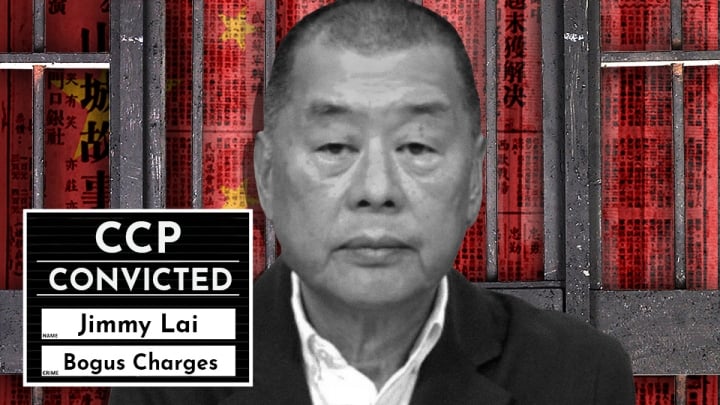

In turn, various groups slammed the court decree as a “sham conviction” and an assault on democracy.
Also, in remarks to CNN’s Jim Sciutto that the court verdict was unsurprising but pernicious, Lai’s daughter Claire lambasted the CCP-imposed national security law on Hong Kong as extremely ambiguous and harsh.
“This was not going to be solved in the once promising but now highly compromised Hong Kong legal system,” Claire Lai declared.
Lai, the founder of Hong Kong’s “Apple Daily” newspaper and an outspoken advocate of democratic freedoms, currently is a poignant symbol of what would happen when an individual’s convictions for notions like “freedom” and “democracy” clash with a regime’s focus on control and hegemony.
Arrested and charged as per Hong Kong’s draconian national security law—a legal tool designed to quell resistance against the CCP under the pretext of “stability”—Lai’s trial was more about the message the CCP is trying to convey than about the crimes he supposedly perpetuated: that opposition will be penalized severely, and that the regime’s ambitions for hegemony will sanction no dissent.
Evidently, the spectacle of the Jimmy Lai trial that culminated in the recent December verdict declaring the media tycoon as guilty for sedition offenses was predictable, to say the least. The recent verdict of Lai was the choreographed and expected conclusion of an undertaking that started years ago when Beijing sought to pull apart Deng Xiaoping’s “one country, two systems” idea; the latter that was meant to fortify mainland China’s efforts to modernize in the 1990s. Besides, the CCP’s enforcement of the national security law in 2020 effectively recalibrated the social contract Hong Kong had long operated under, turning a semi-autonomous region, hitherto a hub of democracy, into a politically repressive satellite of Beijing.
Moreover, the CCP’s insistence on Lai’s guilt, and its dogged intransigence regarding his sentencing, is telling of the ancient Chinese imperial mindset of autocracy and centralized bureaucracy; that dissent is never to be tolerated.
For centuries, authoritarian Chinese dynasties from the Qin era to the Qing did not survive only by clamping down on resistance, but by totally dismissing the notion of any legitimate opposition. When analyzed in such a historical light, Lai’s peaceful advocacy for democracy can be interpreted by the CCP authorities (as well as their totalitarian dynastic forefathers) as a threat to the stability of existing authorities.
Just like the autocratic rulers of China’s imperial past, the CCP has tried (since the official establishment of the People’s Republic of China (PRC) in 1949 to reconstruct the autocratic “Qin order” in the 20th and 21st century. Taking references from the Han dynasty’s expansionist actions as well as the Qing empire’s subjugation of restive frontiers, China’s notion of control has always been premised on the concept of loyal vassal states and docile subjects in a Sinocentric world order. Such geopolitical logic is undoubtedly clear: the Chinese authorities tolerate no other form of governance apart from unity through foreign subordination and harmony through conformity. Put simply, the traditional Chinese worldview that the CCP has conveniently adopted is not one that prioritizes respect for the international rule of law, but emphasizes world hegemony with China as the center.
Additionally, as the Qin emperor (Shihuang) enjoyed absolute authority due to his governance with an iron fist, CCP leaders (from Mao onwards) have attempted to enforce absolute authority in China for decades. Alluding to historical narratives of “Chinese unity” to justify state control over Chinese citizens, the CCP has tried to conflate loyalty to the regime with loyalty to China. The imperial bureaucracy, from the Qin dynasty onward, established its power upon the repression of opposing ideas and eradicating dissenting voices. Fast forward to the 21st century when China’s cyberspace regulators erase subversive comments challenging the CCP’s legitimacy on the Internet. Although Beijing’s methods have modernized, its ancient imperial urge to ensure compliance and control via end-to-end surveillance and moral intimidation has not died out.
Hence, international pressure and pleas for the CCP to liberate Lai using diplomatic means, as well as calls for China to respect the current geopolitical order of nation-states, are merely illusory. Arguably, to demand such an act of magnanimity (i.e. releasing Lai) from the CCP regime that is so obsessed with hegemony and control is nothing but a pipe dream, save for divine intervention.
Admittedly, it is highly likely that the CCP regards external criticism and international pressure to relent on its treatment of Lai as a contestation of its own authority, reaffirming its determination to prove that foreign pressure carries no weight.
Exonerating and freeing Lai would be a display of weakness and the equivalent of the regime dropping the ball in terms of asserting Chinese hegemony. By remaining non-compliant to foreign (mainly Western) pressure, the CCP can only boost its domestic narrative of enabling Chinese resurgence.
Non-Chinese observers might think that portraying Lai’s case as a matter of individual “rights” or judicial independence would somehow compel the CCP to cave in. However, to those familiar with imperial Chinese thought and ancient Chinese tendencies towards totalitarian state control, Lai’s existence is an existential threat to the CCP and contests the notion that the Chinese people require authoritarian guidance to thrive. To give concessions to free Lai would be equivalent to admitting weakness, something that the CCP is not willing to do, except in moments of “dynastic disintegration” (again another highly unlikely prospect in the near future).
Strikingly, in his book “Bully of Asia: Why China’s Dream Is the New Threat to the World Order”, China specialist Steven Mosher explained the rationale behind the CCP’s behavior as influenced by centuries of Chinese hegemonic ambitions:
“China must either continuously expand its power to achieve hegemony or, like the failed states crushed and absorbed by the Qin, it will face ultimate defeat and eventual annihilation” as “in a world of uncertainty, only hegemony offers security”.
Nevertheless, the irony of the matter is that the more the CCP clamps down on voices like Lai’s, the more it reveals its own weaknesses and fears that its own legitimacy and desires for hegemony are unsustainable and contestable. Despite all its saber-rattling and claims to power, the CCP is, at its very core, an immensely insecure and fragile regime as its narrative of coercion and control cannot weather honest challenges to its rule.
Lai’s Catholic convictions, his deep devotion to the Blessed Virgin Mary, make him untouchable by the CCP because of his faith in a God beyond the purview of the CCP.
Also, Lai’s resilience in face of CCP totalitarianism and authoritarianism is a sobering and encouraging reminder that his Catholic Faith and moral courage, can still withstand the power-crazed regime that is trying to smother it. To boot, Lai’s deep Catholic convictions have proven to be irrepressible even amidst the most repressive mechanisms of CCP power. By remaining steadfast in his Catholic Faith, Lai epitomizes a spiritual freedom that totalitarian forms of governance like the CCP regime find unendurable. In a sense, Lai’s Catholic convictions, his deep devotion to the Blessed Virgin Mary, make him untouchable by the CCP because of his faith in a God beyond the purview of the CCP.
Consequently, even if Lai remains behind bars for the rest of his life (an outcome I hope will not happen still), he is, in a sense, already unassailable by his enemies. In view of what one of my favorite political writers, Hillaire Belloc, said about the Church being a “perpetually defeated thing that always outlives her conquerors”, may Lai, a condemned and silenced man (at least in all outward appearances), eventually triumph over the arbitrary grip of the CCP with his moral courage and Faith.
Our Lady of Persecuted Christians, pray for us.