

Throughout the broadcast of the Netflix documentary series Ancient Apocalypse between 2022 and 2024, its tagline was worth a thousand images:
“What if everything we know about prehistoric humans is wrong?”
It targeted the mainstream “evolutionist” history that speaks of chronologies of millions and billions of years and of cultures that appeared independently in different places. Which, indeed, is wrong. For any educated and faithful Christian, the contradictions between these theories and the sacred histories related in the Bible hardly need to be emphasized. This does not mean that Graham Hancock’s documentary intended to support the sacred histories of the Old Testament. And yet, some of his hypotheses, as well as the reactions they provoked, deserve our attention.
Everything written in the Old Testament truly happened: Adam and Eve existed and sinned in Eden, Moses truly wrote the books of the Pentateuch, and the Holy Apostle John is indeed the author of the last book of the Bible, the Apocalypse. Yet today, accepting any of these fundamental truths excludes you from the circles of “serious” historians.
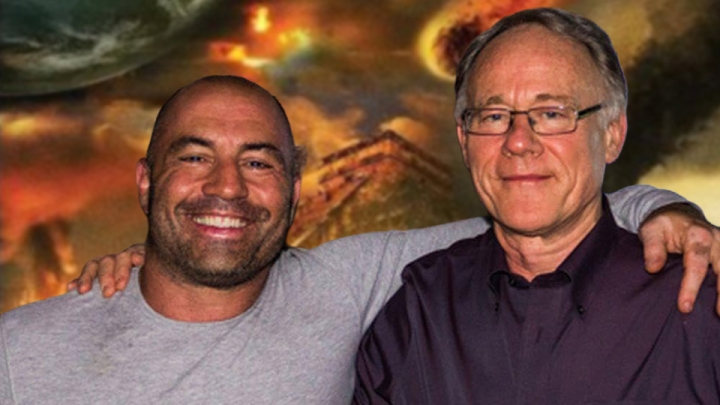
It is enough to look at the criticisms and accusations brought against Joe Rogan’s friend to begin to ask questions. Certain left-leaning publications have published articles in which Hancock is accused of everything considered politically incorrect, from conspiracy theories and pseudo-archaeology to racism and supremacism in their most radical forms. What could a secular author who puts forward theories about ancient history have done to become the target of such attacks? Obviously, if you appear on The Joe Rogan Experience, some will never forgive you. Beyond Graham Hancock’s popularity, however, it is certain that his ideas are what make him so disliked by a certain part of the media as well as by “academic” historians. It is to these that the following pages are devoted.
Although I was formed in the school of first-rank academic historians and classicists such as Louis Gernet, Aram Frenkian, Francis Macdonald Cornford, Marcel Detienne, Dionisie Pippidi, Christopher Dawson, and Alain Besançon, I learned early on to avoid the tedious works of those who are content to endlessly list dates and chronologies. Without denying the value of precision, I have always been convinced that the stake of history is something else. First, to provide examples of heroism and holiness. Then, second but not least, to recount the workings of Holy Providence in the context of our fallen, post-lapsarian world.
The Bible is right. Everything written in the Old Testament truly happened: Adam and Eve existed and sinned in Eden, Moses truly wrote the books of the Pentateuch, and the Holy Apostle John is indeed the author of the last book of the Bible, the Apocalypse. Yet today, accepting any of these fundamental truths excludes you from the circles of “serious” historians. This is why I have never tired of searching among the authors of “alternative histories,” closer to the exotic Jesuit Father Athanasius Kircher (1601–1680) than to the austere Theodor Mommsen (1817–1903). Without any doubt, Graham Hancock belongs to this category that does not let you fall asleep while watching Ancient Apocalypse.
Hancock attempts to demonstrate the existence of a single primordial culture from which all later cultures derived. In his view, such evidence is identifiable in monuments such as the ruins of Nan Madol in Micronesia or the ancient pyramid Gunung Padang in Indonesia, built by a superior civilization. Aligned with certain current theories, Hancock believes that an apocalyptic catastrophe—a meteorite or something of that kind—destroyed it 12,000 years ago.
I came into contact with his interpretations through the “Orion correlation theory” supported and developed by his close friend and collaborator Robert Bauval. As I have already shown in an earlier article,[i] Bauval applied to the pyramids Mircea Eliade’s theory of analogy between cosmic constellations (understood in a mythological way) and the principal architectural constructions of ancient cultures. In short, what he claims in The Orion Mystery (1994) is that the positions of the three pyramids on the Giza plateau were designed to “mirror” on earth the positions of the three stars that make up Orion’s Belt—Alnitak, Alnilam, and Mintaka. Bauval was not original. Mircea Eliade, like other historians of religions such as Paul Mus (1902–1969), had already maintained that ancient cultures were based on belief in the existence of an immutable and stable spiritual world that was celestial and that alone could guarantee the stability of its reflected version on earth. Without any doubt, such theories are more interesting and significant than chronologies and factual histories that content themselves with recording dates and endlessly debating their authenticity.
Appearing one year after Bauval’s book, Graham Hancock’s Fingerprints of the Gods: A Quest for the Beginning and the End (1995) almost instantly became the bestseller that replaced the Swiss paleo-astronaut Erich von Däniken’s Chariots of the Gods? (1968). While the latter exploited the false idea of extraterrestrial origins of humanity, Hancock proposed far more reasonable hypotheses, seeking to explain similarities among architectural features of ancient monuments created by civilizations located thousands of kilometers apart. He also pursued one of the most controversial historical themes: the existence of Atlantis—the island mentioned by Plato in the unfinished dialogue Critias. Setting aside the compromised extraterrestrial hypothesis, Hancock crystallized a vision of humanity’s common origin, the idea that underlies the Netflix series.
By secularizing the biblical narrative that speaks of the existence of a single language and a single culture before the Babel episode (Genesis 11:1: “And the whole earth was of one language and of one speech”), Hancock attempts to demonstrate the existence of a single primordial culture from which all later cultures derived. In his view, such evidence is identifiable in monuments such as the ruins of Nan Madol in Micronesia or the ancient pyramid Gunung Padang in Indonesia, built by a superior civilization. In the age of egalitarianism, Hancock has been attacked for his “elitist” vision, which—certainly without intending it—asserts that there existed a culture superior to those that followed it. Finally, the postulate of such an ancient culture inevitably raises the question: “Why did it disappear?”
Although very different in detail and scale, the destruction of Plato’s Atlantis and the destruction of the world by the Old Testament Flood are both the result of a moral judgment: the God of the prophets and of the apostles decided to punish the world by water because it had sunk into an ocean of sins.
Aligned with certain current theories, Hancock believes that an apocalyptic catastrophe—a meteorite or something of that kind—destroyed it 12,000 years ago during the last great glaciation. It transmitted advanced knowledge of architecture, astronomy, agriculture, metaphysical symbolism, etc., to emerging cultures. Here is another idea that reflects, in a secular manner, the biblical narrative of the apocalyptic Flood survived only by Noah’s family and the successors of his sons, Shem, Ham, and Japheth.
Relying on the participation of a superstar of Keanu Reeves’s caliber, Graham Hancock demonstrates that a set of high-aiming hypotheses is worth more than dull and flat historical discourse, tangled in endless discussions that most often deny the veracity of ancient histories and sources. If you read Marcel Bordet’s Précis d’Histoire Romaine (1998), the only certain thing that remains is that all the histories transmitted by Polybius, Livy, Tacitus, Appian, and Cassius Dio are uncertain. I chose this book at random, which happens to be on my desk right now. Unfortunately, many other works of history are the same: they cast doubt on everything that is known, including what the ancients themselves believed about their own cultures—most often without offering any alternative explanation in its place. One hardly knows what such works are good for if, in any case, most of the data transmitted by the ancients are debatable and unreliable.
Unlike the dominant, predominantly descriptive history, Hancock’s theories convey interpretations that have the merit of being, if not true, at least interesting. In other words, in his discourse historical “facts” are correlated with meanings that make them shine differently in the eyes of viewers. Of course, these gleams can be deceptive. And yet they offer far more than the flat descriptions of professional historians, who often say nothing about their meanings. They forget that man is essentially a being thirsty for meaning.
Both events originate in moral deviation punished by a transcendent authority. This is a lesson that those who write and rewrite history, however interestingly they may do so, no longer wish to transmit. Our duty is to remind them of it.
I have already stated that between Hancock’s diffusionist theory, which proposes the hypothesis of the existence of an ancient civilization from which all others derive, and the biblical narrative that shows that there existed a unique culture fragmented after the “confusion of tongues,” there is a pale similarity. The same applies to the idea of an ancient catastrophic event that would have almost completely annihilated the primordial, unique human culture. Likewise, if we remember how many controversies the Babel episode has generated, we are not surprised that Graham Hancock has been accused of all imaginable aberrations resulting, of course, from certain contemporary ideologies’ hostility toward the idea of the “primacy” of one culture over others. Setting aside such useless issues, we must nevertheless emphasize a notable absence from Hancock’s “apocalyptic” theory.
Although at first glance there seems to be no resemblance between his theories and those of “official” historians, they are nevertheless perfectly aligned in what concerns the absence of the moral dimension of historical catastrophes. Hancock never mentions that Plato’s Atlantis did not sink because of a purely natural event, but because of the intervention of spiritual beings recognized by the Greeks—the gods—who punished the most terrible sin: hýbris. Thus the sinking of Atlantis is not a purely horizontal catastrophe due to blind forces of nature, but the result of a divine judgment that led to the tragic outcome. Although very different in detail and scale, the destruction of Plato’s Atlantis and the destruction of the world by the Old Testament Flood are both the result of a moral judgment: the God of the prophets and of the apostles decided to punish the world by water because it had sunk into an ocean of sins. Both events originate in moral deviation punished by a transcendent authority. This is a lesson that those who write and rewrite history, however interestingly they may do so, no longer wish to transmit. Our duty is to remind them of it.
