
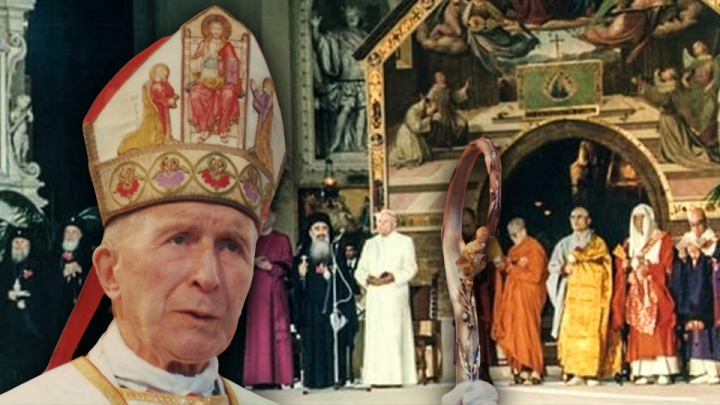

Nearly 38 years have passed since the consecration of the four bishops at Écône, on June 30, 1988, by Archbishop Marcel Lefebvre and Bishop Antônio de Castro Mayer. Recently, the Priestly Society of Saint Pius X announced that it will repeat this act on July 1 of the current year. Immediately after the announcement was made, Reverend Father Davide Pagliarani, Superior General of the Priestly Society of Saint Pius X, was received in audience by the Prefect of the Dicastery for the Doctrine of the Faith, Cardinal Victor Manuel Fernández. This was followed immediately by the publication of a warning statement from the Vatican.
The proposed equation is the same: the Priestly Society of Saint Pius X must renounce the consecration of bishops, and the Vatican commits itself to continuing a theological dialogue to resolve the main issues—among which the relationship with the Second Vatican Council and its documents occupies a central place. What immediately caught my attention, confirming the interpretation I proposed in a previous article,[1] is the fact that the first point of conflict recorded in the Vatican’s statement concerns ecumenism and interreligious dialogue. Let us first look at the key excerpt from the Vatican “comunicato:”
“After clarifying certain points presented by the FSSPX in various letters, particularly those sent between 2017 and 2019—including, among other topics, the question of the divine will regarding the plurality of religions—the Prefect proposed a pathway of specifically theological dialogue, following a precise methodology, on issues that have not yet received sufficient clarification. These include: the distinction between an act of faith and the ‘religious submission of mind and will,’ as well as the differing degrees of adherence required by various texts of the Second Vatican Ecumenical Council and their interpretation. At the same time, he proposed addressing a series of topics listed by the FSSPX in its letter of 17 January 2019.”[2]
It is absolutely certain that Pope Francis’s Abu Dhabi declaration (2019), in which he stated that religious pluralism is positively willed by God, as well as statements such as the one made in Singapore (2024), where he spoke of religions as distinct paths that all lead to God, remain highly sensitive issues—true occasions of scandal and confusion—that must be clarified. However, this necessarily implies the capacity for a critical evaluation of ecumenism and interreligious dialogue. It is to these that the first point of the communiqué signed by Cardinal Fernández implicitly refers: “the question of the divine will regarding the plurality of religions.”
What Lefebvre knew was that such doctrinal positions as ecumenism and the relativism not only have the potential to pervert theology itself, but also end up blocking the work of conversion and evangelization. This can be seen in the almost complete disappearance of conversion efforts and this, more than anything else, is what provoked the reaction of Archbishop Marcel Lefebvre.
A true apostle, active for many years in Africa, Archbishop Lefebvre understood the gravity of adopting ecumenism and the relativism implied by the positive acceptance of religious pluralism in the teaching of the Second Vatican Council. Concretely, what he understood better than anyone else was that such doctrinal positions not only have the potential to pervert theology itself, but also end up blocking the work of conversion and evangelization both of (pseudo)Christians from other confessions and of members of other religions.
This can be seen in the almost complete disappearance of conversion efforts—for example—directed toward members of Eastern schismatic “orthodox” churches or toward Lutherans and the numerous neo-Protestant sects. We live in a Church full of committees and dialogue groups, but one can no longer find a single contemporary manual of apologetics in which their errors and heresies are systematically presented, exposed, and refuted. On the contrary, following the Second Vatican Council, simultaneously with the multiplication of ecumenical events, we witness the exclusion of the profession of faith and of apologetics aimed at denouncing the heresies of sects and non-Catholic confessions. And this is the result of a certain formation of bishops and priests in an “ecumenical spirit.” This, more than anything else, is what provoked the reaction of Archbishop Marcel Lefebvre.
Unfortunately, however, just as 38 years ago, the Vatican appears as unwilling to acknowledge the erroneous and deviant character of ecumenism and relativistic interreligious dialogue. Practically nothing has changed, except for the multiplication of “Assisi-style” declarations and events. Not even the violently negative reactions of (neo-)Protestants and “Orthodox” to the famous declaration Dominus Iesus, published in 2000 by the Congregation for the Doctrine of the Faith under the leadership of Cardinal Joseph Ratzinger, were sufficient to show the Vatican that it had embarked on a wrong path. All those who understood this and insisted on pointing it out were forced to be silent or to find alternative solutions, as did the founder of the Priestly Society of Saint Pius X.
I am convinced, however, that the moment will come—painful, to be sure—when the Pontiff and the hierarchy will be compelled to accept the Truth, just as happened with Pope John Paul II, who was compelled by an assassination attempt to consecrate Russia to the Immaculate Heart of the Blessed Virgin Mary. It is saddening, however, to see that ecclesiastical discipline is invoked with strictness when it comes to the consecration of bishops who certainly would not follow the broad and easy paths of ecumenism and religious relativism.
One thing that would be of great help in the present context would be the intervention of other Cardinals and Bishops who would underscore the ecumenist error and its devastating consequences. But do such hierarchs exist—ones who do not hesitate to speak publicly, admonishing their superiors with due respect yet with firmness, when the supernatural Truth of the Christian Faith is at stake? Do there still exist, in fact, hierarchs who are convinced that the Catholic Church is not only the one, holy, apostolic, and true Church, but also the representative of Christianity—the only religion positively willed by God? In these times of great confusion, we would welcome hearing their voices and testimonies.
- “New Episcopal Consecrations for the Fraternity of Saint Pius X:” https://www.remnantnewspaper.com/web/index.php/articles/item/8092-new-episcopal-consecrations-for-the-fraternity-of-saint-pius-x [Accessed: 12 February 2026]. ↩︎
- I quote the English translation of the Italian original presented on Mrs. Diane Montagna’s substack:: https://dianemontagna.substack.com/p/vatican-warns-sspx-to-suspend-bishop [Accessed: 12 February 2026]. The Italian original can also be read here. ↩︎
