
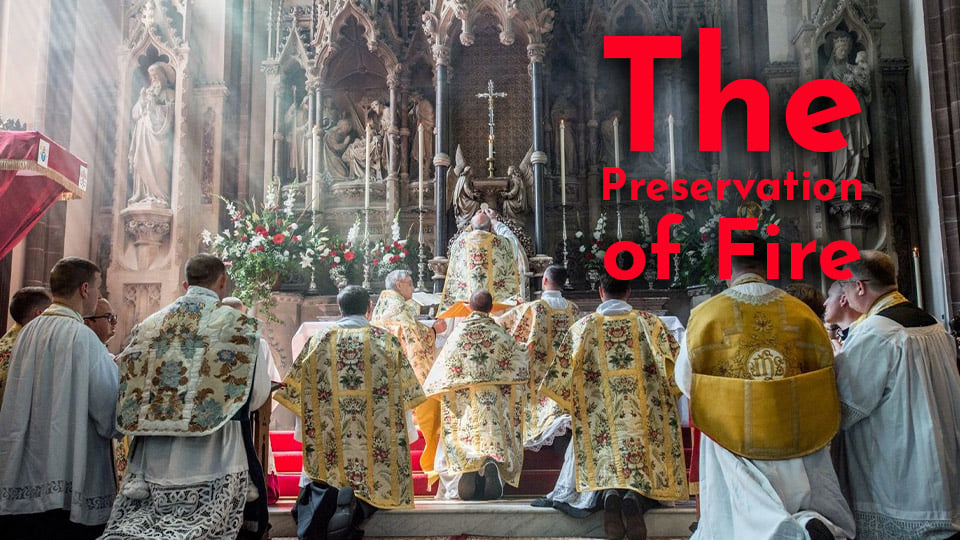
GREENVILLE, S.C. – The Priestly Fraternity of St. Peter (FSSP) continues to increase its numbers and expand both its own apostolates and in serving in dioceses like Arlington, Va., despite the brakes being applied by the previous pontificate and Cardinal Roche eliminating diocesan Traditional Latin Masses and sacraments.
Since 1988, the FSSP has grown to 579 members including 387 priests and 192 seminarians and deacons. The FSSP serves Catholics in 151 dioceses at 251 locations across the globe including 48 personal parishes.
The future appears to be reliance on Tradition.
According to the CARA report, the average age of a U.S. Catholic priest is 63 years of age (not including retired priests). Note that the average age of the members of the FSSP is 39 years. This age gap is widening. The future appears to be reliance on Tradition.
An outstanding example of the growth among its parishes and Mass centers includes its Dallas location in Irving, Texas, a few minutes from the University of Dallas, founded in 1988 by Pope St. John Paul II. It is one of, if not the longest-running FSSP apostolate. In 1988, when a group of parishioners approached, Joseph Cardinal Ratzinger about their “rightful desires” [Ecclesia Dei motu proprio], Cardinal Ratzinger reportedly requested the bishop at that time to fulfill the wishes of the lay faithful by allowing one of the first Traditional Latin Mass centers in the United States in the Dallas area.
Nearly 40 years later, Mater Dei parish has eight Sunday Mass times are listed for the parish as well as 14 daily Mass times (15 for the week of first Saturday). The five FSSP Priests also serve daily Mass for the religious sisters of the Carmel of the Infant of Prague and St. Joseph. The obviously urgent need for a capital development campaign was reportedly scuttled after being initially approved years ago by the bishop.
Truth does not change. Therefore, we should change things as minimally as possible.
Examples of other U.S.-based FSSP apostolates experiencing substantial growth include locations in Atlanta, San Diego, Los Angeles, Phoenix, Baltimore, Richmond, Va., Naples, Florida, Philadelphia and Providence, R.I., as well as others. Building expansion plans have been discussed with bishops at some of these locations to accommodate the overflowing crowds of Catholics attached to Tradition.
Another growth example is the FSSP personal parish St. Francis de Sales in Atlanta. Its three FSSP priests offer 12 daily Masses every week. Four Traditional Latin Masses are offered every Sunday.
According to a reliable source who wished to remain anonymous, St. Francis de Sales reportedly had about 200 families about 5 years ago and has grown to nearly 500 families today. Multiple inquiries to the pastor of St. Francis de Sales for an interview and to provide more clarity were not returned by deadline.
This surge of new families and Catholics flocking to Traditional Latin Mass locations has been noted by many laymen and priests at many TLM locations including the Society of St. Pius X and diocesan venues especially in Charlotte and Atlanta.
Tradition is totally God-centered.
Why families are flocking to Tradition
The FSSP has served the National Shrine of St. Alphonsus Liguori in Baltimore with the bishop’s approval since 2017, according to Joshua Gaeng, 24, whose family attends the parish. “At the time just before the FSSP takeover, the parish saw, on average, a total of 33 attendees between all three Sunday Novus Ordo Masses (an average of 11 people per Sunday Mass). Now, we have about 800 registered parishioners with well over 1,000 attendees among all three Sunday Latin Masses.”
Gaeng and his wife Bronwen plan to educate their children at home and provide them an authentic Catholic formation and education. Gaeng said he came to Tradition during his sophomore year at Ave Maria University in Naples, Florida.
“After attending a FSSP parish during university, my wife and I were determined to make St. Alphonsus our home,” Gaeng said. “We plan for Bronwen to stop working and homeschool our children,” he said. “The formation and education our children receive will be totally influenced by our daily, traditional liturgical life. Everything we do, whether it be daily Mass to devotional prayers like the rosary, all the way to catechism classes, will be centered on the traditional Faith. Sports and other activities will not take precedence over, particularly on Sundays and weekends, over the living out of a traditional Catholic life,” he said.
These are real men; these are real priests who care more about their flock than themselves.
Brendan Keane and his wife Jenna are both in their late 20s, and they also attend the FSSP apostolate in Baltimore. Their plans for educating their children are to either find an affordable Catholic school or to educate their children at home.
“Catholic schools are insanely expensive right now,” Keane said. “There are some cool Catholic hybrid schools, as well as the possibility of homeschooling, which would allow for our children to attend daily Mass,” he said.
Keane also noted that the FSSP Priests teach the catechism classes to the children, and not laymen. “The actual Priests do the teaching!”
“We hope to foster devotions and follow traditional calendar at home as a point of emphasis,” he said.
Tradition Growth Examples on the East Coast from Baltimore to Atlanta to Florida
Scott Baier, his wife and family, have lived in Naples for more than 20 years along with their five children, now 14 to 23 years old.
“We have been parishioners in a number of churches previously where unfortunately scandals kept us parish hopping,” Baier said. “I started exploring the FSSP and the Traditional Latin Mass, which was then offered at a local diocesan parish in about 2017. We have been attending the now FSSP parish ever since,” he said.
Baier said that he was attracted to the beauty of the traditional liturgy that also did not have the “irregularities we were experiencing in other parishes.”
“Second, we are confident that the true teachings of the Catholic faith were being upheld and taught in sermons and in the confessional at the FSSP parish,” he said. “The culture at the local FSSP chapel is amazing. This is due to the FSSP priests but also the fellow parishioners who we share so much in common with and feel comfortable having our kids be around. We are uplifted and challenged in a healthy way by our fellow parishioners.”
The reverence, beauty, and tradition of 2000-plus years comes to the surface and resounds in the heart and mind.
Baltimore FSSP parishioner Gaeng reiterated his appreciation of the sermons, liturgy and clear doctrine provided by his FSSP priests.
“I am tired of the false virtue of niceness by which the Church today, particularly the clergy and hierarchy, is so concerned with appealing to and making friends with the world that it has become utterly watered-down, unappealing and un-Catholic. Tradition is totally God-centered; I know exactly what I will get, that is, it is part of the long line of saints and teachings stretching back to Christ, and it connects me with this sacred tradition,” Gaeng said.
The 2020 COVID hysteria awoke Baier’s wife to Tradition, he said.
“For my wife, it was especially during COVID, when other local churches seemed to be living in total fear that led my wife to appreciate tradition. The FSSP priests were actively ministering to their parishioners, not living in fear like many others seemed to be. She told me, ‘These are real men; these are real priests who care more about their flock than themselves.’ This opened her up to the beauty of the fullness of the FSSP culture as a whole.”
Gaeng further explains what attracted him to the traditional Faith.
“Having grown up in a world over-saturated with screens and artificial ‘beauty,’ the younger generation and I are tired of being inundated with false realities,” Gaeng said. “The traditional Faith and worship are a stark contrast [Ed. Note: to the typical new style]—that is—one rooted in the human person and focused on God that draws me out of myself in the most beautiful act in human history; I am not the focus but God is.”
Keane concurs. “Truth does not change. Therefore, we should change things as minimally as possible, not wholesale in reaction to outside forces (i.e., modernism). Dogma does not change, but practices can,” he said. “Therefore, limiting changes in practices keeps continuity with antiquity and our ancestors, the saints. Sadly, too much nonsense can be found in the Novus Ordo in many parishes.”
Baier provides his perspective on why he believes his parish, and traditional parishes more widely, are on the uptick.
“Since COVID especially, the growth of the FSSP locally has been exponential. Catholic families who find us, are mainly drawn by the fact that they do not have to worry about all the Modernist manifestations that have infiltrated their previous experiences in parishes. Even if they cannot define Modernism, when they step out of that mindset, they intuitively recognize that something is different. The reverence, beauty, and tradition of 2000-plus years comes to the surface and resounds in the heart and mind.”
“For me, it was clear that this was what formed the saints of the past and I wanted that, not only for me, but for my family.”
The headquarters for the Priestly Fraternity of St. Peter was contacted numerous times for requests for interviews, fact checking and input for this story.
