
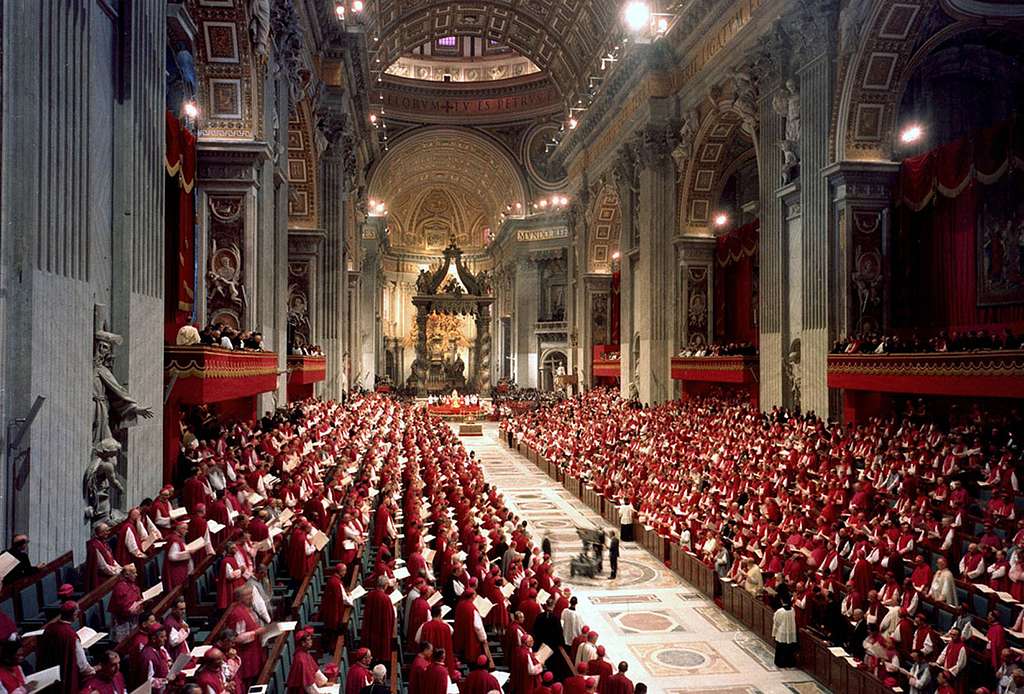

December 7, 2025 marks the 60th anniversary of the close of Vatican II, which in many ways has served as the most divisive event in the history of the Catholic Church. Whereas various heresies and schisms over the centuries have resulted in departures of countless souls from the Church, Vatican II has led to unprecedented turmoil within the Church among men and women who still identify as Catholic. Broadly speaking, this turmoil has flowed naturally from what John XXIII referred to as “aggiornamento,” an updating or renewal of the Church. As a result, for sixty years we have witnessed competing experiments: would the aggiornamento succeed in producing good fruits, and could Catholic Tradition survive opposition from Rome?
Paul VI’s closing address of the Council from December 7, 1965 helps us better understand the spirit of aggiornamento, which presents itself to the world as an effort to satisfy the religious needs of mankind through an ongoing process of renewing Catholicism:
“Would not this council, then, which has concentrated principally on man, be destined to propose again to the world of today the ladder leading to freedom and consolation? Would it not be, in short, a simple, new and solemn teaching to love man in order to love God? To love man, we say, not as a means but as the first step toward the final and transcendent goal which is the basis and cause of every love. And so this council can be summed up in its ultimate religious meaning, which is none other than a pressing and friendly invitation to mankind of today to rediscover in fraternal love the God ‘to turn away from whom is to fall, to turn to whom is to rise again, to remain in whom is to be secure…to return to whom is to be born again, in whom to dwell is to live’ (St. Augustine, Solil. I, 1, 3; PL 32, 870). This is our hope at the conclusion of this Second Vatican Ecumenical Council and at the beginning of the human and religious renewal which the council proposed to study and promote; this is our hope for you, brothers and Fathers of the council; this is our hope for the whole of mankind which here we have learned to love more and to serve better”
As Paul VI said, the Council “concentrated principally on man” as a way of fostering love of God. For those anchored in what the Church had consistently taught prior to the Council, this line of thinking raised more questions than it answered. Paul VI acknowledged this in his address:
“And if quite a few questions raised during the course of the council itself still await appropriate answers, this shows that its labors are now coming to a close not out of weariness, but in a state of vitality which this universal synod has awakened. In the post-conciliar period this vitality will apply, God willing, its generous and well-regulated energies to the study of such questions.”
If Vatican II had merely restated what the Church had always taught, it would have answered the pressing questions facing mankind rather than raising unanswered questions. However, because the aggiornamento was essentially a turning way from what the Church taught, Paul VI correctly noted that the Council raised “quite a few questions” which “still await appropriate answers.”
Traditional Catholicism has had to overcome three challenges, each of which should have been fatal. First, Rome has spent the past sixty years persecuting those who have resisted the aggiornamento…
This turning away from what the Church has always taught predictably caused a crisis for those Catholics who adhered to what the pre-Vatican II popes had consistently taught. For many, the words from St. Pius X’s Oath Against Modernism were specifically intended to guard against any such turning away from tradition:
“I sincerely hold that the doctrine of faith was handed down to us from the apostles through the orthodox Fathers in exactly the same meaning and always in the same purport. Therefore, I entirely reject the heretical misrepresentation that dogmas evolve and change from one meaning to another different from the one which the Church held previously. I also condemn every error according to which, in place of the divine deposit which has been given to the spouse of Christ to be carefully guarded by her, there is put a philosophical figment or product of a human conscience that has gradually been developed by human effort and will continue to develop indefinitely. . . . I also reject the error of those who say that the faith held by the Church can contradict history, and that Catholic dogmas, in the sense in which they are now understood, are irreconcilable with a more realistic view of the origins of the Christian religion. I also condemn and reject the opinion of those who say that a well-educated Christian assumes a dual personality-that of a believer and at the same time of a historian, as if it were permissible for a historian to hold things that contradict the faith of the believer, or to establish premises which, provided there be no direct denial of dogmas, would lead to the conclusion that dogmas are either false or doubtful.”
Anyone who condemns Traditional Catholics for “schismatic attitudes” necessarily rejects these words from St. Pius X’s Oath Against Modernism because they constitute a complete and unambiguous defense of those who refuse to accept the aggiornamento. Perhaps for this reason, Paul VI did away with the requirement for clergy to recite the Oath Against Modernism.
Second, Traditional Catholics have had to endure the unprecedented scandal of Rome continually exacerbating the evils caused by the aggiornamento — many serious Catholics have seen these scandals and (falsely) concluded that the Church must have defected.
Thus we have the initial set up for the competing experiments. For the next six decades, all-powerful Rome pursued its aggiornamento, while Traditional Catholics were not only deprived of almost all support from the Church hierarchy but were also persecuted for refusing to accept the novelties. The odds were so far against Traditional Catholicism that it would take a miracle for it to even survive. Every expectation was that aggiornamento would deliver its promised renewal while Traditional Catholicism would soon die.
As we can clearly see from Paul VI’s assessment from 1972, though, it did not take long to see that the experiment of aggiornamento was failing:
“Through some cracks the smoke of Satan has entered the temple of God: there is doubt, uncertainty, problematic, anxiety, confrontation. One does not trust the Church anymore; one trusts the first prophet that comes to talk to us from some newspapers or some social movement, and then rush after him and ask him if he held the formula of real life. And we fail to perceive, instead, that we are the masters of life already. Doubt has entered our conscience, and it has entered through windows that were supposed to be opened to the light instead. . . Even in the Church this state of uncertainty rules. One thought that after the Council there would come a shiny day for the history of the Church. A cloudy day came instead, a day of tempest, gloom, quest, and uncertainty. We preach ecumenism and drift farther and farther from the others. We attempt to dig abysses instead of filling them.” (June 29, 1972)
Remarkably, neither Paul VI nor his successors were able to reverse the damage that was already so evident a few years after the Council. Indeed, the aggiornamento continued to fail at a somewhat steady pace until shortly after Benedict XVI offered this assessment during his final address to the clergy of Rome on February 14, 2013:
“We know that this Council of the media was accessible to everyone. Therefore, this was the dominant one, the more effective one, and it created so many disasters, so many problems, so much suffering: seminaries closed, convents closed, banal liturgy . . . and the real Council had difficulty establishing itself and taking shape; the virtual Council was stronger than the real Council. But the real force of the Council was present and, slowly but surely, established itself more and more and became the true force which is also the true reform, the true renewal of the Church. It seems to me that, 50 years after the Council, we see that this virtual Council is broken, is lost, and there now appears the true Council with all its spiritual force.”
As he said, the Council “created so many disasters, so many problems, so much suffering: seminaries closed, convents closed, banal liturgy.” Have those who suggest that the crisis began with Francis forgotten these words; or are they intentionally gaslighting the rest of us? How do they imagine that Bergoglio could have been elected if the aggiornamento experiment had not already failed in spectacular fashion? The Francis years (and the first months of Leo XIV’s papacy) have accelerated the failure of the aggiornamento experiment at such an alarming rate that it seems that Satan could not have devised a better way to attack the Church.
Third, Traditional Catholicism has had to endure all of the societal changes that the defenders of the aggiornamento typically blame for the putrid fruits of Vatican II.
What, though, can we say about the experiment of Traditional Catholicism? To understand the basic context of why we can even speak of such an experiment, it is worth considering the words of Archbishop Marcel Lefebvre from his Open Letter to Confused Catholics:
“Besides, the Truth does not depend on numbers and numbers do not make the Truth. Even if I were alone and all my seminarians left me, even if the whole of public opinion were to abandon me, that would be a matter of indifference as far as I am concerned. I am bound to my Creed, to my catechism, to the Tradition which has sanctified the elect in heaven and I want to save my soul. We know public opinion all too well. It condemned Our Lord a few days after having acclaimed Him. It is Palm Sunday followed by Good Friday. His Holiness Paul VI asked me: ‘But after all, don’t you feel in your heart something that reproaches you for what you are doing? You are causing in the Church an enormous scandal, enormous. Doesn’t your conscience tell you so?’ I replied: ‘No, Holy Father, not at all.’ If I had something to reproach myself with, I would stop at once. Pope John Paul II has neither confirmed nor quashed the sanction pronounced against me. During the audience which he granted me in November 1979, he seemed after a long conversation quite disposed to allow freedom of choice in the liturgy, in short to let me do what I asked from the beginning, to carry on the “Experiment of Tradition” among all the other experiments that are carried on in the Church. The moment had come when perhaps everything could have been settled; no more outlawing of the Mass and no more problems. But Cardinal Seper, who was present, saw the danger. ‘But, Holy Father,’ he exclaimed, ‘they make this Mass into a banner!’ The heavy curtain which had lifted for a moment fell back. We must still wait.”
The “experiment of Tradition” would have ended if Archbishop Lefebvre had either given up or died before he consecrated bishops in 1988 because Rome would have had no reason to support the Society of St. Pius X or establish the former Ecclesia Dei communities. The fact that Traditional Catholics have the Traditional Latin Mass, and try to adhere to what the Church has always taught, attests to the need to be grateful to God for giving the Church Archbishop Lefebvre to continue the “experiment of Tradition.”
Despite these challenges, Traditional Catholicism has thrived. Every single indicator of religious health — including vocations, baptisms, marriages, Mass attendance, and adherence to Church teachings — is exemplary for Traditional Catholics and abysmal for those who have followed the aggiornamento.
Beyond this, Traditional Catholicism has had to overcome three challenges, each of which should have been fatal. First, Rome has spent the past sixty years persecuting those who have resisted the aggiornamento. This persecution is all the more perverse because Rome has simultaneously pursued its policies of false ecumenism and religious liberty, which accept and promote all religious beliefs except those of St. Pius X. Second, Traditional Catholics have had to endure the unprecedented scandal of Rome continually exacerbating the evils caused by the aggiornamento — many serious Catholics have seen these scandals and (falsely) concluded that the Church must have defected. Third, Traditional Catholicism has had to endure all of the societal changes that the defenders of the aggiornamento typically blame for the putrid fruits of Vatican II.
Despite these challenges, Traditional Catholicism has thrived. Every single indicator of religious health — including vocations, baptisms, marriages, Mass attendance, and adherence to Church teachings — is exemplary for Traditional Catholics and abysmal for those who have followed the aggiornamento. Among the few categories in which those who follow the aggiornamento excel are annulments and apostasies — in these categories they have achieved figures that even the Church’s greatest enemies probably could not have imagined.
It is natural to ask why God has permitted the experiment of aggiornamento. While we may not find out the answer to that question this side of Heaven, perhaps it suffices to observe that there would be no need for the “experiment of Tradition” without the crisis — Catholics would simply be Catholic and we would have no reason to fight so hard to practice our Faith. But this need to fight to keep and practice the Faith has had countless spiritual blessings for those who might have had far less fervor and devotion in more normal times in Church history. With the experiment of aggiornamento showing no signs of ending despite its astounding failure, it is among the greatest blessings for us to be able to cooperate with God’s grace to continue the “experiment of Tradition.” Immaculate Heart of Mary, pray for us!
