

We did not need another indication that the Catholic Church is in a state of grave crisis, but Fr. James Martin and his fellow enemies of Catholicism have provided yet another, as reported by Rorate Caeli:
“‘Gio’ Benitez, an openly homosexual television presenter with ABC News, was confirmed yesterday at the problematic Saint Paul the Apostle parish church in Manhattan — there was a mass of Paul VI celebrated by homosexual-adjacent homosexuality-promoting Jesuit James Martin, and in the presence of the ‘husband’ of Mr. Benitez . . .”
The video accompanying the report seems like it was specifically crafted by Satan and his minions to drive men of good will from the Church. It is stunningly evil and, in reality, has nothing to do with Catholicism other than the fact that it is intended as a mockery of the true Faith.
When faced with such scandals, we have various options in deciding how to respond, such as: ignoring them, accepting them as legitimate developments of Catholic morality, blaming them all on Francis or Leo XIV, or seeking to determine why such scandals are so prevalent. As unpopular as the latter option is, it is the only one that can ultimately help stop the scandals.
The option of trying to determine the root causes of the current scandals is also prone to heated debate, in large part because various groups have vested interests in defending the factors that have contributed to the crisis. For that reason, it is especially valuable today to consider reliable sources of sound Catholic guidance who spoke clearly about the threats to the Faith prior to the Council.
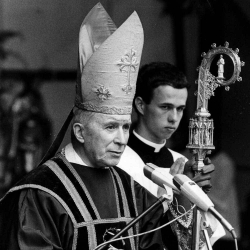
One such source is Archbishop Marcel Lefebvre’s March 26, 1961 pastoral letter from Dakar, in which he began by discussing John XXIII’s Christmas letter to the world:
“His Holiness Pope John XXIII’s Christmas Letter to the world this year was on the subject of ‘Truth.’ I should like to re-echo for this diocese the Holy Father’s most timely message, and to draw your attention, my dear people, to the necessity to flee from error and the sources of error, and to be wholeheartedly attached to the truth which the Church teaches.” (p. 114)
Some Traditional Catholics might find it ironic that John XXIII’s Christmas letter to the world spoke of the need to flee from error and the sources of error. Had he heeded his own words, perhaps he would not have opened Vatican II by announcing that the Church would no longer condemn error.
While many would argue that John XXIII failed to live up to his own words, Archbishop Lefebvre dedicated the remaining thirty years of his life to fighting for the truth and opposing error. He continued his letter by explaining why souls seek truth:
“Many motives can stir up in our hearts the thirst for truth. Our souls are made for the Truth. Our intelligence, a reflection of the Divine Spirit, was given us that we might know the truth and to bring us its light, which will show us the goal towards which all of our life must be directed.”
We thirst for truth, which is why the unadulterated Catholic Faith draws serious men and women to the Church. Conversely, blasphemous nonsense like the homosexual spectacle described above leads souls to conclude that the Church must no longer have the truth, if it ever did.
Rome is so full of those who think that their ideas matter more than what the Church has aways taught that it is rare to hear a bishop or cardinal speak at length about the Faith without hearing something that calls into question Church teaching.
Those promoting the LGTBQ agenda are but one example of the groups that Archbishop Lefebvre likened to the Scribes and Pharisees who try to impose their own ideas on the Church:
“It is St. John . . . who tells the story of the man born blind, and reports what Our Lord had to say on the subject of blindness. He rebuked the Scribes and the Pharisees, who claimed to see the light and to possess the truth, when in fact they were blind; and He praised those who came to Him like blind men, for they sought to see the light. The Scribes and Pharisees represent those who come to the Church, the mistress of truth, claiming to impose upon her their own ideas and concepts, instead of coming with minds ever thirsting for truth, and prepared to receive it and bring it to fruition. Happy are those who drink from the sources of Light and shun those who are dubious and discouraged by the Church. Why do souls have this deep desire for truth? It is because, as Our Holy Father the Pope reaffirms, truth is reality. The intelligence which accepts truth partakes of the reality of the Divine Being as well as of the creature.” (p. 114-115)
Rome is so full of those who think that their ideas matter more than what the Church has aways taught that it is rare to hear a bishop or cardinal speak at length about the Faith without hearing something that calls into question Church teaching. When Archbishop Lefebvre wrote these words in 1961, such Scribes and Pharisees were “discouraged by the Church”; but today those who “drink from the sources of Light” are the ones who are shunned.
Archbishop Lefebvre continued by describing the grave evils caused by those who live by their own version of truth:
“The man who makes his own truth lives in an illusion, in an imaginary world. He creates inside his mind, as it were, a film, made up of thoughts which have only the appearance of reality. Living in the unreal, and above all attempting to realize concepts which are nothing but the figments of an imaginative mind is, sad to say, the root cause of all the ills which beset humanity. Corrupt ideas are a much graver matter than corrupt morals, for the scandal caused by morals is less extensive than that caused by errors. The latter spread far more rapidly, and corrupt entire peoples.” (p. 115)
Presumably the archbishop could not have fathomed at the time that in just a few years the Church would appear to be the one spreading corrupt ideas, which “are a much graver matter than corrupt morals.” If, as he wrote, corrupt ideas could corrupt entire peoples, there should be no mystery as to why the world is in such a desperate state of corruption sixty years after Vatican II.
When the Church has spoken clearly on a topic for centuries and then begins to speak on the topic with ambiguous language that happens to please the Church’s persecutors, it will promote error and darkness.
Even if he did not foresee the grave crisis in the Church, he knew that pastors needed to do all in their power to protect the Faith against the errors that eventually led to the crisis:
“That is why the most pressing obligation on your pastors, whose bounden duty is to teach you the Truth, is to diagnose your spiritual diseases, which is what errors are. The Church constantly teaches the truth, and by that very fact points out error. But alas, it has to be recognized that many even among the faithful either do not take the trouble to learn the truth, or else turn a deaf ear to the warnings they are given. And how should we not, with St. Paul, deplore the fact that some who have been commissioned to preach the truth no longer have the courage to do so, or else present it in such an equivocal fashion that the line between truth and error is no longer discernible.” (pp. 115-116)
These words indicate that Archbishop Lefebvre knew of those who no longer preached the truth. Although he did not necessarily attribute malice to such pastors, he identified the problem of equivocation that he would in later years deplore as a weapon deliberately used by the Church’s enemies:
“It is a fact that nowadays there are certain religious writers, or writers claiming to be concerned with religion, who have a talent for using equivocal terms and for forging neologisms in such a way that it is impossible any longer to know precisely what they really intend to convey. Those who write or speak in this way hope to retain the Church’s official approval, while at the same time pleasing those outside the Church, and even her persecutors.” (p. 116)
Some conservative Catholics defend Vatican II’s documents by saying that they were ambiguous. As Archbishop Lefebvre clearly saw, though, those who employ equivocal or ambiguous language promote error and intellectual and spiritual darkness:
“In so doing there are laboring under a total misapprehension as regards the result of their action. All they are doing is confirming in their error those who are in ignorance or who are actively opposed to the Church. Not at all are they transmitting to them the True Light of souls, Our Lord Jesus Christ, and His choicest creation, the Church. Meanwhile, those who are still in darkness are, deep down, seeking the light, and themselves wonder at seeing those whom they should naturally expect to oppose their ideas come flooding towards them.” (p. 117)
It seems almost certain that most educated Catholics of good will would have agreed with Archbishop Lefebvre on this point because it is in perfect accord with common sense. When the Church has spoken clearly on a topic for centuries and then begins to speak on the topic with ambiguous language that happens to please the Church’s persecutors, it will promote error and darkness.
The archbishop even applied this specifically to the cause of false ecumenism:
“Protestants do not expect Catholics to adopt their patterns of thought and judgment. They are well aware of their own countless divisions both doctrinal and pastoral. They do not ask any more than do the pagans, that we we abandon our faith and our unity. These days they themselves are prevented, more often than not, from entering the Church more by social and moral pressures and by several centuries of tradition than by doctrinal difficulties or supposed defects in the Church.” (p. 118)
Already Archbishop Lefebvre saw the real problems associated with the false ecumenism that would dominate the Council just a year later. His observation about the real obstacles to Protestants joining the Church is fascinating when we observe that the grave scandals in the Church today often involve widespread rejection by Catholics of precisely those teachings that foster the “moral and social pressures” for Protestants. Do the high-ranking advocates of false ecumenism permit these scandals — such as Catholic acceptance of divorce, contraception, and abortion — for the sake of making the Church appear more Protestant? Or do Catholics learn from false ecumenism that Protestant morality is pleasing to God?
Rome tells us so often how we must love others: by erasing national borders, by recycling and turning off our appliances, by taking Covid shots, and by accepting everyone as they are. But these people refuse to do the one thing that is most important: tell souls the truth about what God wants them to do.
As he so often did after the Council, Archbishop Lefebvre did not merely critique the evils around him. He ended his letter by reminding his readers of the Christian approach to truth:
“As a necessary complement to what I have already said, and to avoid that culpability to which the Holy Father speaks, I should like to set before you some lines written by Fr. Jean Daniélou which perfectly express the attitude of a true Christian regarding truth. They will encourage us to advance along a road well illuminated by the light of Our Lord and His Church.” (p. 122)
Already with this instruction we can understand Archbishop Lefebvre’s attitude of relying on what the Church has always taught — he wants us to advance along a road that has been “well illuminated by the light of Our Lord and His Church” rather than a path of our own choosing. With this, he devoted most of the remainder of his letter to the words of Fr. Daniélou:
“If we do not tell others the truth, it is perhaps because we feel they are not disposed to accept it, but also it is often through cowardice, through self-centeredness, because we have not the courage to face up to their displeasure. Because we fear to offend them we do not dare to love them truly and to the bitter end. For loving others means seeking what is for their good, even in spite of themselves. Loving others means helping them to bring about within themselves the triumph of truth over their paltry day-to-day ‘reality.’ Loving means helping every man to realize God’s plan for him. Indisputably, charity of this kind forbids us to allow others what we know is not for their own good. . . . In today’s world millions of souls are deprived of the living bread of truth, and this is a situation which we have no right to tolerate. The fact is that we tolerate it all too easily. To compromise with this situation is to fail to love.” (p. 122-123)
Rome tells us so often how we must love others: by erasing national borders, by recycling and turning off our appliances, by taking Covid shots, and by accepting everyone as they are. But these people refuse to do the one thing that is most important: tell souls the truth about what God wants them to do to serve Him and save their souls.
Archbishop Lefebvre was correct, and if his fellow bishops had shared his Faith and fortitude, the Church would not be suffering through the crisis that began in earnest with the Council. We cannot turn back the clock, but we can return to what the saints would tell us we must do. For those Catholics who are sickened by the continuous scandals, there seems to be no better ways to respond than to pray and follow the advice that Fr. Daniélou, Archbishop Lefebvre, and even John XXIII gave. The truth must be taught clearly, and errors must be condemned. Anything short of this simply prolongs the crisis, offends God, and leads souls to hell. Immaculate Heart of Mary, pray for us!
