

The value proposition of the Catholic religion is easy to understand. For two thousand years, souls have followed the Church’s difficult teachings because they believe that it is the religion established by Jesus Christ to lead souls to heaven. This reality is seldom more evident than in the stories of the martyrs. Here, for example, is how Leo Knowles described the witness to the Catholic Faith given by St. John Houghton, one of the forty English martyrs:
“When the executioner knelt and asked his victims for the customary pardon, John Houghton embraced him. In a firm voice he called the crowd to witness that he had refused to obey the king, not from malice, but solely for fear of offending God. ‘Our holy mother the Church has decreed and enjoined otherwise than the king and Parliament have decreed,’ he declared. ‘I am therefore bound in conscience, and am ready and willing to suffer every kind of torture rather than deny a doctrine of the Church.” (The Prey of the Priest Catchers: The Lives of the 40 Martyrs, p. 19)
He and many of his fellow martyrs might have obtained “mercy” if they had denied the Catholic Faith; and they merely had to follow the new religion made by Henry VIII, which still resembled Catholicism in many respects. But St. John Houghton knew that even if he obtained some reprieve from the executioner, he would ultimately face Our Lord’s judgment. And so instead of abandoning the religion of the Supreme Judge, he willingly faced the torments his earthly judges heaped upon him:
“He asked his hearers to pray for him and for his brethren. As he commended his soul to God, the cart was driven from under him. The executioners used a specially thick rope for fear he might die before he was cut down and the disembowelling began. As the executioner groped deep inside him, John, still conscious, knew what was happening. ‘Good Jesus, what will you do with my heart?’ he murmured. A moment later the heart was torn from his body and he was dead.” (p. 19)
In that moment, Our Lord welcomed the martyred priest into Heaven, and all generations of future Catholics were given an example of how we ought to value the precious gift of the Faith that Jesus has given us.
Pre-Vatican II: If you want to serve God and save your soul, you must join the Catholic Church and follow its teachings.
Post-Vatican II: You can save your soul outside the Church, but if you want a fuller Christianity you are welcome to become Catholic.
For two thousand years, Catholics have been willing to make great sacrifices to practice their Faith and pass it along to others because they shared St. John Houghton’s understanding of the Catholic value proposition. Yes, it would be much easier to practice any number of non-Catholic religions, but our goal is Heaven and we cannot afford to make a foolish bargain with eternal judgment on the line.
Of course, though, there have always been threats to this desire to faithfully preserve, follow, and spread the Catholic Faith. In his 1832 encyclical on liberalism and religious indifferentism, Mirari Vos, Pope Gregory XVI described the evil of indifferentism:
“Now We consider another abundant source of the evils with which the Church is afflicted at present: indifferentism. This perverse opinion is spread on all sides by the fraud of the wicked who claim that it is possible to obtain the eternal salvation of the soul by the profession of any kind of religion, as long as morality is maintained. Surely, in so clear a matter, you will drive this deadly error far from the people committed to your care. With the admonition of the apostle that ‘there is one God, one faith, one baptism’ may those fear who contrive the notion that the safe harbor of salvation is open to persons of any religion whatever. They should consider the testimony of Christ Himself that ‘those who are not with Christ are against Him,’ and that they disperse unhappily who do not gather with Him. Therefore ‘without a doubt, they will perish forever, unless they hold the Catholic faith whole and inviolate.’”
The question is simple: do we really need to be Catholic and follow what the Church teaches if we want to save our souls? St. John Houghton and other saints knew the answer is “yes.” It is interesting to imagine how different the lives of the saints would have been if they had succumbed to this plague of indifferentism. Would St. John Houghton or the other English martyrs have adhered to the Catholic Faith if they had thought that the religion of Henry VIII was pleasing to God and capable of leading souls to Heaven?
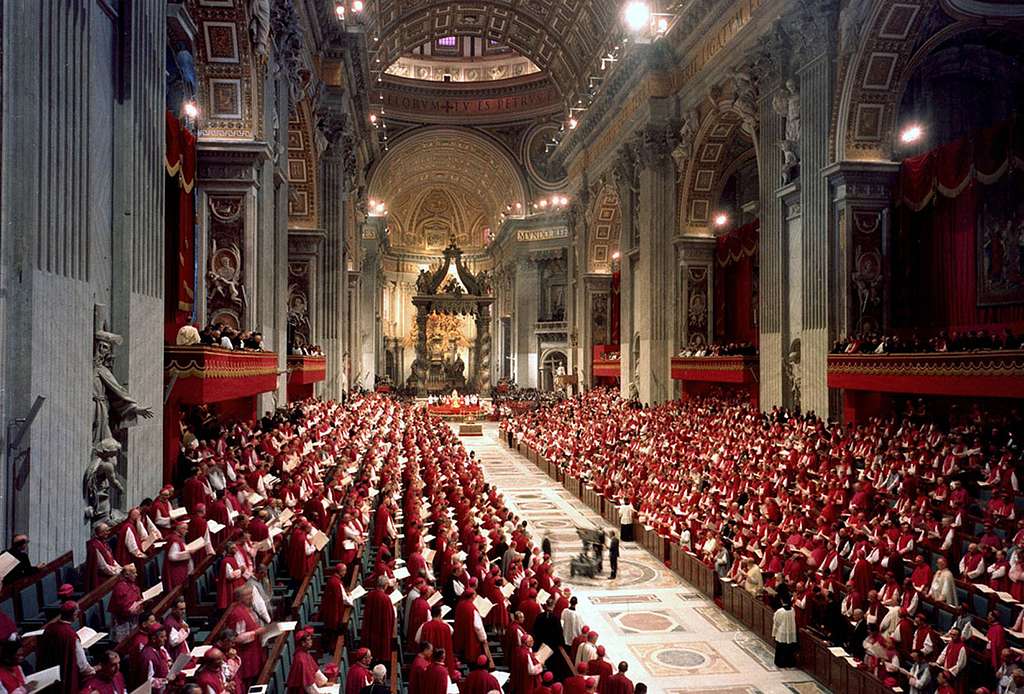
The question has become tragically relevant since Vatican II because many of the dominant ideas flowing from the Council — especially religious liberty and false ecumenism — effectively promote the indifferentism condemned by Gregory XVI. As we know, the defenders of the Council never stop telling us that the documents of Vatican II were perfectly orthodox, even if they were ambiguous in places. To appreciate the inanity of this defense of the Council, we can consider two hypothetical billboards stating the Catholic value proposition:
Pre-Vatican II: If you want to serve God and save your soul, you must join the Catholic Church and follow its teachings.
Post-Vatican II: You can save your soul outside the Church, but if you want a fuller Christianity you are welcome to become Catholic.
We can of course debate whether or not the second statement is erroneous or merely deficient, but it should be obvious to all that it communicates something fundamentally different than what is communicated by the first statement. As such, it matters very little in practice whether or not the second statement is “heretical” — it is inherently misleading in comparison to what the Church consistently taught prior to Vatican II.
Perhaps there was always a large percentage of lukewarm and indifferent Catholics throughout the centuries, but they had little opportunity to act on their indifference in a “respectable” manner until Bea and his accomplices achieved their objectives at Vatican II.
For those who perhaps doubt that the documents of Vatican II taught anything like the second statement above, we can merely quote the Council’s decree on ecumenism, Unitatis Redintegratio:
“It follows that the separated Churches and Communities as such, though we believe them to be deficient in some respects, have been by no means deprived of significance and importance in the mystery of salvation. For the Spirit of Christ has not refrained from using them as means of salvation which derive their efficacy from the very fullness of grace and truth entrusted to the Church.”
For six decades, Catholics and non-Catholics with common sense have translated this into the second value proposition above despite efforts from the defenders of the Council to tell us that it really says the same thing as what the Church has always taught.
Common sense can also tell us how St. John Houghton, Pope Gregory XVI, and every other serious Catholic with the use of reason would have responded to the two different formulations of the Catholic value proposition above. They would know that, all else being equal, the first statement is far more likely to lead souls to follow what the Church teaches. They would also know that laity, religious, and clergy who believed the second statement would be much more likely to leave the Church or, at the very least, become lukewarm. In other words, common sense would have been entirely sufficient to forecast what we have seen since Vatican II.
If we want to know why this happened, we can consider one of the most influential men at the Council, Cardinal Augustin Bea, who was determined to make the world think that the Catholic value proposition had changed. In his They Have Uncrowned Him, Archbishop Marcel Lefebvre asserted that the B’nai B’rith had asked Cardinal Bea to promote religious liberty at Vatican II:
“‘Freemasons, what do you want? What do you ask of us?’ Such is the question that Cardinal Bea went to ask the B’nai B’rith before the beginning of the Council. The interview was announced by all the papers of New York, where it took place. And the Freemasons answered that what they wanted was ‘religious liberty!’ — that is to say, all the religions put on the same footing. The Church must no longer be called the only true religion, the sole path of salvation, the only one accepted by the State. Let us finish with these inadmissible privileges. And so, declare religious liberty. Well, they got it: it was Dignitatis Humanae.” (p. 214)
So, according to Bea, the best way for the Catholic Church to help non-Christians save their souls is to encourage them to practice their false religions as well as possible. So much for the Catholic value proposition…
Cardinal Bea did many things at the Council — from promoting false ecumenism in various documents to giving us Nostra Aetate — and they all tended to shift the Catholic value proposition to what the world erroneously believes it to be today. As discussed in a previous article, the extraordinary extent of Bea’s efforts can be seen from his words about non-Christian religions, as quoted in Fr. Stjepan Schmidt’s Augustin Bea: Cardinal of Unity:
“Since in the normal way of things the conversion of non-Christians is a very difficult task, which is slow and often concerns relatively few converts, it follows that in actual fact for many people — in practice, for the majority — the only way to salvation is that of living in good faith according to the religion they have inherited from their fathers, and of following the moral code they know. Hence, if the church wishes to help them — as is its duty, by reason of its mission to be the salvation of all people — on the basis of real possibilities, the work it performs through the new secretariat will concentrate on the confirmation of what is naturally good, true, and morally honest and healthy in the religions and practical life of these non-Christians.” (p. 607)
So, according to Bea, the best way for the Catholic Church to help non-Christians save their souls is to encourage them to practice their false religions as well as possible. So much for the Catholic value proposition . . .
Perhaps there was always a large percentage of lukewarm and indifferent Catholics throughout the centuries, but they had little opportunity to act on their indifference in a “respectable” manner until Bea and his accomplices achieved their objectives at Vatican II. A bad Catholic would have been treated as a bad Catholic. To a large extent, this is not the case today. The lukewarm occupy honored positions in their Novus Ordo parishes, with little threat of a priest asking them to change. They follow the examples of their lukewarm (or openly heretical) pastors and the Synodal Church listens and learns from them.
The only remedy is to return to the truth about the Catholic value proposition, which Archbishop Lefebvre stated so well in his The Mystery of Jesus:
“The only remedy is to reflect, meditate, and be convinced of the necessity of the social reign of our Lord Jesus Christ, of His reign over us not only as persons, but also in society. Be assured that if you tell yourself that you want to live according to the law and the morality that our Lord has taught us, and by His grace, love and sacraments, but that out in the world you must accept freedom of morals and free-thinking, then sooner or later you will be contaminated. The mere fact of conceding that it is a human right to be able to think whatever you like, as is done in the declaration on religious liberty, leads to the abandonment of the missionary spirit. Make no mistake. It is completely erroneous to think that if someone thinks otherwise than I do, if he has another religion than mine, he is free to do so. No, he is not free, and we must tell him, however sorry we may be, that he is wrong, that he is not in possession of the truth. One day you will be judged on your thoughts, your behavior, and your attitude: you had better convert. And this holds, not only for ideas, but also for morals, for everything.” (p. 81)
This sounds so foreign to us today, so mean and un-ecumenical. But it is what the Church truly teaches, even though the disciples of the godless Vatican II revolution insist otherwise. If we want to lead souls back to the Church and bring about the social reign of Christ the King, then we must unlearn the lies of Vatican II and relearn the lessons taught by all the saints. Immaculate Heart of Mary, pray for us!
