
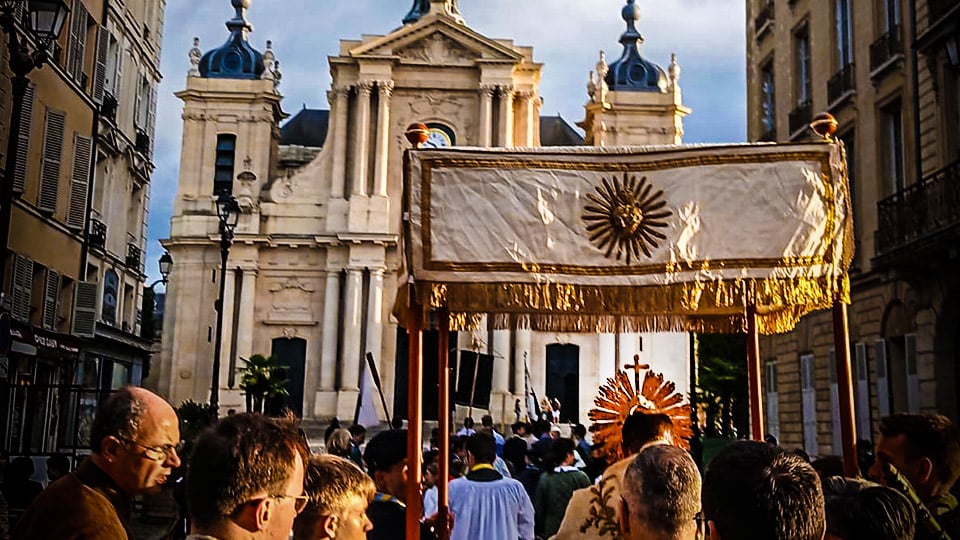

On June 4, a Eucharistic procession gradually formed from the parish of Notre-Dame des Armées, making its way along the Avenue de Paris toward the Château of Versailles, the former seat of monarchical power in pre-Revolution France.
For the agnostic or atheist bystander, the procession may have seemed like a quaint religious custom: priests in vestments, altar boys in cassocks and surplices, as well as families gathered in pious devotion.
For Catholics with eyes of faith, this was not a mere ostentatious cavalcade, but a public proclamation of the True Faith and an affirmation of the Kingship of Jesus Christ.
However, for Catholics with eyes of faith, this was not a mere ostentatious cavalcade, but a public proclamation of the True Faith and an affirmation of the Kingship of Jesus Christ.
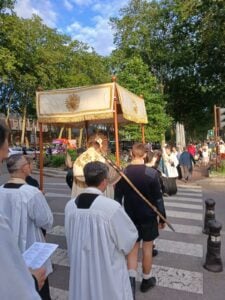
Gradually, the procession advanced like a living prayer through the sunlit streets of Versailles. Under a canopy, the Monstrance gleamed in the priest’s consecrated hands, catching the evening sunlight. Within it—so easily glossed over and neglected by the world—was Our Lord Himself, concealed under the fragile appearance of bread. There lay the wondrous paradox: the God who created the universe and the King before whom angels tremble, decided to hide Himself in humility. No dazzling display, no garish ostentations, and no overwhelming force—but only silence, stillness, and love. The Host does not impose; it invites. It does not conquer by force; it reigns by sacrifice.
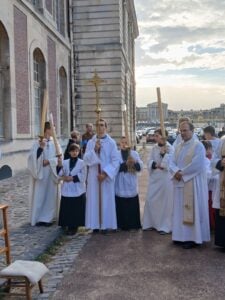
Ahead of the canopy, little flower girls in white dresses sauntered with solemn joy, their small hands scattering petals and confetti across the cobblestones to delineate a path worthy of the Eucharistic King. As the petals shimmered beneath their feet—rose, gold, and ivory—softening the ground where the Blessed Sacrament would soon pass. Besides, altar boys walked at the front, guided by the cadence of the procession, carrying a gravity that seemed to extend beyond their years.
Within it—so easily glossed over and neglected by the world—was Our Lord Himself, concealed under the fragile appearance of bread.
Additionally, this procession did not happen in isolation, tucked away within church grounds. It moved intentionally through the public square, along a boulevard leading toward one of the most iconic symbols of earthly power: the Palace of Versailles.
This scene was France as she once was before the atheistic French Revolution—and as she is called to be again.
Built by Louis XIV, the so-called Sun King, Versailles stands as an impeccable testament to monarchical glory. Its opulent halls, verdant gardens and architectural grandeur were designed to mirror the glory of an earthly monarch who tried to consolidate power and embody the state itself.
And yet, on this June evening, another King traversed before the palace’s affluent gates.
The contrast could not have been more conspicuous.
The Host does not impose; it invites. It does not conquer by force; it reigns by sacrifice.
On one side, the vestiges of an ancient kingdom premised on earthly authority, wealth, and splendor—magnificent, yes, but ultimately ephemeral.
Louis XIV, for all his glamor and self-promotion, could not flee the pangs of death. His dynasty crumbled eventually. Worse still, the monarchy he epitomized would falter amid a Masonic-linked revolution and genocide.
On the other end, the procession of the Eucharistic King— unadorned by worldly might, without any armies, temporal palaces, and political apparatuses. Nonetheless, this second King has endured, despite being crucified, dead, and buried. Defying all expectations, this King rose again, while His Kingdom, not of this world but immensely present in it, has survived persecutions, revolutions, and apostasies.
To boot, it is through processions like these that the true meaning of Corpus Christi reveals itself.
After all, this feast is not solely devotional; but extremely political in the greatest sense.
On one side, the vestiges of an ancient kingdom premised on earthly authority, wealth, and splendor—magnificent, yes, but ultimately ephemeral.
This commemoration unabashedly declares that Our Lord Jesus Christ is not only King of souls, but King of societies. He is, as Scripture declares, the “Sun of Justice”—the true light that no earthly monarch can dwarf.
France, once commonly referred to as the “eldest daughter of the Church,” was built upon this undeniable truth. Her laws, her culture, her very identity were shaped by the humble and public acknowledgement of Christ’s sovereignty. In France’s ancien régime, public worship was not a private preference but a national act of homage to God Himself.
Today, France’s glorious Catholic heritage is beleaguered by anti-Christian enemies on all sides. Modern Republican France has embraced a militant secularism that attempts to dispel God from the public square. Anti-life laws proliferate, eroding the dignity of the human person from conception to natural death. Also, religious expression is increasingly confined, tolerated only insofar as it remains invisible. In spite of the numerous churches and cathedrals that still dot the map of France today, the somber reality is that the state has the final say over these buildings. As a friend put it: “The state giveth, the state taketh away.”
And yet, on this very evening in Versailles on June 4, faithful Catholics bore witness to a different order. They genuflected on pavement and stone as the Blessed Sacrament passed. They intoned hymns in pious devotion, enunciating, without slogans or banners, that Christ is King—not only in heaven, but on earth, and in the streets of France.
This is why such processions matter. They are acts of reparation in a country that has publicly rejected the authority of the one true God. What’s more, they are acts of hope in an era that often appears hopeless.
This King has endured, despite being crucified, dead, and buried… His Kingdom, not of this world but immensely present in it, has survived persecutions, revolutions, and apostasies.
After all, the hidden God in the Host is not absent or far removed from Man’s affairs—He is patient.
He patiently waits for France to remember her Catholic inheritance.
He patiently anticipates for cold and lukewarm hearts to return to His Sacred Heart.
He waits, as He always has, with a love that is both kind, gentle and infinite.
As the procession drew nearer to the Saint-Louis de Versailles Cathedral, one could not help but ponder where true greatness can be found.
Is it to be found in gilded halls and political power? Or in the loving condescension of a God who humbles Himself to remain with His people?
The answer, contained in the Monstrance, passed before me.
And His reign, though currently largely obscured, will eventually triumph—in the streets of Versailles, and in the world.
Notre Dame de France, ora pro nobis.