
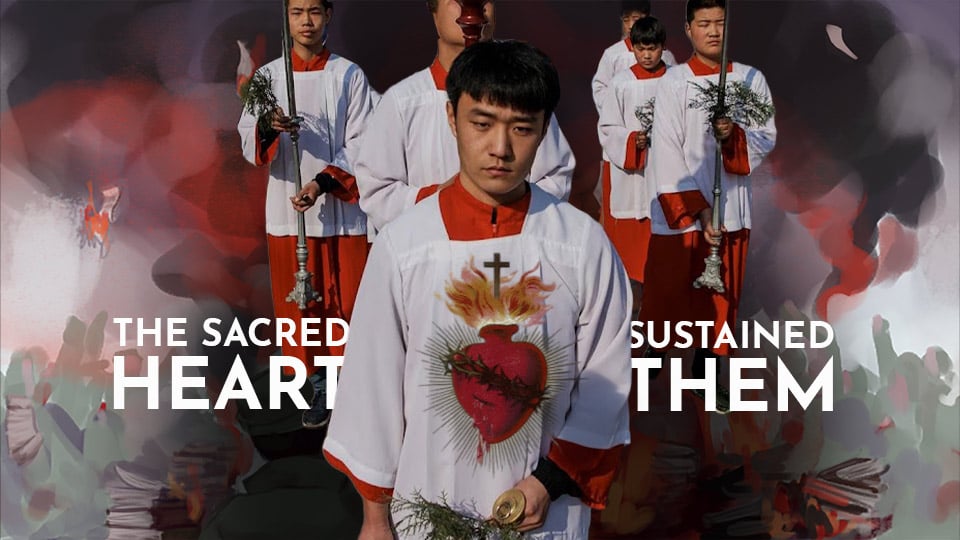

The devotion to the Sacred Heart of Jesus (“耶穌聖心敬禮” in Traditional Chinese or “耶稣圣心敬礼” in Simplified Mandarin) has long been one of the pillars of Chinese Catholic life.
Chinese Catholic memory traces the devotion’s beginnings to Jesuit missionaries, with the Catholic periodical Shengxin (“聖心”), published in Shanghai between 1887 and 1949, attributing the introduction of devotion to the Sacred Heart in China to the Jesuit missionary Fr. Jean Charles de Broissia (1660-1704).
Following Fr. Broissia’s footsteps, Fr.Romain Hinderer (known in the Chinese language as “De Manuo 德瑪諾”) (1688–1744), also a Jesuit and an ardent apostle of the Sacred Heart, propagated devotion to it during his decades of missionary apostolate in China.
“If my hope does not deceive me, it is through the grace of the Divine Heart that the mission in China will not only be preserved, but will rise higher than it has ever been,” Fr. Hinderer predicted in 1725.
For many Chinese Catholics, devotion to the Sacred Heart of Jesus has helped them tide over difficult times, reminding them that suffering is not meaningless when united to the Passion of Christ.
Moreover, Fr. Hinderer was responsible for constructing one of China’s earliest eminent churches to the Sacred Heart of Jesus in the city of Hangzhou. At the moment, more than 200 parishes, churches, and chapels across mainland China are dedicated to the Heart of Jesus, including the famous Archdiocesan Cathedral in Guangzhou. Newer places of worship continue to be set up, such as the Sacred Heart Church in Wenzhou, consecrated in 2003.
Missionaries of the Divine Word likewise played a significant role in promoting devotion to the Sacred Heart among Chinese Catholics. From their founder, Saint Arnold Janssen, to Saint Joseph Freinademetz, they consistently drew strength from the Divine Mercy poured out upon humanity through the Heart of Jesus.
For instance, St. Arnold Janssen, founder of the Society of the Divine Word, had a profound devotion to the Sacred Heart of Jesus and consecrated himself to it on the feast day in 1875.That very day was then regarded as the founding date of his society. The spiritual life of his missionary congregation was premised on devotion to the Sacred Heart of Jesus: its mission houses were filled with images from Paray-le-Monial, and every community prayer ended with the words, “And may the Heart of Jesus live in the hearts of all men.”
Even when churches were closed and priests imprisoned, images of the Sacred Heart remained in Chinese Catholic homes as domestic sanctuaries of faith.
Vivat Deus, a website detailing St. Arnold’s spirituality and devotion to the Sacred Heart of Jesus, had this to say:
“The devotion to the Sacred Heart of Jesus of Father Arnold started after his ordination, especially when the bishop sent him as a priest-teacher to the Junior High School in Bocholt. During his time at Bocholt, Father Arnold got to know the Apostleship of Prayer, a movement founded by a Jesuit, Fr Francis X. Gautrelet. It owed its popularity particularly to the writings of another Jesuit, Fr. H. Ramière. The Apostleship of Prayer is ‘a holy league of Christian Hearts united with the Heart of Jesus, to obtain the triumph of the Church and the salvation of souls.’”
The same Vivat Deus website added:
“Father Arnold joined the Apostleship of Prayer in 1865. His membership in that movement inspired him to have a devotion to the Sacred Heart and which led him to dedicate his life to the mission.”
Subsequently, the Divine Word missionaries who went to China carried with them an immense devotion to the Sacred Heart. Among them, St. Joseph Freinademetz, one of the first Divine Word missionaries in Shandong, stood out for entrusting everything to the Sacred Heart. He saw special meaning in the fact that he left Hong Kong for Shandong on June 1, 1881, during the month dedicated to the Sacred Heart, and arrived on June 24, the actual feast of the Sacred Heart.

As the Fides News Agency put it:
“Today, devotion to the Sacred Heart of Jesus is part of the Christian life lived in the daily life of Chinese Catholic communities. A spiritual dynamic that is particularly cultivated in the month of June, the month that the People of God in every part of the world dedicated to the Sacred Heart. There are lay people who consecrate their entire family to the Sacred Heart of Jesus, while priests celebrate the Day of Priestly Sanctification on its liturgical solemnity. In every home of a Chinese Catholic family there is at least one image of the Sacred Heart. In this month of June too, testimonies of devotion to the Sacred Heart of Jesus are increasing in China. For example, in the Sacred Heart Parish in Quxi, Ouhai, in the Diocese of Wenzhou, every Sunday in June, after the solemn procession from the Convent of the Nuns of Saint Theresa, more than 350 baptized people participate in the Eucharist and pray the Rosary together, also participating in meetings and catechisms dedicated to the devotion of the Sacred Heart.”
The Heart of Jesus became a refuge for Chinese Catholics living under relentless Communist persecution.
Similarly, in an article for AsiaNews, author Wilhelm K.Müller, Svd elaborated:
“Among the Catholic communities in China, devotional practices to the Sacred Heart of Jesus are widespread. Where the pace of life allows it – more commonly in the countryside than in the cities – the faithful live an almost communitary spiritual life, which initially was a reflection of the monastic or seminary life. Early in the morning, called to prayer by the sound of bells, they gathered, where possible, in the church or village chapel to recite morning prayer together. It is a long prayer, abundant, generous, with many intentions and invocations. At least in June, dedicated to the Sacred Heart of Jesus, it contains the Litany of the Sacred Heart, followed by several pages of prayers addressed to the Sacred Heart. After these prayers, which occupy more or less an hour, if there is a priest, Holy Mass is celebrated. The faithful often continue with the meditation of the Via Crucis. In the past, Sunday was entirely dedicated to common prayer and the faithful spent more time in church than at home. The evening prayer, again prayed together, took up again the theme of the Sacred Heart and again the faithful recited the invocations and litanies.”
“The countless churches and chapels dedicated to the Sacred Heart of Jesus in China, witness to this widespread devotion. The first church in honor of the sacred heart was consecrated in 1863 in Zhangzhuangcun (now in the Diocese of Xianxian, Hebei), at that time called ‘the number one church of northern China’. It was a historical event, after long years of apparitions of the Heart of Jesus to St. Margaret Mary Alacoque (1673-1675) and the ecclesiastical imprimatur to celebrate the liturgy publicly (in 1765 for Poland alone, in 1856 for the whole Church).This first church dedicated to the Sacred Heart in China was destroyed in 1976, at the end of the cultural revolution, but was rebuilt and dedicated on October 10, 1999. Today, according to a booklet on the history of Xianxian, there are 52 churches and chapels in the diocese in honor of the Sacred Heart of Jesus.We do not know how many churches in other dioceses are dedicated to the Sacred Heart. The table of contents of the recent Guida of the Catholic Church in China indicates only the address of many churches, but without the title of dedication,” Müller continued.
“The iconography of the Heart of Jesus according to the description of St. Margaret Mary Alacoque – the heart chained by the Crown of thorns, surrounded by flames of love, sprinkled with the blood drops, the cross implanted in the center – is also a constant for decor in Catholic churches and homes in China. In this aspect the Church in China has not been innovative. The icon has been accepted as is, though the Chinese sensitivity formed by virtue of ‘filial piety’ could oppose such a representation: the ideal of filial piety requires that after death the body of a man be returned intact to the parents; the dismemberment of a dead body was considered the supreme horror,” Müller went on.
Even when the true religion was cruelly suppressed by the Communists, images of the Sacred Heart remained prominent in many Chinese Catholic homes.
Over time, devotion to the Sacred Heart of Jesus became part of daily prayer, family consecration, and one’s Catholic identity in China. Even when the true religion was cruelly suppressed by the Communists, images of the Sacred Heart remained prominent in many Chinese Catholic homes, acting as domestic sanctuaries when public church buildings were shut down, and clergy humiliated, tortured, jailed, or murdered.
For many Chinese Catholics, devotion to the Sacred Heart of Jesus has helped them tide over difficult times, reminding them that suffering is not meaningless when united to the Passion of Our Lord Jesus Christ. Such spirituality premised on the Divine Heart of Jesus is particularly fitting for those facing relentless government persecution, because this devotion contemplates a Christ who reigns not by coercion or repression, but by mercy and love.
True enough, in face of the Chinese Communist state that incites fear by threats of torture and death the image of the Heart of Christ reminds Chinese Catholics that they are never abandoned by God, but that divine love is present even in suffering, fear, and isolation. The Most Sacred Heart of Jesus thus becomes a refuge for prayer, a symbol of hope, and an encouragement to remain courageously faithful to the end. Indeed, the Heart of Jesus exhorts Chinese Catholics to respond to their destiny and vocation with a love stronger than death, especially when the future seems bleak and uncertain.
Most Sacred Heart of Jesus, have mercy on us.
Our Lady of the Sacred Heart, pray for us.
***Here is a Chinese hymn to the Sacred Heart of Jesus (sung to the tune of Fr. Frederick Faber’s “Jesus My God and My All”):