
On Saturday, June 13, the annual March for Life took place in Rome, organized by Catholic associations and civil movements to defend human life from conception to natural death. A peaceful and public march bringing together families, young people, priests, and lay faithful to bear witness to the value of life and to express their dissent from legislative processes that normalize practices such as abortion and the suppression of the sick and other “non-productive” members of society by the state (that is, “euthanasia,” as politically correct language would have it).
Towards the conclusion of the event, the organizers unexpectedly read a letter from the renowned tenor Andrea Bocelli, who shared his testimony of gratitude towards his mother: although doctors had advised her to terminate the pregnancy because of the blindness diagnosed in the unborn child, she chose to trust life and carry the pregnancy to term, a gesture that Bocelli defined as the root of all that he is and all that he has received.
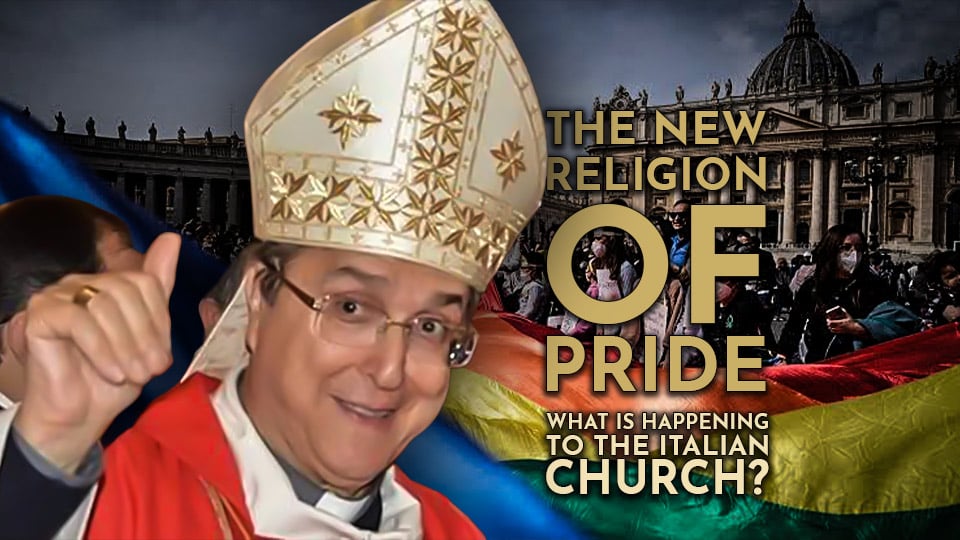
The Italian Church is experiencing a genuine LGBT turn, supported by the silence—and at times by the tacit consent—of a significant part of the Roman Curia.
Amid this atmosphere of joy and love for human life, a strong note of bitterness. Only one Italian bishop was present at the March. He was Antonio Suetta, bishop of Ventimiglia-Sanremo since 2014. Suetta has recently been the victim of numerous controversies and media attacks because of his ministry consistently in defense of Catholic doctrine and morality.
On the occasion of Pentecost, on May 24, Suetta published an apostolic letter inviting the faithful to bear courageous witness to the Catholic faith and to evangelize also the many Muslim immigrants present in the territory, defining this commitment as an authentic “act of charity.” With this initiative, Suetta confirms himself as a voice crying in the wilderness within the Italian episcopate and even worldwide, distinguishing himself for his doctrinal firmness in an ecclesial context increasingly marked by a strong ecumenism shifting into religious relativism. He is also known for the initiative of the “bells for unborn children,” a call to prayer for the victims of abortion and for the mothers who have lived through this painful choice.
Suetta is, in short, a true rarity within the Italian episcopate, similar to what is happening in France. During the March for Life in Paris, held last January 18, only one Catholic bishop took part. He was Dominique Rey, bishop emeritus of Fréjus-Toulon, known for having been placed under apostolic administration by Francis because of the high number of vocations and sacred ordinations celebrated in his territory and because of the spirituality he promoted, considered too “traditionalist.”
Faced with these rare exceptions, the question arises spontaneously: where are all the other bishops? What pastoral priorities guide the custodians of the Catholic faith in their dioceses today? Observing the ecclesial landscape of recent months, the answer appears evident: the Italian Church is experiencing a genuine LGBT turn, supported by the silence—and at times by the tacit consent—of a significant part of the Roman Curia.
The opposition between these two ‘liturgical objects’ is highly eloquent: on the one hand, the Sacred Heart of Jesus; on the other, the celebration of what exalts the exact opposite of humility: pride.
The ground was naturally prepared by the Declaration Fiducia supplicans “on the pastoral meaning of blessings” (2023), which in fact legitimized—despite several different interpretations and various reversals—or at any rate allowed the idea to pass that those who were once considered “irregular couples” must now be regarded as at least potentially good. One must no longer speak of intrinsic immorality with regard to these relationships.
This process was accelerated by the publication of the Italian Synodal Document approved on October 24, 2025, Lievito di Pace e di Speranza (“Leaven of Peace and Hope”). In it, among the other neo-modernist proposals advanced to revolutionize the Church in a progressive direction, we also find the pastoral inclusion of LGBT persons with a language close to activism.
In continuity with the process of moral and sacramental normalization of all irregular couples initiated in particular by Bergoglio with Amoris Laetitia (2016), the Italian synodal document supports the appropriateness not only of accompanying, but of explicitly recognizing “same-sex attracted, transgender persons and their families.”

Furthermore, the document invites the clergy to support civil days against “homophobia and transphobia,” also through moments of reflection and prayer. The publication of that document was prepared in the media by an interview with Francesco Savino, the ultra-progressive bishop and vice-president of the Italian Conference of Bishops for Southern Italy.
When the document was released, I wrote in a commentary article: “This effectively opens, although it is not explicitly written, to the possibility that priests participate in events such as gay pride.”
No sooner said than done: in June 2026, the month that the Church traditionally dedicates to devotion and adoration of the Sacred Heart of Jesus, numerous Italian bishops instead turned their attention to the LGBT cause. According to the civil calendar, in fact, June is Pride month, that is, the month of homosexual pride—and more generally of all atypical forms of sexual appetite.
The real question is this: what mission do these men of the Church believe they have?
The opposition between these two “liturgical objects” is highly eloquent: on the one hand, the Catholic liturgy; on the other, a secular liturgy, yet still religious in the etymological sense of the term, since every liturgy implies a “participation of the people.” On the one hand, the Sacred Heart of Jesus, adored by Catholics as a symbol of the human will of Christ, perfectly submitted to the Father and therefore truly “meek and humble.”
On the other hand, the celebration of what exalts the exact opposite of humility: pride, which Saint Thomas Aquinas defines as the mother and matrix of all the capital vices and of every sin, as well as the very form of original sin in which every man is conceived.
At least twelve Italian bishops decided to participate in prayer vigils against so-called “homo-trans-phobia,” more than double the number of the previous year. In total, twenty-three Italian dioceses are involved. Some of them are very important for the Italian ecclesiastical fabric: Parma, Cremona, Florence, Pesaro and Fano, Bari-Bitonto, Milan, Padua. The most important Italian pro-LGBT lobby in the Catholic Church, “La Tenda di Gionata,” listed on its website 47 events between vigils and related initiatives, many of which were hosted directly inside Catholic churches.
During these events, there were no shortages of provocations and insults against the Catholic faith, to which the bishops chose not to respond, or — as in the case of Padua — even reacted by justifying the authors.
During a Pride parade, some demonstrators displayed blasphemous panels in front of the Cathedral of Padua with inscriptions such as “Here we are in frocessione”; “The catto-queers are here”; “I am beautiful in my own way, because God makes no mistakes”; “God is queer among us,” et similia.
It should be noted that those who displayed these panels belong to the association Il Mandorlo, another LGBT lobby officially recognized by the Diocese of Padua and, according to what is published on the association’s own website, also engaged in the “formation of seminarians and priests.” Obviously, the position defended by this association is not that of Sacred Scripture, Tradition, and the two-thousand-year Magisterium.
The question is no longer whether sinners are welcomed, but whether sin and virtue are still being clearly distinguished.
Nevertheless, the Archbishop of Padua, Claudio Cipolla, issued a statement that left astonished: “I am embarrassed by the gesture carried out by these young people. The image with the displayed signs made me feel very embarrassed,” he said.
“But let us see, let us wait. It is important that there is always respect for all those who have different thoughts. A bishop is at the top of a large institution, which includes the entire Christian people composed of persons who think in different ways. I would not want to be dragged either to one side or the other.”
“Yes, I know these young people personally and this is the point, in any case we must continue to love our children, and this is my attitude,” Cipolla concluded.
In substance, the reaction of the Archbishop of Padua proved worse than silence: he not only acknowledged the blasphemous nature of the episode, but also offered a justification for it. It is significant that his attitude recalls that of the modern weak father, who in the face of his children’s errors prefers to close his eyes rather than correct them, fearing that truth might drive them away.
A behavior diametrically opposed to the evangelical teaching: the good father of the parable of the prodigal son does not hold on to the sinful son at all costs, but lets him go, because silence about truth never produces good.
In the same way, how distant Cipolla’s attitude is from the warning of Saint Paul: “Preach the word, be instant in season, out of season” (2Tim 4:2). The Apostle does not invite preaching when the message is inconvenient for those who hear it, as is often interpreted, but when it is inconvenient for the one who proclaims it — that is, when truth is costly, but must still be spoken.
Another sadly eloquent event took place in Milan on Friday, June 12. It should be noted: liturgical feast of the Sacred Heart of Our Lord. The feast of the Sacred Heart in the month of the Sacred Heart. Archbishop Mario Delpini, head of the most important diocese in Italy after Rome, unexpectedly appeared in the church of San Carlo al Lazzaretto, where the local LGBT lobby — Il Gruppo del Guado — had organized a Mass for homosexuals & co.
During the homily, Delpini said: “The Lord has bound himself to you and has chosen you [LGBT activists], not because you are the largest people — on the contrary, you are the smallest — but because he loves you.” One might ask: chosen for what? Perhaps to revolutionize the Church?
In any case, at the moment of Communion, one of the activists approached Delpini wearing a blasphemous shirt depicting Jesus in rainbow clothing and an expression that ridicules one of the best-known Christian liturgical words: Ah Men! (with a clear homo-erotic reference).
As if that were not enough, when Delpini handed him the consecrated Host, this guy responded “Ah Men!” I suspect Delpini did not even notice it.
To welcome does not mean to justify. Welcoming requires conversion, just as the prodigal son converted, changed his own heart, and reoriented his will toward that of the Father.
That is not all. Since irregular couples legitimized by Amoris Laetitia are not limited to homosexual unions, but have no boundaries (after all, truth is one, whereas the lies opposed to it can in theory be infinite), the already mentioned lobby “La Tenda di Gionata” has crossed a new line.
On June 3, during the Turin Gay Pride, this association promoted an initiative aimed at normalizing polyamory, that is, that form of affective and sexual relationship in which a person maintains multiple bonds simultaneously with individuals of both sexes, with the consent and awareness of all partners involved.
This is, in the end, a combined and modern re-proposition of the concepts of polygyny and polyandry. From the standpoint of Catholic doctrine and natural law, so-called polyamory is a form of relationship contrary to marriage and human love, understood not as feeling, appetite, or sexual attraction (today love is reduced to this).
According to the doctrine of Christ, authentic love is unitive and exclusive, self-giving and ordered, founded on the total gift of oneself between a man and a woman, open to divine grace, to procreation, and to the Christian education of offspring. Polyamory multiplies relationships, but fragments love thus understood.
At this point the question does not concern only the moral judgment on certain behaviors, nor the legitimate requirement to welcome every person into the Church—a principle that ecclesiastical authority has always preached and must continue to preach. However, to welcome does not mean to justify.
Welcoming requires conversion, just as the prodigal son converted, changed his own heart, reoriented his will toward that of the Father, before returning home.
The real question is another: what mission do these men of the Church believe they have? If their task is still that of proclaiming conversion, salvation, and holiness according to the Gospel of Jesus Christ, then every pastoral initiative must be evaluated in light of this criterion.
If instead the end becomes primarily social inclusion, identity recognition, acceptance of the brother or sister for what he or she already is, harmonization with the cultural sensitivities of the moment, then the Church has already adapted its language to that of the world rather than calling the world to conform to revealed Truth. “If the salt loses its taste, how shall it be made salty again? It is no longer good for anything except to be thrown out and trampled under people’s feet,” says the Gospel.
Exactly what happened in Padua and Milan.
The events recalled here therefore deserve a serious reflection on the part of the faithful, but also on the part of the bishops—Italian, but not only. The question is not whether the Church must welcome sinners: it has always done so and will continue to do so, since all men are sinners.
Rather, the question is whether it is still clearly indicating the distinction between sin and virtue, between conversion and confirmation in one’s inclinations, between mercy and approval. It is on this distinction, today increasingly obscured, that depends not only the credibility of ecclesial witness, but the very capacity of the Church to fulfill the mission received from our Lord.