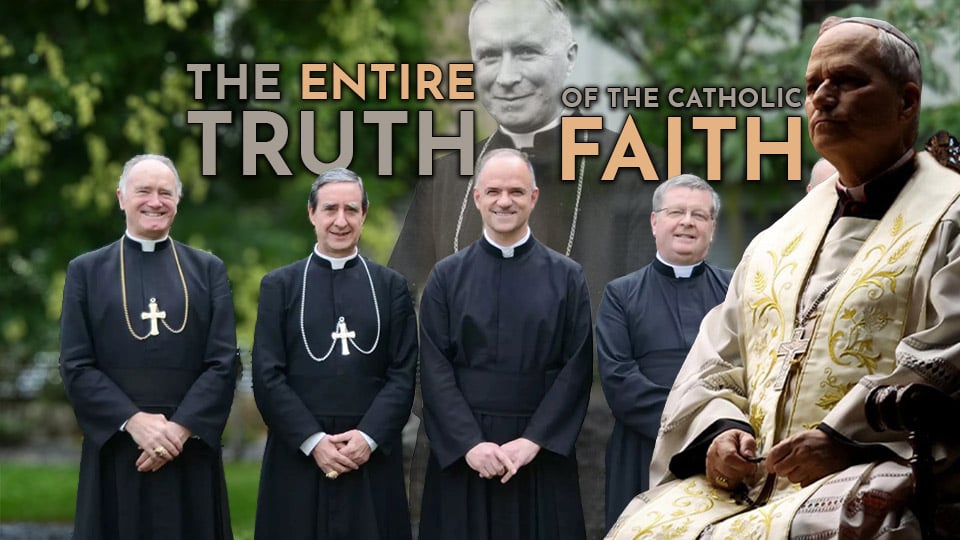

On June 24, 2026, the Society of St. Pius X (SSPX) published a Profession of Catholic Faith of the Society of Saint Pius X to Enlighten Souls in the Face of Modern Errors, a 28-page document consisting of 154 articles. As the document’s title suggests, the various articles set forth truths of the Catholic Faith with corresponding rejections of the errors that oppose those truths. For most Traditional Catholics, the document will be a joy to read; for those in the Vatican, it will presumably be baffling and aggravating.
While Catholics ought to read the document in its entirety, it is worth highlighting one article here because it offers a key to understanding the entire crisis in the Catholic Church. Here is Article 72:
“I therefore reject every claim to invoke the Holy Ghost in order to justify doctrinal adaptations that break with Tradition, moral reversals, or synodal procedures by which what the Church has received from God is put in question. The Spirit of truth cannot today inspire the contrary of what He inspired yesterday. He does not invite the Church to listen to the world in order to receive its aspirations from it; on the contrary, He impels her to teach the world, to convert it, and to sanctify it. His work consists neither in stirring up anarchic inspirations, nor in encouraging doctrinal creativity, nor in grounding spiritual life upon the search for extraordinary charismatic phenomena; it consists in guiding souls by enlightening their faith and defending them against their spiritual enemies, in order to complete in them the work of their salvation and to lead them into the light of eternity.”
The SSPX must reject this error because it has been invoked to justify all of the changes in the Catholic Church flowing from Vatican II. Consequently, if the SSPX is right to reject this error, then the ultimate defense of every innovation flowing from the Council is invalid.
The Holy Spirit was promised to Peter’s successors not to reveal new doctrine, but to guard faithfully the Deposit of Faith.
To appreciate the significance of this Article 72, we can briefly consider certain important supports for the SSPX’s rejection of the error as well as certain important manifestations of the error since the Council.
Catholic Tradition Against This Error
The First Vatican Council’s Pastor Aeturnus tells us that the Holy Ghost aids the popes in safeguarding the Faith rather than making new doctrines:
“For the Holy Spirit was promised to the successors of Peter not so that they might, by His revelation, make known some new doctrine, but that, by His assistance, they might religiously guard and faithfully expound the revelation or deposit of faith transmitted by the apostles. Indeed, their apostolic teaching was embraced by all the venerable fathers and reverenced and followed by all the holy orthodox doctors, for they knew very well that this see of St. Peter always remains unblemished by any error, in accordance with the divine promise of our Lord and Saviour to the prince of his disciples: I have prayed for you that your faith may not fail; and when you have turned again, strengthen your brethren.”
This passage compels us to reject any attempt to invoke the Holy Ghost to justify developments in Catholic doctrine that conflict with what the Church has always taught.
Do we side with those claiming the Holy Ghost guides the Church’s self-destruction, or those willing to sacrifice everything rather than betray the Faith?
In addition, St. Pius X rejected the error more broadly in his Oath Against Modernism, by affirming that the Catholic Faith cannot change in a way that departs from the meaning it has always had:
“I . . . . firmly embrace and accept each and every definition that has been set forth and declared by the unerring teaching authority of the Church, especially those principal truths which are directly opposed to the errors of this day. . . . I sincerely hold that the doctrine of faith was handed down to us from the apostles through the orthodox Fathers in exactly the same meaning and always in the same purport. Therefore, I entirely reject the heretical misrepresentation that dogmas evolve and change from one meaning to another different from the one which the Church held previously. . . . I firmly hold, then, and shall hold to my dying breath the belief of the Fathers in the charism of truth, which certainly is, was, and always will be in the succession of the episcopacy from the apostles. The purpose of this is, then, not that dogma may be tailored according to what seems better and more suited to the culture of each age; rather, that the absolute and immutable truth preached by the apostles from the beginning may never be believed to be different, may never be understood in any other way. I promise that I shall keep all these articles faithfully, entirely, and sincerely, and guard them inviolate, in no way deviating from them in teaching or in any way in word or in writing. Thus I promise, this I swear, so help me God. . .”
Even though this does not mention the inspiration of the Holy Ghost, there is no way to interpret it other than as rejecting the notion that one could invoke the Holy Ghost for justifying doctrinal adaptations that break with Tradition.
The SSPX’s “schismatic” mindset in 1988, as now, was simply their agreement with Vatican II’s admonition to “hold fast to the traditions which they have learned either by word of mouth or by letter.”
Modern Usage of the Error
Despite the fact that the Church has always held the same position set forth by Article 72 of the SSPX Profession of Catholic Faith, the error of invoking the Holy Ghost to justify errors has been an essential component of the ongoing crisis. Although this is most evident today with the blasphemous invocations of the Holy Ghost in connection with the Synod on Synodality, we can see a far more subtle use in John Paul II’s 1988 apostolic letter denouncing the SSPX, Ecclesia Dei Adflicta:
“The root of this schismatic act can be discerned in an incomplete and contradictory notion of Tradition. Incomplete, because it does not take sufficiently into account the living character of Tradition, which, as the Second Vatican Council clearly taught, ‘comes from the apostles and progresses in the Church with the help of the Holy Spirit. There is a growth in insight into the realities and words that are being passed on. This comes about in various ways. It comes through the contemplation and study of believers who ponder these things in their hearts. It comes from the intimate sense of spiritual realities which they experience. And it comes from the preaching of those who have received, along with their right of succession in the episcopate, the sure charism of truth.’”
John Paul II believed that the SSPX was wrong in 1988 because they had not properly taken into account the way that Tradition “progresses in the Church with the help of the Holy Spirit” (quoting Vatican II’s Dei Verbum). Tellingly, though, John Paul II’s quotation from Vatican II’s Dei Verbum left out the language immediately above the passage he cited:
“And so the apostolic preaching, which is expressed in a special way in the inspired books, was to be preserved by an unending succession of preachers until the end of time. Therefore the Apostles, handing on what they themselves had received, warn the faithful to hold fast to the traditions which they have learned either by word of mouth or by letter (see 2 Thess. 2:15), and to fight in defense of the faith handed on once and for all (see Jude 1:3).”
This key idea from the Council was problematic to John Paul II for the same reason that it is problematic to Leo XIV today: it leads the SSPX to resist the Vatican II revolution.
The SSPX’s “schismatic” mindset in 1988, as now, was simply their agreement with Vatican II’s admonition to “hold fast to the traditions which they have learned either by word of mouth or by letter.” However, this key idea from the Council was problematic to John Paul II for the same reason that it is problematic to Leo XIV today: it leads the SSPX to resist the Vatican II revolution.
Closer to the Council itself, Paul VI had this to say about the work of the Holy Ghost in changing the religion:
“Was it not an inner renewal of this kind that the recent Council fundamentally desired? Assuredly we have here a work of the Spirit, a gift of Pentecost. One must also recognize a prophetic intuition on the part of our predecessor John XXIII, who envisaged a kind of new Pentecost as a fruit of the Council. We too have wished to place ourselves in the same perspective and in the same attitude of expectation. Not that Pentecost has ever ceased to be an actuality during the whole history of the Church, but so great are the needs and the perils of the present age, so vast the horizon of mankind drawn towards world coexistence and powerless to achieve it, that there is no salvation for it except in a new outpouring of the gift of God. Let Him then come, the Creating Spirit, to renew the face of the earth!” (Paul VI, Gaudete In Domino, May 9, 1975)
By the time the Paul VI wrote these words in 1975, it was already perfectly clear that the “new Pentecost” had devastated the Church. How, then, was it not blasphemy to say that the Holy Ghost had guided that devastation?
We can see the same blasphemous invocation of the Holy Ghost from Francis’s opening address of the Synod on Synodality:
“Dear brothers and sisters, may this Synod be a true season of the Spirit! For we need the Spirit, the ever new breath of God, who sets us free from every form of self-absorption, revives what is moribund, loosens shackles and spreads joy. The Holy Spirit guides us where God wants us to be, not to where our own ideas and personal tastes would lead us. Father Congar, of blessed memory, once said: ‘There is no need to create another Church, but to create a different Church’ (True and False Reform in the Church). That is the challenge. For a ‘different Church,’ a Church open to the newness that God wants to suggest, let us with greater fervour and frequency invoke the Holy Spirit and humbly listen to him, journeying together as he, the source of communion and mission, desires: with docility and courage. . . Come, Holy Spirit! You inspire new tongues and place words of life on our lips: keep us from becoming a ‘museum Church,’ beautiful but mute, with much past and little future. Come among us, so that in this synodal experience we will not lose our enthusiasm, dilute the power of prophecy, or descend into useless and unproductive discussions. Come, Spirit of love, open our hearts to hear your voice! Come, Holy Spirit of holiness, renew the holy and faithful People of God!” (Francis, Address for the Opening of the Synod, October 9, 2021)
For those with eyes to see, it was obvious from the beginning of the Synod on Synodality that it was an unholy farce — one from hell, designed to lead souls to hell. And yet Francis invoked the Holy Ghost to promote it, and Leo XIV perpetuates it.
One could unfortunately write a lengthy book detailing the various ways in which the Synodal Church has invoked the Holy Ghost to justify anti-Catholic errors, but these few examples should suffice to demonstrate the following pattern (discussed in a 2023 article):
- The progressives introduce anti-Catholic novelties;
- To convince skeptical Catholics of the orthodoxy of the novelties, the progressives insist that the Holy Ghost has inspired them;
- When faithful Catholics argue that the Church cannot actually promulgate teachings that contradict what the Church has always taught, the innovators (and those who have been duped by them) argue that opposition to the pope and the Council calls into question the entire teaching authority of the Church; and
- Faithful Catholics must respond by pointing to the way(s) in which the innovations in question do not actually enjoy the protection of the Holy Ghost.
Does this mean that the Holy Ghost has abandoned the Catholic Church? By no means! The assistance of the Holy Ghost today is exceptionally clear in two ways: He assists all Catholics determined to adhere to what the Church has always taught, and He permits a very visible and painful demonstration of how evil the Vatican II-inspired innovations have been. Fr. Álvaro Calderón may have expressed this latter point best in his Prometheus: The Religion of Man:
“The Holy Spirit does not always prevent the necessary consequences of our negligence.” (p. 201)
By seeing the necessary consequences of the evils of Vatican II, we should be more convinced than ever of the need to adhere to the unadulterated Catholic Faith, which the pre-Vatican II popes sought to defend against the errors detailed in the SSPX Profession of Catholic Faith. The SSPX understands this, and the Vatican does not. And so in a real sense, the choice of sides in this matter should not be as difficult as some would have us believe: do we side with those blasphemously claiming that the Holy Ghost is guiding the self-destruction of the Church, or do we side with those willing to sacrifice their lives rather than betraying the Faith the Holy Ghost still safeguards today? Immaculate Heart of Mary, pray for us!