
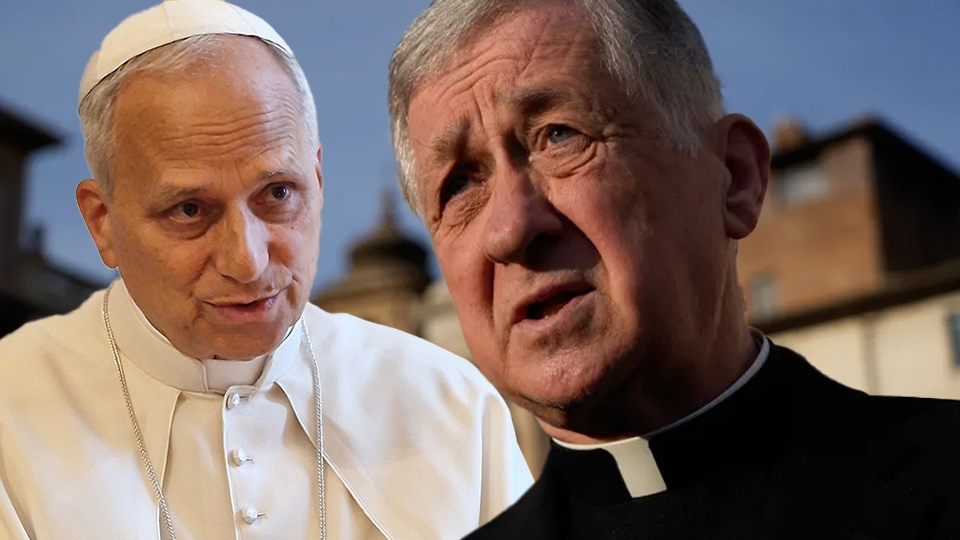

On October 15, 2025, Pope Leo XIV appointed Cardinals Blase Joseph Cupich (Chicago, United States of America) and Baldassare Reina, Vicar General of His Holiness for the Diocese of Rome, as Members of the Pontifical Commission for the Vatican City State. The two new appointments replace Cardinal Leonardo Sandri and Robert Francis Prevost.
At the same time, the Pope confirmed for the current term the following Members of the same Commission: Cardinal Kevin Joseph Farrell (Prefect of the Dicastery for the Laity, Family and Life); Cardinal Arthur Roche (Prefect of the Dicastery for Divine Worship and the Discipline of the Sacraments); Cardinal Lazarus You Heung-sik (Prefect of the Dicastery for the Clergy); and Cardinal Claudio Gugerotti (Prefect of the Dicastery for the Eastern Churches).
What is this Commission? It is the legislative body of Vatican City — a distinct institution that operates under the authority of the Pope as Sovereign of the Vatican City State, not as the supreme authority of the Catholic Church. In other words, it is not an organ or dicastery of the Roman Curia, but rather an instrument of the Pope’s temporal governance.
The Commission proposes laws and regulations for the City in areas such as security, health, environment, economy, postal and customs services, and the protection of cultural heritage. Composed of cardinals directly appointed by the Pope, it currently includes six members. According to the Fundamental Law of the State, recently revised by Pope Francis, the governance of the City should be entrusted to a cardinal. Yet Francis chose to override his own provision — one of Bergoglio’s many contradictions — and appointed a nun, Raffaella Petrini, as its head.
If anything, the appointment is problematic because it generates non-negligible legal conflicts, for which Pope Francis has consistently declined to offer solutions.
This appointment (which I previously discussed here) does not, in fact, raise issues either because it concerns a woman or due to its evident contradiction with the Fundamental Law. The role in question is not ecclesiastical but political, and the Pope is absolute — that is, unbound — when it comes to human positive law, while he remains subject to divine and natural law. If anything, the appointment is problematic because it generates non-negligible legal conflicts, for which Pope Francis has consistently declined to offer solutions.
Returning, however, to the appointment of the two new members of the Commission, it is worth offering some reflections and analysis. The Pope is finally addressing appointments to key positions — both curial and non-curial — within the Vatican. Following the motu proprio aimed at dismantling the IOR monopoly initiated by Francis (which I spoke about here), and the long-awaited appointment of the Prefect for Bishops (my analysis here), it is now the turn of the Vatican Legislative Commission.
These are two significant appointments involving Blaise Cupich, a longtime friend of Pope Prevost (let us not forget the Pontiff hails from Chicago), and Baldassarre Reina. What stands out is that these appointments come in the wake of the Durbin Affair, from which Pope Prevost attempted to distance himself — rather clumsily, it must be said — creating a doctrinal mishap that reminded many of the tangled, ill-timed, and indeed deliberately provocative interviews once given by Francis.
The meaning of these appointments is clear: they concern the kind of relationship Pope Leo intends to establish with the Roman Curia — even though, as we’ve reiterated, the appointments in question are not strictly curial but political. We’ve often pointed out how Pope Prevost has relied excessively on Francis’s Curia, delegating to it many of the most sensitive matters, such as the Secret Agreements with China, the Traditional Mass, and the disastrous episcopal appointments.
Perhaps Leo intends to devote time and energy to each of these issues. What is certain, however, is that Francis’s curial allies are wasting no time.
By elevating the controversial Cupich to a key role in the temporal governance of Vatican City, one could say that Pope Leo XIV has, in a sense, “locked down” the Curia. At first glance, this might seem contradictory — but Vatican political and institutional logic is more subtle.
The Pontifical Commission for Vatican City State is indeed a “civil” and political body, yet its operations and real influence indirectly affect the Roman Curia. It manages the administrative and financial levers of the microstate — that is, the material and logistical structures through which the Curia itself functions (think buildings, security, infrastructure, state funds, services).
Moreover, the Commission works daily with the Governorate, the State’s executive body, which interacts constantly with the curial Dicasteries. As is well known, appointments to the Commission often reflect internal power balances.
In this context, it is therefore evident that the appointment of Cardinal Blase Cupich — a figure closely aligned with the Bergoglian line — and of Baldassare Reina, likewise a trusted man of the previous pontificate, should be interpreted as Pope Leo XIV’s intention to retain within the Vatican’s “administrative circle” individuals shaped by the school and vision of Francis.
Let us not forget that Bergoglio (backed by the St. Gallen Group) sought to “reform” not only the Catholic Church as a divine-human institution founded by Jesus Christ, but also the Vatican’s political and temporal structure, aiming to make it more akin to modern Western states (democratic, parliamentary) and more palatable to major international bodies such as the European Union and the United Nations — institutions in which Francis placed great trust and which he regarded as the ultimate legitimate arbiters of social matters.
Although the Commission is not formally part of the Curia, its “Bergoglian” members remain in positions from which they can oversee, influence, or even steer the material and political management of the Vatican State — making it difficult for Leo XIV to carry out a deep reform of the Curia without their influence.
These are not curial appointments in law, but curial in effect. Let us not forget that the remaining members of the same Commission confirmed by Leo — namely Farrell, Roche, Gugerotti, and Heung-sik — belong to the same ideological line.
At this point, one naturally wonders about the role Cupich may have played in Prevost’s rise to the papacy, a suspicion partly confirmed by the Archbishop of Chicago himself: in a recent interview, with his usual ironic tone not devoid of self-satisfaction, he jokingly remarked, “You cannot pick the Pope, but I can and I did”.
A remark made lightly, yet one that perhaps betrays an awareness of real influence. The relationship between Cupich and Prevost is longstanding and built on mutual respect. Prevost displays toward Cupich an attitude of deep trust — at times bordering on gratitude — and more than a few in Rome have observed how the positions of one often echo, in a more subdued tone, the pastoral and disciplinary lines of the other.
One is left to wonder how much Cupich’s influence weighed on the more conservative or traditionalist bloc of cardinal electors — think, for instance, of Dolan, Burke, and other voting cardinals who, while doctrinally distant from Cupich’s orientation, may nonetheless have been swayed by his persuasive force. Cupich, after all, is an affable figure, courteous in manner, endowed with natural self-assurance and consistently measured in speech. He has the ability to build consensus even where his theological positions are unwelcome.
It is therefore legitimate to ask whether, with due distinctions, something similar occurred in the 2025 Conclave to what happened in 2013 — when progressive cardinals managed to persuade several conservative electors of Cardinal Bergoglio’s supposed “moderation”, a belief later contradicted by events, as even Cardinal Dolan acknowledged. Time will tell.
Cupich’s appointment to the Pontifical Commission for Vatican City State appears not merely as a prestigious recognition, but as a move that consolidates the presence of a key figure within the network of relationships surrounding the new Pontiff. A gesture which, if read attentively, helps illuminate the dynamic by which Leo XIV is reconfiguring the internal balance between the Curia and the Vatican State: a still-fragile equilibrium, in which Cupich represents a decisive node.
As a side note, one might add a symbolic reflection. A photograph of Cardinal Cupich recently circulated, showing him wearing the ceremonial ferraiolo [see image below]. For those familiar with his stance on traditional liturgy, the image inevitably provokes a certain curiosity. It’s a paradox typical of progressives: a lack of affection for Tradition, yet an appreciation for its formalism.
Indeed, it is often in these outward forms that many neo-modernist prelates — perhaps unwittingly — encounter a seductive force: the ancient garb captivates, even when deemed outdated. And this fascination, though doctrinally hollow, can carry significant human and psychological weight, capable of winning over more than one interlocutor.
Pope Leo XIV, as a man of governance and discernment, will surely be able to assess whether this influence serves or hinders his efforts.