

“For the second time, let the Americas hear this holy cry: I die, but ‘God does not die!’ Viva Cristo Rey!” Anacleto shouted, echoing the final words – “Dios no muere!” – of Gabriel Gregorio Fernando Jose Maria Garcia Moreno y Moran de Butron (1821-75), the assassinated president of the Republic of Ecuador.
But the revolution does require of the revolutionary class that it should attain its end by all methods at its disposal – if necessary, by an armed rising: if required, by terrorism. – Leon Trotsky, from “The Defense of Terrorism”
SLOWLY, THE DEAD car rolled to a stop in a city with blood-soaked streets.
Stranded in a bustling intersection – in the heart of Guadalajara, just blocks from the Government Palace that fortified a savage kakistocracy – the occupants felt an overwhelming terror.
All dreaded arrest – and worse – if caught transporting a fugitive from injustice: Jose Anacleto Gonzalez Flores (1888-1927), wanted by authorities as one of the civilian leaders of the Cristero War, the expanding and exploding Liberation Movement in which he helped coordinate faithful in the peaceful-turned-brutal Christian resistance against the regime’s deadly anti-Catholic campaign.
Fortuitously stuck at the intersection of Herrera y Cairo and Calle Moro (now La Calzada del Federalismo), the men rushed desperately down the block to 405 Calle Mezquitan, in the Capilla de Jesus neighborhood. Standing before the large, single-story home belonging to the Vargas family – devout Catholics known for offering refuge to those seeking sanctuary – they knocked on the front door centered between two tall windows.
The door swung open wide, and the Vargas family greeted their friend and mentor Anacleto, warmly embraced him, welcomed him into their home, and he disappeared inside, safe and secure.
It was Sunday, March 27, 1927.
Little Anacleto González Flores
Born in Tepatitlan, Jalisco, into a large family that suffered from extreme poverty, Anacleto began life with very humble beginnings. His parents were Maria Flores Navarro (1869-?), an affectionate mother, and Valentin Gonzalez Sanchez (1862-1944), a difficult father, who earned money as a weaver of rebozos, traditional shawls. Valentin resented his low-rung status as the bastard son of Felipa Sanchez Garcia and Jose Ramon Margarito Gonzalez Gonzalez, a local landowner. Desperate to distance himself and his own growing family from his dishonorable entrance into the world, he worked to elevate his children by instilling in them a strong work ethic and a love of learning, especially literature.
For Anacleto, his fervent Catholicism began at a young age, after attending a series of spiritual exercises given by missionaries visiting Tepatitlan from Guadalajara. The experience ignited a flame in his heart for the Church and Her apostolic mission: the salvation of souls and the spread of the Gospel, the world’s first self-help books. Spiritually inspired, he began each day by attending Mass and kneeling at the Communion rail to receive the Holy Eucharist. As an act of charity, he taught catechism – from the “Catecismo de la Doctrina Christiana,” first published in 1616, by Jesuit Father Jeronimo de Ripaldi (1535-1618) – to the local boys, who referred to him as “Maestro,” a sobriquet that would stick with him throughout his life.
Fortunately, a priest recognized his immense intellectual gifts and recommended that he develop those talents by pursuing higher education at the Auxiliary Seminary of San Juan de los Lagos. He did enroll, in 1908, at the age of 20, and excelled academically, so much so that he often substituted for absent professors and taught the assigned lessons of the day to his fellow classmates, who addressed him as “Maestro Cleto.”
“Maestro Cleto”
Even though the superiors at the seminary acknowledged his great intellect and encouraged him to continue his scholarly work at the Pontifical Latin American College, in Rome, he declined, discerning that the priesthood, for him, was not the Will of God. His vocation and his talents, he believed, lay in the practice of Law. So, in 1913, he finished his education at the seminary, in the mountain town of San Juan de los Lagos, and moved 90 miles to the southwest, to Guadalajara, an intellectual hub with several exemplary higher institutions of learning. In that bustling city of 150,000, he soon began his studies, working toward his future in the legal field.
But, at that time, the nation heaved under great suffering caused by the Mexican Revolution, ignited in 1910, when the never-ending nightmare fell upon the people. Blood flowed in the fields where crops once flourished. Political enemies dangled from trees that once blossomed with fruit. Homes abandoned, once filled with families, chased out by Revolutionary soldiers – culled from the dregs of society – raping and plundering their way through the cities and countryside.
And the Catholic Church – with its wealth and properties, its pro-individual, anti-collectivist tenets, and the long-held belief in the holiness and goodness of all life – stood out as one of the chief enemies of the State. The Bolshevik-inspired government – with its opposition to private-wealth, private ownership and individual self-determination, as well as its ideology of anti-spiritual, anti-human materialism – worked to de-Catholicize Mexico by suppressing the clergy and religious practices.
But the faithful defended their religion and their freedom of worship and rejected the Socialist propaganda.
In 1913, three years into the Revolution and its relentless war and bloodshed, the Church hierarchy sought supernatural intervention, perhaps inspired by Archbishop Prospero Maria Alarcon y Sanchez de la Barquera (1827-1908), who, in 1908, consecrated the nation of Mexico to the Sacred Heart of Jesus, adorned with its symbols of lance, flaming heart, cross and crown of thorns.
The Mexican hierarchy petitioned Pope Pius X (Giuseppe Melchiorre Sarto, 1835-1914) for permission to dedicate Mexico to Christ the King, depicted with a crown and scepter. Granted with a papal blessing, there would be two:
In Guadalajara, despite prohibitions against public religious ceremonies, and even with the constant threat of arrest, Archbishop Francisco Orozco y Jimenez (1864-1936) openly participated in an outdoor procession that preceded the celebration of the formal dedication, in the Cathedral of the Assumption of Our Lady, on Thursday, January 8, 1914.
Two days earlier, on Tuesday, January 6, Archbishop Jose Mora y del Rio (1854-1928) celebrated the consecration in the Metropolitan Cathedral of the Assumption of the Most Blessed Virgin Mary into Heaven, in Mexico City.
Something fortuitous happened.
When the archbishop placed the crown and scepter at the foot of the image of the Sacred Heart of Jesus, the faithful cheered “Viva Cristo Rey!” giving birth to what would become, years later, the battle cry of the Cristeros and, often, the final words of many executed Catholics.
Months after the consecrations to Christ the King, control of Guadalajara was seized, on July 10, 1914, by the Constitutionalist Army of General “Primer Jefe” Jose Venustiano Carranza de la Garza (1859-1920), under the leadership of General Alvaro Obregon Salido (1880-1928), a caudillo from Sonora, and General Manuel Macario Dieguez Lara (1874-1924), an ex-convict who seethed with hatred and rage during and after his incarceration in the political prison of San Juan de Ulua.
The Carrancistas flooded into Guadalajara and hegemonized the populace, imposing martial law, shuttering all courts of justice. Foreign-born clergy as well as religious were deported, and all native clergy and religious were put on notice. By July 22, 82 priests in Guadalajara were arrested, locked up and charged with conspiring against the Fatherland.
Then, expropriation without compensation.
Many outside the political and military vanguard – especially those connected to the Catholic Church – were categorized as enemies of the State and became victims of the militaristic regime, an apparatus for terror. Its generals, inferior officers and other subordinates took whatever they wanted from whomever they wanted, however they wanted.
Apparatchiks grabbed control of the cathedral, where they violated the tombs of the bishops and destroyed the altar rails. All sacred vessels, chalices, jewels, promissory notes and mortgages – worth many millions, paid for by the faithful, for the faithful – were looted.
The archbishop’s palace, the churches, parochial schools and the new seminary were all grabbed, with many repurposed for use by the military. Nuns were ejected from their Society of the Sacred Heart Convent. Priests – from the orders of the Society of Jesus, the Society of Saint Francis de Sales, Los Juaninos and the Congregation of Marian Fathers of the Immaculate Conception – were all forced out of their religious communities.
Dieguez – the appointed military governor of the state of Jalisco – levied a war tax, forced loans that were nothing more than legalized robberies. Residents were assessed and threatened with severe penalties – including forfeiture of properties and even death – if they failed to pay. Also common were arrests on false charges, just to impose exorbitant fines. Bilimbiques, monies printed by the different Revolutionary contingents, caused devaluation of the standard currency. Inflation hit. Wages stagnated. People sold whatever they had, to buy whatever they could for food, for survival.
Asserting claims for the military effort, troops ransacked and pillaged, as a constant flow of edicts demanded guns, money, horses, livestock, flesh.
However, only months after seizing Guadalajara, the Carrancistas were chased out of the city by Francisco “Pancho” Villa (born Jose Doroteo Arango Arambula, 1878-1923) and his band of Revolutionaries. Under the guerrilla leader, the already financially depleted and emotionally exhausted residents continued to suffer in yet another reign of terror. Same whip, different master.
But it wasn’t long before the Carrancistas – the most cruel, the most vicious of all the insurgents – ousted the Villistas and reclaimed the seat of power.
The vacillating rebel factions – whether the government be de jure or de facto – continued to battle in the outskirts of the city for years. The constant warring – with its cannonading, discharges, explosions, gatling guns, profiteering and corruption in and around the urban outskirts – beleaguered residents, robbed of peace, properties, goods, virtues and, often, their very lives.
Executions of civilians were frequent, random and, often, vindictive.
After a violent clash between the Villistas and the Carrancistas, on January 30, 1915, Father David Galvan Bermudez (1881-1915) – a professor at the re-opened Conciliar Seminary of Guadalajara – rushed to administer the Sacrament of Extreme Unction to the wounded and dying soldiers on both sides of the battle. However, on his way, he was stopped by Lieutenant Enrique Vera, who held a grudge against the priest for stopping him when he was sexually harassing a young woman. After detaining the priest, Vera ordered his immediate execution. Standing in front of the firing squad, the priest refused a blindfold and calmly pointed to his chest, which soon received a hail of bullets.
In reaction to the persecution by the Revolutionaries, Catholic groups started springing up.
One of the most consequential was that of the Mexican Catholic Youth Association (Asociacion Catolica de la Juventud Mexicana), first established, on August 12, 1913, in Mexico City, by Father Bernardo Bergöend, (1871-1943, Society of Jesus), a French Jesuit dispatched to Mexico to organize Catholic youth to restore Christian social order, under the trinity of piety, study, action.
Three years later, while studying for his law degree, Anacleto established a branch of the Association, in Guadalajara, on July 17, 1916. Members, known as Acejotaemeros, held study circles focused on religion, apologetics and Church doctrine. With activities and publications, they promoted religious and political freedom and Chistian order in the family as well as in society, a response to the government’s promotion of fanatical anti-Catholicism and anti-clericalism, an ongoing factor since the War of Reform (1857-61).
And then, on February 5, 1917, religious persecution accelerated even more so with the illegal ratification of the 1917 Political Constitution of the United Mexican States, which contained five articles that specifically targeted, criminalized and eliminated certain aspects of the Church: Article 3 (Catholic schools), Article 5 (monastic orders), Article 24 (public worship), Article 27 (Church ownership of property), and Article 130 (rights of the clergy). Article 27 also made way for Mexican agrarian land reform – the regime’s legalized seizure of privately owned property to establish ejidos, communal land for peasant collectivism.
Archbishop Orozco y Jimenez penned a pastoral letter in protest of the constitutional usurpation of personal and religious freedoms. Priests who read the pastoral letter in churches were arrested on charges of sedition and their churches seized and searched.
In response, Archbishop Orozco y Jimenez penned, on June 4, 1917, a pastoral letter, a simple protest of the constitutional usurpation of personal and religious freedoms, a negation of God-given, everlasting, natural laws in favor of State-mandated, ever-changing, man-made laws. Subsequently, authorities accused the archbishop of being an arch-traitor to his country for encouraging the faithful to rise up against the constituted government. However, the archbishop wrote nothing about rebelling. To the contrary, he encouraged the faithful, among other charitable considerations, to “love virtue and detest vice; also, to walk always in holy dread of God, and to encourage the hope of better times.”
Wherever the clergy read the pastoral letter in churches, on June 24, those priests were arrested on charges of sedition and their churches seized and searched.
For Anacleto, the newly written Constitution caused a major glitch in his life, because it decreed that only class credits issued by State schools – not religious schools – were valid. Disappointed, but not daunted, rather than give up his dream of becoming an attorney, he began his studies all over again, at the age of 30. Dedicated and determined, he revalidated his baccalaureate, after five years, and, finally, obtained his law license, in April 1922.
That same year, on November 17, after four years of courtship and the daily exchange of romantic love letters, Anacleto and Maria Concepcion Guerrero Figueroa – who had been a poor orphan as a child – married, settled in Guadalajara’s Capilla de Jesus neighborhood and were blessed with two children.
Although he had a busy home life and work life, he still remained very active in the Liberation Movement. El Maestro had truly found his vocation.
In 1924, he established the Popular Union, an organization to better coordinate Catholics to peacefully resist their persecutors. He had been inspired by the People’s Association for Catholic Germany (Volksverein fur das Katholische Deutschland) that countered heretical and revolutionary tendencies and defended Catholic order – protecting human rights and human dignity – in society. Volksverein had been created by Ludwig Windthorst (1812-91), on October 24, 1890, in response to the former Imperial Chancellor of the German Empire, Otto Eduard Leopold von Bismarck-Schonhausen (1815-98), and his Kulturkampf (Culture War, 1871-78) that attacked the Church.
In March 1925, the National League for the Defense of Religious Freedom (Liga Nacional Defensora de la Libertad Religiosa) was founded, in Mexico City, as an umbrella organization for all Catholic groups, dedicated to defending the faith and educating the faithful. After learning about the League, Anacleto dispatched a telegram to headquarters, on March 24, requesting that the Popular Union join the League, although keep its name and autonomy.
A natural leader and charismatic, Anacleto used the power of the podium with speeches and the power of the press with pamphlets to encourage support for those fighting oppression. For his consistent dedication to free religion from the shackles of Socialism, Anacleto received from the Holy See, in May 1925, the Pro Ecclesia et Pontifice Cross, known as the Cross of Honor, an acknowledgement of distinguished service to the Catholic Church and to the Bishop of Rome, Pope Pius XI (Ambrogio Damiano Achille Ratti, 1857-1939).
Perhaps inspired by the Mexican bishops, who were the first to consecrate their country to Christ the King, in 1914 – that same Pontiff, Pope Pius XI, decreed, on December 11, 1925, the establishment of an annual Feast of the King of Peace, whose reign is a spiritual kingdom concerned with spiritual matters in the hearts and wills of man. The edict, announced in “Quas Primas: Encyclical of Pope Pius XI on the Feast of Christ the King,” was an effort to battle worldwide anti-clericalism.
In 1926, persecution escalated and forced the Church underground, after the Mexican president – the self-proclaimed Catholophobic Bolshevik, Plutarco Elias Calles (born Francisco Plutarco Elias Campuzano, 1877-1945) – issued his own decree: the Law Reforming the Penal Code, euphemistically known as the Law of Religious Tolerance, but most commonly called Calles Law.
The head of State plotted major actions against the Church. His scheme: Close churches. Plant secular schools. Implant immorality. Install Socialism. Put an end to Catholicism.
Two weeks before the legislation was to go into effect, authorities executed a priest, for continuing to shepherd his flock. They also executed three of his parishioners, members of the Association working to free their spiritual leader after his arrest. The killings were carried out at El Puerto de Santa Teresa, about a mile outside the town of Chalchihuites, in the state of Zacatecas, on August 15, 1926, the Feast of the Assumption of the Blessed Virgin Mary.
After arrested and driven to the middle of nowhere, Father Luis Batiz Sainz (1870-1926), Manuel Morales Cervantes (1898-1926), cousins Salvador Lara Puente (1905-1926) and David Roldan Lara (1907-1926) were ordered out of the two vehicles and given an ultimatum:
“We offer you freedom. All you need to do is acknowledge the legitimacy of the anti-religious laws of President Plutarco Elias Calles. That’s all you need to do,” their captors said.
Devout Catholics, all four refused.
During the Revolution, soldiers from one insurgent camp would confront a stranger with, “Quien vive?” to determine on whose side the stranger stood. Depending on the answer – “Viva Villa!” or “Viva Carranza!” or whomever – the respondent could either escape death or face execution.
Catholics had their own response.
The priest and his three parishioners, on the side of road, facing their executioners, loudly cheered one last time, “Viva Cristo Rey!” as they were gunned down.
As a result of the sheer depravity and senselessness of that mass murder, many faithful Catholics in Mexico found themselves, onetime pacifists, turned into bellicists, pushing the outbreak of the Cristero War.
Rene Capistran Garza (1898-1974) – the national leader of the Association – issued his “Manifesto to the Nation,” in which he announced the start, on January 1, 1927, of the armed rebellion of the Cristeros’ National Guard, the paramilitary branch of the Liberation Movement, with its motto: God, Country and Freedom.
On January 5, Anacleto kissed his wife goodbye and left behind his little family and loving home to coordinate action on the warfront, in particular, the distribution of arms and ammunition to the Cristeros in Los Altos, the Highlands of Jalisco. However, it wasn’t long before he was on the run, rushing from safehouse to safehouse, trying to evade authorities, until he found refuge in the home of the Vargas family.
The welcoming of Anacleto into their home was an extraordinary act of bravery by a family in a city where authorities terrorized residents, especially Catholics, who knew and understood the pervasive dangers they faced and feared daily.
Originally from Ahualulco de Mercado, 50 miles west of Guadalajara, in Jalisco’s upper basin of the Ameca River – the Vargas family suffered, like others around them, after the outbreak of the Revolution.
Outside the cities, Revolutionary bandit soldiers overran towns, villages, haciendas, rancheros, inflicting fear, forcing the populace into submission, and fleecing their victims of all they owned. Asserting claims for the military effort, troops ransacked and pillaged, as a constant flow of edicts demanded guns, money, horses, livestock, flesh. Outrageously high taxes were ordered on anyone with any property, and if not paid on time, usually very short notice, properties were forfeited, and, sometimes, owners were executed to clear the way for the new owners: local military leaders.
Growing crops were trampled by soldiers and their horses. Livestock was slaughtered, butchered and cooked for troops. And despite the near-famine conditions in many towns and villages, whatever crops and livestock commodities could be harvested were packed up and shipped off to the highest bidder in foreign markets.
Though the wealthy – and even the not-so-wealthy – were skinned financially, it was the poorest farm laborers who suffered and starved the most after landowners lost their farming properties. Because many of the labor families had worked on the same land for generations, they depended on the owners, the hacendados, for their food, clothing and shelter. So destitute, some were reduced to walking around in gunnysacks with neck holes and armholes, or nothing but a skimpy breechcloth. Some wore no clothing on at all.
With the desperate situation in the countryside, the very close-knit Vargas family decided they should seek better opportunities for their 12 children, especially regarding education. So, in 1914, the matriarch, Elvira Gonzalez, moved with her large brood from Ahualulco de Mercado to Guadalajara, leaving behind their father, her husband, Antonio Vargas, so he – a medical doctor – could continue his practice.
As the years and persecution progressed, the Vargas family bravely began offering their Guadalajara home as a place of sanctuary to priests, seminarians and other Catholics seeking refuge from the regime.
One of those was Anacleto, after he knocked on their door, March 27, 1927.
Anacleto shared a bedroom with one of the six Vargas brothers, Jorge Ramon Vargas Gonzalez (1899-1927), who had an extra bed in his room. Jorge worked for the Jalisco Hydroelectric Company as an accountant, and he had a girlfriend, whom he planned to marry. A devout Catholic, he attended Mass and Confession frequently, prayed the rosary each day, and joined the Association, where he grew to know and admire Anacleto, whom he adopted as his role model.
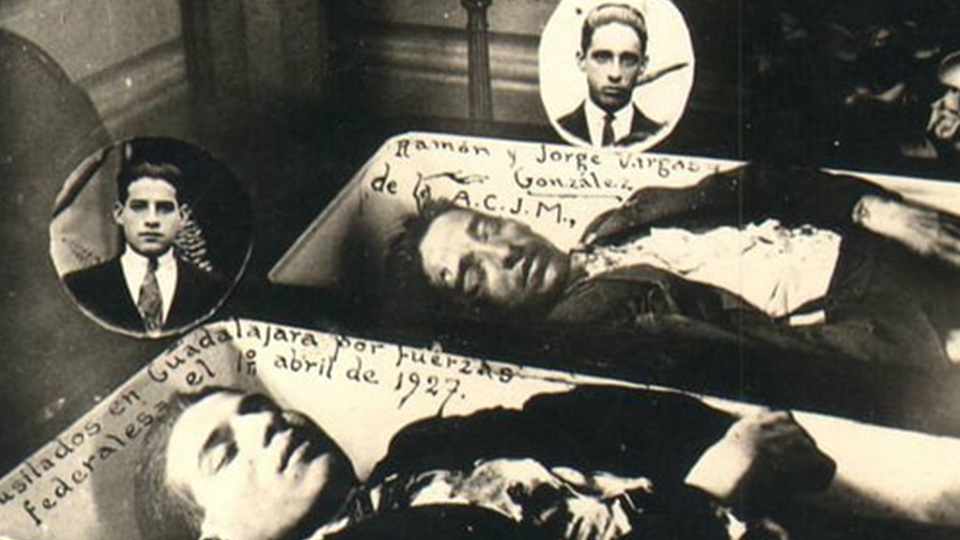
Vargas González Family… a family that gave two Cristero Martyrs: Jorge and Ramón, murdered by the government on April 1 1927 along with Mr. Ana.
Another brother was Ramon Vicente Vargas Gonzalez (1905-1927), nicknamed “Colorado” for the reddish color of his hair. Naturally happy with a joie de vivre personality, tall and athletic, he loved to play basketball. Following in the footsteps of his father and his brother Francisco Vargas Gonzalez, in 1923, Ramon entered Medical School, where he faced intense hostility aimed at Catholics. Not intimidated, he became active in the Association, where he met and befriended Anacleto. Dedicated to the Church and the Sacraments, he prayed the rosary each day, and, as soon as his studies enabled him, he practiced acts of charity by caring for the impoverished for free.
After returning home one morning from a sick call, he greeted Anacleto.
“Good morning, Maestro,” Ramon said.
“Where are you coming from so early in the morning, Colorado?” asked Anacleto, who, while in hiding, wore the clothing of a worker, grew his beard out and left his hair uncombed and unkempt.
“Oh, I’ve just come from treating the son of a poor woman.”
“What’s wrong?”
“He’s in very bad shape. He might lose his leg,” Ramon said of his charity patient, Antonio Quintero.
“How much do you charge each time you go?”
“Maestro, not a cent. Poor old woman! She is in great need. No, no. I go with great pleasure, and it also gives me practice.”
“What year are you in medical school?”
“In the fourth year. I’m going into the fifth year.”
“Listen, Colorado, come with us to the hills to heal our wounded. Look, I’ll make you a captain. You would help us a lot. You would be serving God and the Fatherland.”
“No, Maestro. I don’t like that. I am a man of peace. No, I don’t understand any of this. Besides, I have a lot of hope for my career. Look, to show you that I appreciate you, if they attack you, or if something happens, I’ll bandage your head, your legs, your arms, I’ll give you a cane, and that way, I’ll get you out of harm’s way and keep you safe, and then I’ll escape. But no fighting. That’s for sure.”
Anacleto gave him a look of recognition, and Ramon, humming a tune, walked off toward his room to study.
On March 31st, a priest visited the Vargas family. After Anacleto received the Sacrament of Penance, he and the priest discussed Archbishop of Jose Maria Gonzalez y Valencia (1884-1959), who made public his approval of armed defense, in his famous pastoral letter of February 11, 1927, “Outside the Flaminian Gate”:
“We never provoked this armed movement. But once, having exhausted peaceful means, this movement exists. To Our Catholic sons who are up in arms in defense of their social and religious rights, after having thought about it at length before God and having consulted the wisest theologians of the city of Rome, We must say: Be calm in your conscience, and receive Our blessings.”
Anacleto told the visiting priest, “This is what we were missing. Now we can rest easy. God is with us.”
Inspired by the bishop of Durango, Anacleto returned to the room he shared with Jorge and started to work on a piece for The Gladium, one of his many publications:
“Blessings to the brave, who defend the Church of God with arms in hand. Curse to those who laugh, rejoice, and amuse themselves, being Catholics, in the midst of the immeasurable pain of their Mother. Curse to the lazy, the stingy rich, the clowns who know nothing more than to accommodate themselves and criticize others. The blood of our martyrs weighs immensely on the scales of God and of men.
“The spectacle offered by the defenders of the Church is simply sublime. Heaven blesses it; the world admires it; hell, full of rage and astonishment, sees it; the executioners tremble. Only cowards do nothing; only the critics do nothing but criticize; only the unruly do nothing but hinder; only the rich close their hands to keep their money, that money that has made them so useless and so unhappy.”
Already well past midnight, he penned his prescient, final written words:
“Today we must give God a strong testimony that we are truly Catholics. Tomorrow it will be too late, because tomorrow the lips of the brave will open to curse the lazy, the cowardly and the apathetic.
“There is still time for all Catholics to fulfill their duty. The rich should give, the critics should hold their tongues, the unruly should sacrifice, the cowards should cast aside their fear, and everyone should stand up, because we are facing the enemy, and we must cooperate with all our strength to achieve the victory of God and His Church.”
At 3 in the morning, he took a break.
By then, Ramon had quietly arrived home, around midnight.
Earlier, while at the nearby Civil Hospital, after playing a game of basketball, he had a conversation with his teammate Rodolfo “Pericles” Perez, a friend and classmate.
“What’s wrong with you, Colorado? Why didn’t you play the basketball game with as much enthusiasm as other times?” Perez asked.
“I don’t know,” Ramon answered. “I don’t really know what’s wrong with me. I don’t want to go home to sleep.”
“Well, don’t go. Stay at the hospital.”
“That’s a great idea, because I’m afraid to go home.”
“Afraid of what?”
“Well, that’s just it. I don’t know,” Ramon said, smiling, “but my mother and my brothers would be worried if I don’t go home.”
“Don’t be afraid,” Ramon interrupted, turned toward a window that looked into the garden and climbed up to get a better look. “If we die, our blood will wash away our sins. Honestly.”
“Well, whatever you want.”
“Yes. Bye-bye.”
Ramon left for home, where he slipped into bed and fell asleep.
Hours later, at 5 in the morning, on April 1, 1927, someone knocked at the window located in a corner of the property on Mezquitan Street and Herrera y Cairo, where the family ran El Tepeyac Pharmacy, a drugstore managed by one of the six sisters, Lupe Vargas Gonzalez.
“What can I help you with?” Mama asked from inside. As usual, she was already up at 4, to pray the rosary.
“We want some medicine,” someone answered.
“Ramon, come here. They want some medicine,” she called, trying to rouse him from slumber.
“Tell them no, Mama. I was studying and came home late last night.”
“Poor people. See what they want.”
“Okay. I’ll go see.”
“But don’t go to the door. Something might happen to you. Go to the window.”
By then, unbeknownst to the Vargas family, authorities had already scaled the walls that surrounded the property.
Ramon went to one of the windows – which were all barred – and from inside, he asked, “What do you need?”
“A shot of camphor,” someone answered.
Ramon retrieved the camphor.
“Here it is,” he said, receiving two coins in exchange and then retreated from the window.
But, then, more knocks. This time on the entrance door on Calle Mezquitan. Louder. Pounding. More frequent.
“What do you want?” asked Mama.
“Madam, open the door, in the name of the law. We have a search warrant.”
“Yes, I am bringing the key,” she answered, as she rushed to Jorge’s room, where Anacleto lay in his bed.
“They’re here! Jump over the garden fence! Hurry up!” she encouraged.
Visibly shaken, a resigned Anacleto said nothing, did nothing, fully aware of the dire situation. His death sentence had already been handed down, in absentia.
“But Mama,” Jorge said, “they’re already here.”
“Where? Where? I can’t see them,” she said, without her eyeglasses.
“There, Mama, up there. Look,” he said, pointing toward a wall dividing the first and second patios, where one of the secret police agents stood, pointing his handgun.
“Don’t believe it! Don’t listen to Jorge. Hurry up! Quickly, quickly!” she said.
Another one of her sons, Florentino Vargas Gonzalez, a law student, stood at the front door, asking, “Where is the search warrant?”
“Here it is,” announced Graciano Ochoa, pulling out his gun.
Florentino reluctantly opened the door, and the secret police dressed in plain clothes flooded the house, as Anacleto left the bedroom.
Torture began. They suspended Anacleto by his thumbs, which dislocated from the forced hyperextension. They scourged his back. With razor-sharp knife blades, they cut slices into the soles of his feet.
“Where are you going?” someone shouted from above. “If you take one more step forward, I’ll kill you!”
Anacleto stepped back and took cover under the dining room table, where he ripped up a piece of paper into tiny pieces.
In charge of the operation, Atanasio Jarero, police chief of the state of Jalisco, entered the dining room, bent down and grabbed Anacleto by the front of his pants, pulled him out, straightened him up and shook him.
“Got him!” Jarero shouted, which signaled to others to begin the search, during which they investigated each drawer, closet, cupboard, chest, inside, outside, over, under.
Anacleto stood, with his hands clenched together, tightly.
“What do you have in that hand?” Jarero demanded.
“Nothing.”
“What do you mean nothing?”
Anacleto opened his clenched hand to reveal tiny bits of torn paper.
“What is that letter? Talk!” Jarero ordered, smashing the butt of his .45-caliber pistol into Anacleto’s shoulder. “You’ll talk later.”
Ramon approached Jarero and said, “Whatever concerns El Maestro, don’t hit him. Whatever has to do with him, take it out on me.”
“I have something for you, too,” Jarero responded, turning on Ramon, bashing his arm with the .45.
With a shrug and a look of contempt, Ramon turned, left the house and walked over to the corner, but soon returned when he saw authorities place his mother and sisters in a police van, commonly referred to as “La Julia.”
“Ramon! Bring a sweater for Nena. Look how she is shaking,” Lupe called, for their baby sister Maria Luisa Vargas Gonzalez, who was in the fifth grade.
One of the secret police guarding the entrance door scuffled with Ramon, shoved him against the wall, cutting a gash in his upper lip. Nonetheless, Ramon entered and retrieved the sweater for little sister.
Hours passed by the time authorities searched every inch of the premises and transported their suspects. Mother, daughters and Anacleto were driven to the General Police Department. The three Vargas brothers – Jorge, Ramon, Florentino – arrived at the military Colorado Barracks, around mid-morning, locked up in subterranean cells. Damp, filthy, smelly dungeons.
About an hour later, Anacleto arrived, in custody, with Jose Dionisio Luis Padilla Gomez (1899-1927), both moved into a cell across from the Vargas brothers. Luis had been arrested hours earlier, at 2 a.m. While peacefully sleeping, his home was surrounded by authorities, who barged in and dragged him out of bed, under the direction of Major General Jesus Maria Ferreira Knappe (1889-1938), federal chief of Jalisco Military Operations. Not only was Luis arrested, but so, too, were one of his sisters, Luz Padilla Gomez, and his elderly mother, Mercedes Gomez.
Luis Padilla Gomez
Anacleto and Luis knew each other well.
Jesus Maria Ferreira Knappe
As secretary of Anacleto’s Popular Union, Luis often went on speaking tours, sometimes giving as many as 20 speeches in a single day. Also a member of Catholic Action and the Mexican Catholic Youth Association, his apostolic work was so outstanding, he was awarded the position of president of the Archdiocesan Committee of the Mexican Catholic Youth Association of Guadalajara.
Born in Guadalajara, to Mercedes Gomez de Padilla and Dionisio Padilla, Luis had two sisters. Tragically, when he was still young, his twin brother, as well as their father, died.
On November 1, 1916, Luis met Father Othon Leon Romero, who helped him enroll, at the age of 17, in the Conciliar Seminary of Guadalajara, which had been re-opened. After five years of study, although exemplary in his academic work as well as his conduct, on November 1, 1921, he left the seminary because of his doubt of a priestly vocation. However, in 1926, he decided to resume his studies for the priesthood, but, by then, all seminaries had been shuttered again by the regime.
Throughout much of his life, he kept diaries. One entry revealed a heartfelt, sorrowful-yet-aspirational self-portrait, which he had jotted down at the age of 24:
My golden dream: To achieve self-esteem.
What constitutes my misfortune: Not esteeming myself.
What would make me happy: To know my path and follow it without weakness or cowardice.
How I would like to be: Bold for good and brave against evil.
My greatest enemies: Inner prodigality and self-doubt.
My motto: God with me and for me.
How I would like to live: Without fear of life.
How I would like to die: With great hope in the future life based on the past life.
Locked up, behind bars in the Colorado Barracks, Luis expressed a deep desire for a final Confession.
“No, Brother,” Anacleto answered. “It is no longer time to confess, but to ask for forgiveness and to forgive. It is a Father, and not a Judge, who awaits you. Your own blood will purify you.”
Across the way sat the three Vargas brothers.
“It’s First Friday,” Jorge noted. “We haven’t confessed, and if they kill us – ”
“Don’t be afraid,” Ramon interrupted, turned toward a window that looked into the garden and climbed up to get a better look. “If we die, our blood will wash away our sins. Honestly.”
A soldier walked up to the cell.
“Are you going to kill us?” Florentino asked.
“No. No way! You are too young. They won’t do that,” the soldier answered.
But a few minutes later, a second soldier walked up to the cell.
“The youngest, stand up,” commanded the soldier, who had been instructed by Ferreira to separate the youngest of the three brothers.
Turning to the firing squad, Anacleto said, “The same Judge who will judge me will be your Judge, and then you will have in me, an intercessor with God.”
“He’s the youngest,” lied Ramon. “Get up, Narciso,” he ordered Florentino, pushing him into a standing position. In reality, Ramon was the youngest, the seventh-born. Florentino was the sixth. Jorge, the fifth.
The soldier then grabbed Jorge and Ramon, leaving behind Florentino, who noticed that the guards also rounded up Anacleto and Luis, escorting all four to the same interrogation room, where, once inside, the demands began, with El Maestro, the first target.
Tell us the secrets of the Liberation Movement.
Admit your involvement in the Cristero War that rages on battlefields.
Denounce all those Cristeros involved in the fighting.
Reveal where the Archbishop of Guadalajara is hiding.
Anacleto admitted his role, but revealed nothing about others.
Ferreira gave the signal.
Torture began. They suspended Anacleto by his thumbs, which dislocated from the forced hyperextension. They scourged his back. With razor-sharp knife blades, they cut slices into the soles of his feet.
“Tell us, miserable fanatic, where is Orozco y Jimenez hiding?”
“I don’t know, and if I knew, I wouldn’t tell you,” he replied.
“Tell us, who are the leaders of that damn League that intends to overthrow our boss and lord, General Calles?”
“There is only one Lord of heaven and earth,” he answered.
“Cut! More! More!” Ferreira ordered.
Eventually, Anacleto was dropped to the floor, and then the questioning began with Luis and the Vargas brothers, causing Anacleto to cry out, “Don’t mistreat those boys! If they want blood, here’s mine!”
Although tortured, they revealed nothing, and Ferreira ordered a summary court-martial be held, immediately, on charges of complicity with a rebel group near Los Altos. Subsequently, all four, Anacleto, Jorge, Ramon and Luis, received death sentences for being in collusion with the Cristeros against the State.
Hearing his fate, Anacleto responded, “I will say only one thing, and that is this: I have worked with complete selflessness to defend the cause of Jesus Christ and his Church. You will kill me, but know that with me the cause will not die. Many are behind me, ready to defend it to the point of martyrdom. I am leaving, but with the certainty that I will soon see, from heaven, the triumph of religion in my country.”
Around 2 that afternoon, Friday, April 1, Ferreira ordered the firing squad of the 201st Battalion to line up, posthaste, in the inner courtyard of the Colorado Barracks.
In excruciating pain, Anacleto – eldest, mentor, advisor, spiritual leader – encouraged his fellow Catholics to be strong. To the authorities, he requested that he be shot last so that he could comfort the others until the very last moment.
Together, the four prayed the Act of Contrition out loud. Jorge held a crucifix to his chest, and as Ramon crossed himself, they uttered their final words. Gunshots. The brothers crumpled to the ground.
Luis requested a few more moments for prayer and dropped to his knees, where a fusillade of bullets ended his life.
An emotional-yet-firm Anacleto addressed Ferreira.
“General, I forgive you from the bottom of my heart. Very soon we will see each other before the divine Tribunal.” And then turning to the firing squad, he said, “The same Judge who will judge me will be your Judge, and then you will have in me, an intercessor with God.”
After hearing his words, the soldiers hesitated to shoot, so the chief of arms signaled to a captain, who drew back and then forcefully thrust a bayonet into Anacleto’s left side, causing him to collapse.
Trying his best to sit up, he sputtered his final words:
“For the second time, let the Americas hear this holy cry: I die, but ‘God does not die!’ Viva Cristo Rey!” Anacleto shouted, echoing the final words – “Dios no muere!” – of Gabriel Gregorio Fernando Jose Maria Garcia Moreno y Moran de Butron (1821-75), the assassinated president of the Republic of Ecuador.
Gunfire exploded.
Soldiers stuffed the four bodies into an ambulance, transported them to the General Police Department and dumped them unceremoniously in the courtyard, where they remained all afternoon until family members were able to retrieve their loved ones.
Funeral of Luis Padilla and the Vargas brothers
Jorge had no shoes. Authorities stole the crucifix he had held in his hand next to his chest. Blood slowly seeped from Ramon’s chest. His right hand, still folded, would remain forever in the midst of making the Sign of the Cross. The two dead men arrived home, in coffins, at 8 that evening, and soon a large crowd gathered, with family and friends overcome with shock, grief, anger, while they wondered, worried about what had happened to Florentino.
When he finally arrived, at 10 that night, Lupe called, “Mama! Mama! Come! Florentino is here. Go out and greet him.”
Their mother rushed to her son, embraced him and said, “Oh, Son. How close the crown of martyrdom came to you.”
“Colorado. Where is he?” he asked.
His mother took him by the hand and led him to the living room, where his brothers’ bodies lie for viewing.
To the Mezquitan Cemetery, only nine blocks to the north, the mass of mourners carried on their shoulders the two Vargas coffins and Luis’, whose family had collected his body and discovered wounds from blunt force trauma as well as signs of torture on his tongue.
Florentino collapsed upon Ramon’s coffin, sobbing, “Oh, Colorado, it would have been better if I had died, rather than you. I will not be able to live without you!”
The next day, April 2, the Vargas patriarch – still in Ahualulco de Mercado – headed for the train depot to go to Guadalajara.
“Good morning, Don Antonio. Where are you going?”
“I’m going to Guadalajara, because I received a telegram that two of my children are seriously ill. I hope it is nothing serious.”
On the way to Guadalajara, less than 50 miles away, the train stopped at all the stations, making the trip excruciatingly long, until he, finally, arrived in the afternoon. Surrounded as he neared home, he made his way through the crowd of mourners.
Lupe rushed to her father, hugged him and took him gently by the hand.
“Come, Papa, come. I will tell you everything. Your children are in Heaven.”
Hearing what happened, he said, “Now that I know, it is not condolences that you should give me, but rather congratulations, because I am fortunate to have two martyr sons.”
The executions devastated the people of Guadalajara. To the Mezquitan Cemetery, only nine blocks to the north, the mass of mourners carried on their shoulders the two Vargas coffins and Luis’, whose family had collected his body and discovered wounds from blunt force trauma as well as signs of torture on his tongue.
Anacletos’s casket
Not far away, Anacleto’s body lie in repose in a funeral chapel set up in his humble home, near Calle Garibaldi and Calle Moro. His young widow brought their two children to the side of the coffin, to see the body of their father, whom they last saw alive, a few nights earlier, on March 29, when he risked staying overnight – while still evading authorities – spending time with his wife, praying and playing with his two little ones.
“Look,” she said, addressing her eldest, a son. “That’s your father. He died for confessing his faith. Promise on this body that you will do the same when you grow up, if God asks it of you.”
A throng of Catholic mourners from Guadalajara crowded around the house and shuffled by the coffin, where one asked the eldest for the cause of the tragedy.
“They killed him, because he loved God very much.”
Two of those who paid their respects to the martyrs were Salvador Huerta Gutierrez (1880-1927) and Jose Luciano Ezequiel Huerta Gutierrez (1876-1927), brothers – born in the mountain village of Magdalena, to Isaac Huerta Tome and Florence Gutierrez Oliva, who sold their hardware store and home and moved their family to the Santuario neighborhood of Guadalajara, in 1884, to ensure their five children would receive an education and have more opportunities in their lives.
Salvador Huerta Gutiérrez and wife
José Luciano Ezequiel Huerta Gutiérrez and wife
“Salvador, what if they kill us, too?” Ezequiel asked his brother.
“Don’t worry. If they want to kill us, then let them kill us,” Salvador answered.
Ezequiel was a gifted operatic tenor, music composer and pipe organist, with a sensitive nature and a great appreciation of the Church’s artistic aesthetic. Although music was his passion, he politely refused several professional offers over the years, including an opera company from Italy. He believed that his voice, his vocation, was only for God, in church choirs.
“I cannot serve two masters. I owe my voice to my Father, God, and to my Father, God, I offer it to Him,” he often said.
Married to Maria Eugenia Garcia Ochoa, they were a perfect match. Her strong, realistic temperament complemented his idealistic, romantic tendencies. And his business-minded, no-nonsense wife made certain that her pushover husband was paid for his music contributions. To make ends meet, he earned extra money working as a sacristan for the Order of Friars Minor Capuchin. Ezequiel and Maria had 10 children, and they were a very close family.
Salvador was happily married to Adelina Jimenez, and the couple had 11 children. He was tall, calm-yet-cheerful, affectionate, as well as a hard and dedicated worker. A talented mechanic, he began his vocation as an apprentice to German immigrants, mostly under Carlos Trowsdo. After opening his own automobile repair shop, he gained the reputation as the best, the most honest, the most humble mechanic in all of Guadalajara. With a large clientele, he earned his nickname, the “Magician of Cars.”
“Work is also a temple where one can communicate with God,” he often said, setting an example to his many employees, to encourage them in their work, in spiritual ways.
Previously, he had worked as an explosives technician in the mines of Zacatecas and a locomotive repairman at La Casa Redonda, in Aguascalientes, where all the rail cars of the Mexican National Railways were built and repaired.
At 9 in morning, on April 2, the day after attending the wakes of the four martyrs, Ezequiel answered his front door when two men knocked at the gate to his home, at 866 Calle Independencia.
“Hello, gentlemen,” Ezequiel said, kindly greeting the men.
“We came to check the water valves,” they told him.
Once inside, they announced that they were police officers, that they had a search warrant and that they were looking for weapons, ammunition and Catholic propaganda. They locked the gate behind them, did not let anyone leave, and began searching the property, turning everything upside down, inside out.
After roughing up the adults, intimidating the children, stealing and destroying property, they grabbed and tied up Ezequiel and Juan Bernal, a seminarian who had arrived earlier just to visit.
Unable to say goodbye to his wife, Ezequiel cast a look of desperate sadness in her direction.
“Don’t worry, Ezequiel. If we don’t see each other again in this life, we will meet in heaven,” she called out to him.
Simultaneously, at 9 a.m., authorities from the General Police Department arrived at Salvador’s auto shop. Because he had worked on their vehicles previously, he trusted them when they requested his mechanical services. But once he arrived at the Cuartel Colorado, they arrested him there without explanation, and he never returned home.
Locked up in the dark and dank basement of the military barracks, a thin partition separated the two brothers, who were charged with hiding clergy, making ammunition and raising funds for the armed resistance.
To extract information and to try to make them apostatize, Ferreira ordered they be tortured. Sergeant Felipe Vazquez made certain the torture was carried out: hanging the brothers by their thumbs and whipping their backs.
First, Ezequiel.
Vazquez wanted to know the whereabouts of the Archbishop and also about the two Huerta brothers who were priests: Jose Refugio Huerta Gutierrez (1874-?) and Eduardo Huerta Gutierrez (1878-?), both ordained following the completion of their studies at the Conciliar Seminary of Guadalajara, and who – after the enactment of the Calles Law – moved their Catholic ministries underground.
“Where are they hiding?” Vazquez demanded.
In response, Ezequiel, a renowned tenor, sang, “Himno a Cristo Rey,” also known as “Que Viva Mi Cristo, que Viva Mi Rey”:
“Viva mi Cristo, viva mi Rey,
“Viva mi Cristo, viva mi Rey,
“May his law reign triumphant everywhere,
“May his law reign triumphant everywhere;
“Viva Cristo Rey! Viva Cristo Rey!”
On and on he sang. To silence him, his tormentors beat him, until they beat him unconscious.
Dragged back to his cell and dropped onto the floor, he regained consciousness and prayed, “Lord, have mercy on us. Christ, have mercy on us.”
To his cellmate, the seminarian, he requested, “Please, when they kill me, tell my wife that in the secret pocket of my pants, I hid a gold coin worth 100 pesos, which is the only thing they didn’t steal from me, which is the only thing I can leave them.”
Next, Salvador. Tortured after refusing to give up his faith or to disclose any information, he was thrown half-dead beside his brother.
After midnight in the early-morning hours of April 3, 1927, guards loaded Ezequiel and Salvador into a police van, La Julia. With siren blaring, they drove toward the Mezquitan Cemetery, entered through the gates, veered right and headed for the wall that surrounded the graveyard, where a firing squad, already assembled, waited.
Forced out of the van, the two stood at the wall, near the edge of a gaping hole. It was around 1 a.m.
“We forgive them, right?” Salvador asked.
“We forgive them,” Ezequiel answered and then began singing again, “Viva mi Cristo, viva mi Rey!” which prompted a barrage of fatal gunfire.
Looking at the body of his brother, Salvador removed his hat and said, “I take my hat off to you, Brother, because you are already a martyr.”
Salvador then stood with his back to the wall and asked for a candle from the night watchmen – Casimiro Rodriguez and Atanasio Sanchez – who held candles to illuminate the blackness of the night shrouded by the new moon.
In the dark, standing, all alone, Salvador ripped open his shirt and put the candle in front of his chest.
“So that you do not fail, I place this candle before this heart that dies for Christ. Viva Cristo Rey! y Santa Maria de Guadalupe!” he cheered, as the firing squad aimed and pulled the triggers.
The captain of the military execution platoon walked over to the two brothers and gave each a tiro de gracia, right in the middle of their foreheads. The bodies of the two martyrs were then kicked into a single, shared grave.
Blocks away, Ezequiel’s wife heard the gunshots. Not knowing that the victims were her husband and brother-in-law, she called to her children.
“My children, let us recite the Rosary for these poor people who have just been shot.”
***
___________
Addendum:
To legitimize the unjust and widely publicized executions of the four well-known and highly respected Catholics, authorities took advantage of the recent murder of Edgar M. Wilkins, an American electrical engineer from Savannah, Georgia, who was in charge of the Electric Company of Chapala, in Jalisco.
Wilkins had been kidnapped, on Sunday, March 27, for a ransom of 40,000 pesos. On March 30, he was killed near the town of Santa Ana Acatlan, and two days later, on April 1, his body was found. His 10-year-old son – who had also been kidnapped, but released with a message demanding the ransom – identified their abductors: ringleader Mariano Calzada, Isidro Perez and Vicente Revolcada. On April 4, the three were executed, in the military jail, in Guadalajara.
The next day, April 5, the War Department issued a statement of propaganda in which Ferreira, falsely claimed that Anacleto was the author of the kidnapping plot and that he and his cohorts had received the ultimate punishment along with Wilkin’s killers, making a total of seven implicated, arrested and executed.
Authorities falsely claimed that they had intercepted a message from Anacleto to Calzada, with the following excerpt: “If Gringo does not give any money he will die of fright, and with the death of Wilkins the Government will blow up.”
Wilkins’ widow knew that the four Catholic martyrs were innocent and wrote to American officials in Washington D.C., completely exonerating Anacleto, Luis, Jorge and Ramon.
____________
Miscellanea and facts were pulled from the following:
“3 Wilkins Slayers Are Put to Death: Immediate Execution Follows Confession of Mexicans Who Killed American Engineer,” by New York Times Company.
“Arquetipos Cristianos,” by Alfredo Saenz, SJ.
Arquidiocesisgdl.org/boletin/2011-8-5.php.
“Consagrar a México al Sagrado Corazón de Jesús en 1914: Dos Lecturas Desde la Historia Cultural,” by Julia Preciado.
“Edgar Wilkins Killed by Mexican Kidnappers; Held for Several Days for $20,000 Ransom,” by New York Times Company.
Enciclopedia.udg.mx/articulos/vargas-gonzalez-jorge.
Enciclopedia.udg.mx/biografias/vargas-gonzalez-ramon.
Es.m.wikipedia.org/wiki/Anacleto_González_Flores.
“Experiences and Observations of an American Consular Officer During the Recent Mexican Revolutions: As Mainly Told in a Series of Letters Written by the Author to His Daughter,” by Will B. Davis, M.D.
“Huerta Gutierrez, Ezequiel and Salvador,” by Fidel Gonzalez Fernandez.
“Lays Wilkins Murder to Anti-Calles Plot: Mexican War Office Tells of Reports of Intercepting Message Revealing Conspiracy,” by the New York Times Company.
“Memoir of the Most Reverend Francisco Orozco y Jimenez Archbishop of Guadalajara Mexico: Being a True Account of His Life for the Ten Months After His Secret Return to His Diocese and the Incidents Connected with His Arrest and Expulsion; Also the Documents and Protests Connected with Same.”
“Tierra de Cristeros! Historia de Victoriano Ramirez y de la Revolucion Cristera en los Altos de Jalisco,” by Juan Francisco Hernandez Hurtado.
