
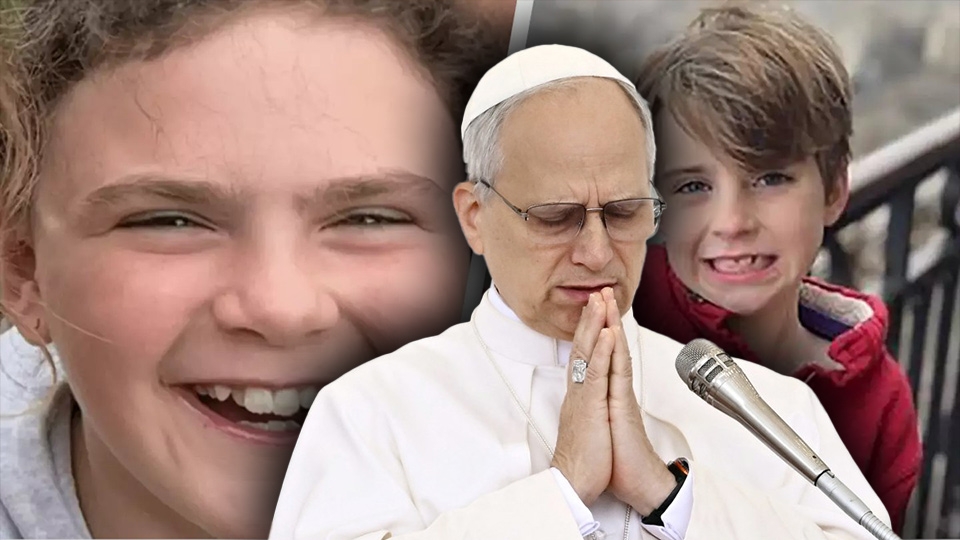

What took place in Minneapolis on Wednesday, August 27, 2025, is not merely another attack among many. It is the most explicit and coherent manifestation of the Revolution’s hatred against Christ and His faithful: a young transgender individual—alleged Catholic—murdering children during the Eucharistic Sacrifice. It is urgent to initiate the process of canonization for the two little martyrs.
Minneapolis, an ultra-liberal city in Minnesota, was shaken by yet another massacre on American soil. Wednesday, August 27, 2025, at 8:30 a.m., during a Mass at the Church of the Annunciation, affiliated with the Cristo Rey Catholic School, a 23-year-old former student opened fire from outside, killing two children aged 8 and 10, and injuring 17 others, 14 of whom were children.
The attacker, identified as Robin Westman, took his own life shortly after the assault. The FBI classified the event as an act of domestic terrorism and launched an investigation into a hate crime targeting Catholics. The term “domestic terrorism” refers to acts of violence or intimidation carried out within a country by its own citizens or residents, with the aim of influencing politics, religion, or society through terror.
The young man responsible for the attack was named Robert Westman at birth. He legally changed his name between 2019 and 2020. He chose the name Robin because he identified as a “transgender woman,” and in English, Robin is a unisex name.
The killer had previously attended the Cristo Rey Catholic School adjacent to the church and had prepared a manifesto intended for publication on YouTube, which was later blocked by police. The contents of the manifesto have not been made fully public, but authorities have described it as being motivated by religious hatred, specifically targeting the Catholic faith.
When reflecting on some of the images found in Westman’s notebook, one is compelled—as Catholics—to ask whether something deeper and more disturbing is at play.
Westman had allegedly planned to publish a video on YouTube, approximately twenty minutes long, in which numerous weapons are carefully arranged and decorated with hateful slogans, including: “Israel must fall,” “Kill Donald Trump,” and “Do you believe in God?” The last phrase directly echoes the Columbine High School massacre of 1999, when two students opened fire, killing 14 people. According to some accounts, one of the shooters reportedly asked that very question to a victim before pulling the trigger.
In the video, Westman slowly flips through a red-covered notebook filled with sketches and technical diagrams of firearms. Among the pages appear the floor plan of a church and handwritten notes in both English and Cyrillic, in which the individual clearly outlines their intentions. In one passage from the diary, the young person writes: “I think Sandy Hook was my favorite among the school shootings” — a chilling statement that reveals an obsession with mass school killings.
According to testimony from the U.S. Secretary of Homeland Security, Kristi Noem, the attacker was described as “a psychopathic monster.” He had publicly emphasized his transgender identity precisely at a time when the Trump administration was advancing a campaign in defense of life and the natural family.
However, when reflecting on some of the images found in Westman’s notebook, one is compelled—as Catholics—to ask whether something deeper and more disturbing is at play. There is currently no evidence that Westman spoke Russian or had direct ties to Russian-speaking environments, yet many of his notes are written in correct Cyrillic script.
In some passages from the diary, it’s possible to read as follows: “I was corrupted by this world and have learned to hate what life is”.
And again: “I have wanted this for so long. I am not well. I am not right. I am a sad person, haunted by these thoughts that do not go away. I know this is wrong, but I can’t seem to stop myself. I am severely depressed and have been suicidal for years. Only recently have I lost all hope and decided to perform my final action against this world”.
In particular, on one page of the diary, there is a hand-drawn image by the attacker depicting himself, armed, standing in front of a mirror. However, instead of his own reflection, a monstrous figure appears—resembling either a cockroach-like creature or a skeleton with two pairs of horns. An image evocative of a demon. Surrounding the scene are several phrases written in Cyrillic, including:
Кто я? – “Who am I?”
Когда это закончится? – “When will this end?”
Помощь мне! – “Help me!”
Я не хочу – “I don’t want [to do this]”
and repeated twice with emphasis: УБЕЙ СЕБЯ – “KILL YOURSELF!”
All of this suggests not only a deeply disturbed psychiatric profile, but possibly a case of true demonic possession. Those familiar with demonological literature know that polyglossia is a phenomenon often associated with extraordinary manifestations of possession.
Beyond the question of whether the phenomenon is satanic in nature, it is worth reflecting on the possible media repercussions of the Minneapolis attack. It is foreseeable that the media—both American and international—in their ideological fervor, may distort the event and steer the narrative against the Church itself, accusing it of perpetuating alleged views of “homophobia and transphobia”.
However, the reality is far more complex: the Catholic hierarchy, in many of its expressions, demonstrates a profound difficulty in truly caring for the most vulnerable souls, and often hesitates to clearly proclaim moral truth on delicate matters. Gender dysphoria, like other issues related to sexuality, cannot be reduced to a mere question of identity or orientation. It is rooted in unresolved inner conflicts, often tied to deep emotional wounds—most notably, the theme of an unredeemed, unreconciled fatherhood, whether spiritual, familial, or symbolic.
In this context, the question becomes inevitable: how can the Church respond with clarity and charity to a crisis that is spreading throughout liberal and post-Christian Western society, if unresolved dynamics, doctrinal ambiguities, and a significant presence of ecclesiastical figures who themselves—more or less latently—experience the same psychological conflicts persist within its own hierarchy? The issue of homosexual clergy, and the so-called internal lobbies, cannot be ignored if the Church truly intends to embark on a path of truth, healing, and reform.
Pope Leo XIV expressed deep sorrow over the tragedy that occurred in Minneapolis. In a telegram addressed to Archbishop Bernard Hebda of Saint Paul and Minneapolis, Cardinal Secretary of State Pietro Parolin, on behalf of the Holy Father, conveyed the Pope’s grief over the loss of life and the many injuries caused by the shooting at the Church of the Annunciation.
The message offers the Pope’s heartfelt condolences and his spiritual closeness to all those affected by this tragic event, with particular attention to the families mourning the death of a child. Leo XIV entrusts the souls of the departed children to the merciful love of Almighty God and lifts up prayers for the wounded, for the first responders, for medical personnel, and for the clergy caring for the victims and their loved ones.
In this moment of profound sorrow, the Holy Father imparts his apostolic blessing upon the community of the Annunciation Catholic School, the Archdiocese of Saint Paul and Minneapolis, and all the people of the Twin Cities metropolitan area, as a sign of peace, strength, and consolation in the Lord Jesus.
We cannot limit ourselves to mourning our little brothers in the faith. It is necessary to acknowledge, with the clarity of Tradition, that they were killed in odium fidei, and that, through the mystery of grace, their vocation to martyrdom is a purification in the blood of Christ for the entire Church—and indeed, for the whole world. They are martyrs, and as such, already enjoy the beatific vision in Paradise.
On behalf of all Catholics faithful to the Gospel and to the perennial Church, we issue an appeal to the Dicastery for the Causes of Saints, that the process of canonization for these two children be initiated without delay. Their witness, though silent and shattered by gunfire, is a powerful cry against the hatred of the Revolution and a light of hope for the People of God. The innocent blood shed in Minneapolis is not in vain: it is the seed of Christians, and the entire Church recognizes its sacred value.