

Today’s “science” has camouflaged—knowingly or unknowingly—the powers of the occult sciences of the past, which now reemerge unrestrained.
I don’t know when, I don’t know where, but I know for sure that Chesterton was the one who, with his brilliant wit, stated that the greatest problem is not that modern man no longer believes in what the Christian (i.e., Catholic) Church teaches, but that, in the absence of that belief, he is ready to believe in anything. It doesn’t take much insight to see how right Chesterton was. Indeed, from little “green men” to Yeti (the “Abominable Snowman”) and underground worlds, life on other planets, fairies and ghosts, the majority of our contemporaries seem ready to believe in anything. The void left in the soul by the absence of supernatural faith must be filled with something, right? And yet, despite the countless superstitions and alternative “beliefs” that make up the sum of today’s wanderings, there are a few that predominate. Among them, “magic” holds the most visible place.
If we look around, almost all products of consumer culture are saturated with “magic.” Commercials, music, video games, fantasy and science fiction literature, movies, cartoons; in a word, everything is (or contains) “magic.” Even athletes whose skills and physical abilities help them achieve remarkable performances are frequently described as “magical” (at odds with the fact that their physical achievements have nothing to do with the world of paranormal phenomena).
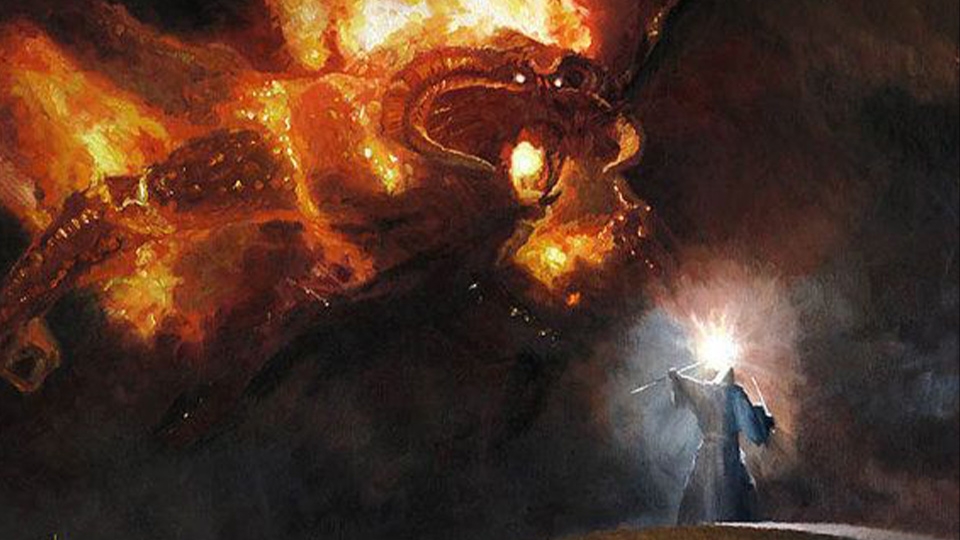
I could note dozens, hundreds, even thousands of advertising slogans that contain the word “magic.” Coupled with the limitless spread of relativism, denounced by Cardinal Joseph Ratzinger, the use of the term “magic” seems to describe a certain mental state of the world we live in. This very mentality explains the huge impact of literary characters like Gandalf and Harry Potter. Before, however, discussing the “magical” creations of contemporary culture, it is necessary to define the terms.
In The Acts of the Apostles we encounter an episode where God’s power is confronted with the occult power of a magician. This is the encounter with a certain sorcerer, Simon, also known as “the Magus,” and the Apostles of the Lord Jesus Christ.
Common sense defines magic as the manipulation of objects or people based on certain verbal formulas or gestures. Going a bit deeper, in the realm of scholarly studies dedicated to our term we find the following:
“Magic is an ancient practice of acting upon objects, beings, and conditions in nature and society by appealing to supernatural forces. The person who performs the act of magic is called a ‘mage,’ ‘magician’ (from the Assyrian maga, meaning ‘priest;’ which gave magos in Greek and magus in Latin – Persian priest).”[i]
Based on the above definition, proposed by Professor Ivan Evseev (1937-2008), we understand that magic is an operation of power (a manifestation of forces), based on hidden links between the seen world (i.e., the material/physical world) and the unseen world (i.e., spiritual world). At the level of common sense, we also distinguish between a positive form of magic, “white,” and a negative form, “black.” In fact, as French historian Robert Muchembled has shown,[ii] this is a distinction between “natural magic” or theurgy, and “demonic magic” or goeteia.
Without insisting on the more difficult details involving the crucial notion of the “preternatural,” I will present two biblical episodes—one from the Old Testament and one from the New Testament—that can enlighten us regarding the serious dangers involved in the practice of magic.
In the well-known episode of the confrontation between Moses and the Egyptian priests, we see how, for three of the miracles performed by the great prophet through the power of God, the latter perform similar wonders, but based on occult powers: turning a staff into a snake, turning water into blood, and multiplying frogs (Exodus, chapters 7–12). Thus, we see two powers facing each other: that of God, and that of the Egyptian magicians. The power of the latter, of course, could only end up defeated.
In the New Testament, in the book describing the life of the first Christian community, The Acts of the Apostles, we once again encounter an episode where God’s power is confronted with the occult power of a magician. This is the encounter with a certain sorcerer, Simon, also known as “the Magus,” and the Apostles of the Lord Jesus Christ. Overwhelmed by the unprecedented miracles they performed, Simon the Magus desires their power at all costs. He is even willing to pay large sums of money to obtain it. Against the sin of “simony,” the apostolic verdict remains forever valid: “thy heart is not right in the sight of God” (Acts 8:21).
Where was Simon’s error? In an unworthy attitude toward divine power — which cannot be bought with money, since the miracles performed by the apostles were gifts from God to His chosen ones for the salvation of people. This, then, is the difference between magic and faith. The former seeks to manipulate, to impose something through an occult force, while the latter is offered quietly, as a proposal for a bright and free (i.e., sinless) life for man—the image and likeness of God.
In 1326, Pope John XXII (1244–1334) issued the bull Super illius specula, where he lamented the spread of witchcraft and ordered the burning of such literature. In 1398, theology professors at the University of Paris condemned necromancy and other forms of magic. And in the famous inquisitors’ manual Malleus Maleficarum, magic is condemned, and in 1484, Pope Innocent VIII (1432–1492) issued the bull Summis desiderantes affectibus against magic and witchcraft.
In the history of the Church, we can see from the earliest times how faith and magic have been in constant confrontation. The first councils categorically condemned any inclination of the people toward superstitions and magic. For example, in the Fifth Local Council of Laodicea (year 343 AD), in canon 36, we read:
“They who are of the priesthood, or of the clergy, shall not be magicians, enchanters, mathematicians, or astrologers; nor shall they make what are called amulets, which are chains for their own souls. And those who wear such, we command to be cast out of the Church.”[iii]
The Middle Ages faced the escalating spread of magic. In 1326, Pope John XXII (1244–1334) issued the bull Super illius specula, where he lamented the spread of witchcraft and ordered the burning of such literature. In 1398, theology professors at the University of Paris condemned necromancy and other forms of magic. And in the famous inquisitors’ manual Malleus Maleficarum, magic is condemned, and in 1484, Pope Innocent VIII (1432–1492) issued the bull Summis desiderantes affectibus against magic and witchcraft.
If during the Middle Ages there was a reaction from the Church, in the Renaissance and modern periods this reaction was stifled by the extraordinary explosion of pseudo-gnoses of all kinds, among which magic held its place. Mesmerism, spiritism, Satanism, hypnotism, etc.—all of these are phenomena that intersect with magic in various forms. These developments have continued up to the present, reaching worrying proportions, as we can see in a statistic taken from the study The Scourge of the Fates: Modern-Day Witchcraft in France by André Julliard (quoted by Robert Muchembled in Magie et sorcellerie en Europe du Moyen Âge à nos jours):
- France: 30,000–40,000 clairvoyants; 30,000–40,000 healing witches
- Great Britain: In 1987, there were 30,000 witches
To all these figures, although we lack precise statistics, we can add Romania, with its thousands of witches and healers of all kinds, whose advertisements flood newspapers and magazines across the country. Not to mention the endemic spread of all kinds of horoscopes, not only in print media but also in radio and television broadcasts. All these widespread phenomena have prompted the authors of the Catechism of the Catholic Church to extensively present the Church’s teachings regarding all forms of magic (articles 2115–2117):
“God can reveal the future to his prophets or to other saints. Still, a sound Christian attitude consists in putting oneself confidently into the hands of Providence for whatever concerns the future, and giving up all unhealthy curiosity about it. Improvidence, however, can constitute a lack of responsibility.
All forms of divination are to be rejected: recourse to Satan or demons, conjuring up the dead or other practices falsely supposed to ‘unveil’ the future. Consulting horoscopes, astrology, palm reading, interpretation of omens and lots, the phenomena of clairvoyance, and recourse to mediums all conceal a desire for power over time, history, and, in the last analysis, other human beings, as well as a wish to conciliate hidden powers. They contradict the honor, respect, and loving fear that we owe to God alone.
All practices of magic or sorcery, by which one attempts to tame occult powers, so as to place them at one’s service and have a supernatural power over others—even if this were for the sake of restoring their health—are gravely contrary to the virtue of religion. These practices are even more to be condemned when accompanied by the intention of harming someone, or when they have recourse to the intervention of demons. Wearing charms is also reprehensible. Spiritism often implies divination or magical practices; the Church for her part warns the faithful against it. Recourse to so-called traditional cures does not justify either the invocation of evil powers or the exploitation of another’s credulity.”
Disillusioned by the failure of positivist, mechanistic science, the man at the end of the second millennium of the Christian era has ventured into exploring the paranormal—magical, one might say—dimensions of existence. This could explain the trend of presenting readers and viewers with technical witch brooms, talking hats, or flying cars.
After this frugal historical and doctrinal overview, we can return to today’s culture. Although we could discuss countless movies, cartoons, games, and literary works, I will refer only to two films (inspired by novels of the same names) that have had extraordinary reach: The Lord of the Rings and Harry Potter. Although both involve magical elements in their subtext, they are not at all similar.
Thus, in The Lord of the Rings, director Peter Jackson seems to have preserved much of the spirit of the book by J.R.R. Tolkien, the author of the trilogy, who was a lifelong faithful Catholic and encoded clear Christian values in his story. In contrast, the Harry Potter films, inspired by the novels of author Joanne K. Rowling, do not seem to contain such a strong Christian framework.
For the moment, I will mention from Harry Potter only the flying car that, sustained by magical powers, carries the hero of the film to Hogwarts School. This flying car indicates the postmodern culture’s tendency to forge a new alliance: that between science and magic. Disillusioned by the failure of positivist, mechanistic science, the man at the end of the second millennium of the Christian era has ventured into exploring the paranormal—magical, one might say—dimensions of existence. This could explain the trend of presenting readers and viewers with technical witch brooms, talking hats, or flying cars. In essence, scholars like Lynn Thorndike (1882–1965), Frances Amelia Yates (1899–1981), and Ioan Petru Culianu (1950–1991) were right: a descendant of Renaissance magic, today’s science has camouflaged—knowingly or unknowingly—the powers of the occult sciences of the past, which now reemerge unrestrained.
Referring to Harry Potter, one well-known exorcist, Father José Antonio Fortea, stated:
“They are merely literary fantasies in the manner of stories that have existed in Europe since the Middle Ages. I am neither in favor of condemning nor prohibiting them. To me, they are just unobjectionable stories.”[iv]
Of course, there are also negative opinions, such as that of Father Gabriele Amorth (1925–2016). We can discuss which one is most likely correct. But for me the question is about something else: why is the reality of holiness—that is, the lives of saints from yesterday and today, which were not “just fantasy”—not illustrated as fascinatingly as the illusory postmodern little wizard Harry Potter? Why are our catechesis schools, our theology faculties, not as attractive as the Hogwarts School? Could we somehow rediscover the joy of catechizing, evangelizing, and studying sacred science? If so, how? These are questions I cannot answer alone. Perhaps together—provoked by films and books like The Lord of the Rings or Harry Potter—we may find the answer.
[i] Ivan Evseev, Dicționar de magie, demonologie și mitologie românească (Dictionary of magic, demonology and Romanian mythology), Timişoara: Amarcord, 1997, pp. 242-243.
[ii] Robert Muchembled, Magia și vrăjitoria în Europa din Evul Mediu până astăzi (Magic and witchcraft in Europe from the Middle Ages to the present day), București: Humanitas Publishing House, 1997.
[iii] Here are available online all the canons from Laodicea Council: https://www.newadvent.org/fathers/3806.htm [Accessed: 19 June 2025].
[iv] Quoted in Father Alfonso Aguilar’s article published by the National Catholic Register, “Judging Harry Potter:” https://www.ncregister.com/commentaries/judging-harry-potter [Accessed: 19 June 2025].
