

The discussions about “good popes – bad popes” (i.e., heretical popes) are more intense than ever. Both Catholics faithful to Tradition and some “conservative” authors have raised serious questions in the face of the wall of silence from the hierarchy, which seems unwilling to answer the difficult questions raised by the recently ended pontificate. [1] This is why we must reflect on the message that God Himself wants to convey to us through the famous chapter 16 of the Gospel of Matthew, where the first Pope in history, after being called Peter – “the rock,” is just a few verses later called “Satan.”
In the life of our Lord Jesus Christ, nothing is accidental. Not a single detail recounted in the Gospels, not a single nuance—in short, nothing that the divine Logos made man did or said is without purpose. As Saint John Chrysostom says, even His silences are full of teachings. This is one of the most important premises underlying the interpretations offered by the Holy Fathers and Doctors of the Church. By taking this premise seriously, we can reread chapter 16 of the Gospel of Matthew from an entirely revelatory perspective. For here, as we probably all know, are found the words by which the Son of God establishes the papal office and its authority in the person of Peter:
“That thou art Peter; and upon this rock I will build my church, and the gates of hell shall not prevail against it. And I will give to thee the keys of the kingdom of heaven. And whatsoever thou shalt bind upon earth, it shall be bound also in heaven: and whatsoever thou shalt loose upon earth, it shall be loosed also in heaven. (Et ego dico tibi, quia tu es Petrus, et super hanc petram aedificabo Ecclesiam meam, et portae inferi non praevalebunt adversus eam. Et tibi dabo claves regni caelorum. Et quodcumque ligaveris super terram, erit ligatum et in caelis: et quodcumque solveris super terram, erit solutum et in caelis” – Matthew 16: 18-19).
The above words of our Lord have been discussed in thousands upon thousands of pages of exegesis over the centuries. Even today, they remain a stumbling block for those who refuse to acknowledge the primacy and infallibility of the papacy. For us Catholics, however, they point to the establishment of the ecclesiastical hierarchy of the militant Church, which—just like the heavenly hierarchies headed by God Himself—reflects this divinely ordained structure on earth through the existence not only of the apostolic college but also of its visible head and the head of the Church: the Pope.
How is it possible that almost immediately after granting him the power of the keys and naming him “the rock,” our Lord would rebuke him so severely by calling him “Satan”?
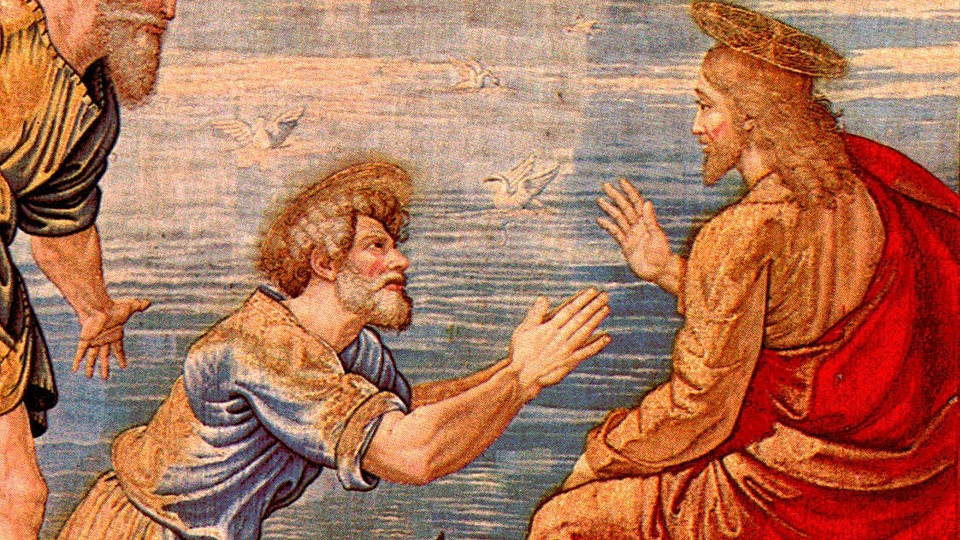
What is often omitted, however, from reflections on these verses is the broader context of chapter 16, where, just a few verses later, that same Peter—“the rock”[2]—is called by one of the most terrible names imaginable: “Satan.” We recall the context: when Jesus begins to speak to the apostles about the terrible end of His mission on the cross in Jerusalem, “Peter took him aside and began to rebuke him, saying: Lord, be it far from thee, this shall not be unto thee” (Matthew 16: 22).
The commentaries of the Holy Fathers emphasize both the apostle’s inability to grasp the divine depths of the Savior’s mission and his fear of the sufferings and passion foretold by Christ. In other words, his fallen human nature, afraid of suffering and death, fully manifested itself. Our Lord Jesus Christ’s response came as a cold shock, especially after He had just recently named him “the Rock”—Peter:
“Go behind me, Satan, thou art a scandal unto me: because thou savourest not the things that are of God, but the things that are of men. (Vade post me Satana, scandalum es mihi: quia non sapis ea quae Dei sunt, sed ea quae hominum.)” (Matthew 16: 23).
How is it possible that almost immediately after granting him the power of the keys and naming him “the rock,” our Lord would rebuke him so severely by calling him “Satan”? And what is Peter’s true identity—“the rock” or “Satan”? We must admit that we cannot help but feel deeply disturbed by the fact that the first pope in history, in the very presence of God Himself, could be subject to such contradictory thoughts. This is yet another biblical mystery that must be properly resolved. To shed light on it, today I will present the interpretation of one of the most famous converts: the Russian philosopher Vladimir Solovyev (1853–1900).[3]
In 1885, he published La Russie et l’Église universelle (Russia and the Universal Church)[4] in Paris—a book that played a significant role in my own conversion. An enthusiastic supporter of the primacy and infallibility of the Pope, Solovyev brilliantly and eruditely presented both doctrinal arguments of a theological-speculative nature and various historical episodes, accompanied by the testimonies of the Holy Fathers, regarding the vital role of the Supreme Pontiff.
Simon Peter as supreme pastor and doctor of the Universal Church, assisted by God and speaking in the name of all, is the faithful witness and infallible exponent of divine-human truth. The same Simon Peter as a private individual, speaking and acting by his natural powers and merely human intelligence, may say and do things that are unworthy, scandalous and even diabolical.
At the same time, however, he had to respond to critics who, invoking the immorality of certain popes, rejected the divinely instituted authority of the Apostle Peter and his successors. He addressed this issue in a short chapter titled, as directly as possible, “‘Peter’ and ‘Satan’.” Here, before anything else, Solovyev emphasizes that the apostle Peter did not recognize the divinity of Jesus Christ based on his own human reasoning. It was not his own intelligence or understanding that revealed to him the full Truth about the Master he followed. Solovyov explains:
“Peter’s confession, which by a spontaneous and infallible act of allegiance established the bond between mankind and Christ and founded the free Church of the New Covenant, was not just a piece of characteristic behavior on his part. Nor can it have been a casual and momentary spiritual impulse.”[5]
The very words of the Savior prove that the origin of Peter’s confession of faith is supernatural—“flesh and blood hath not revealed it to thee, but my Father who is in heaven.” This revelation made by our Lord Jesus Christ points to the source of Peter’s recognition that the One standing among them was both God and Man:
“This confession of Peter’s is then an act sui generis, an act whereby the moral being of the Apostle entered into a special relationship with the Godhead; it was this relationship which enabled human utterance to declare infallibly the absolute truth of the Word of God and to create an impregnable foundation for the Universal Church.”[6]
Once the correct interpretation is established regarding the reasons why the apostle was called by God Himself “Peter”—that is, the foundational “rock” of His Church—Vladimir Solovyev confronts without hesitation the difficulties arising from the latter part of chapter 9 of the Gospel of Matthew, where Peter is called “Satan.” How can these two antinomic passages contained in the same chapter be reconciled? How is it possible that the one who received the keys to the Kingdom of God is exposed as a true servant of the devil and his schemes when he tries to prevent the Passion and shameful death on the Cross of the Son of God? There is only one way to resolve such an apparently insoluble contradiction:
“Simon Peter as supreme pastor and doctor of the Universal Church, assisted by God and speaking in the name of all, is the faithful witness and infallible exponent of divine-human truth; as such he is the impregnable foundation of the house of God and the key-bearer of the Kingdom of Heaven. The same Simon Peter as a private individual, speaking and acting by his natural powers and merely human intelligence, may say and do things that are unworthy, scandalous and even diabolical.”[7]
Here is the explanation! With the clarity of a speculative thinker long trained in the art of thinking clearly, Solovyev draws a distinction between two Peters: the first, faithful to divine inspiration, is the Peter who acts and thinks as a true shepherd and doctor of the Universal Church. In the words of the Apostle Paul from the Epistle to the Romans (7: 23), we might say that this Peter is the one who submits to “the law of the mind,” inspired and guided by God. The second Peter, however, is the man who—under the influence of “the law of the flesh”—is ruled by his own fears, passions, and weaknesses. For, I assure you, this terrible dichotomy has been present in every Supreme Pontiff in history, just as it was in Peter himself (and, of course, just as it is present in each of us). In concrete terms, any sins that we, the simple laity, are capable of committing can also be committed—as we well know—by the Church’s hierarchy (Pope included).
Under the influence of a harmful hyperpapalism, many Catholics today have come to believe that the Supreme Pontiffs are immune to temptation, to falls, to sin (even the most serious ones—such as heresy). This, now more than ever, has been shown to be false.
Moreover, the charism of infallibility does not protect popes from the various sins to which anyone might fall prey. And here we find another traditional teaching that we must always return to. Just as the graces received through the Sacraments of Baptism and Confirmation are merely potentials that must be actualized through the practice of virtue and a life of holiness, so too the graces received by the hierarchy—including those special graces given to Popes—must be “activated” by a life lived according to the enduring demands of sanctity.
Under the influence of a harmful hyperpapalism, many Catholics today have come to believe that the Supreme Pontiffs are immune to temptation, to falls, to sin (even the most serious ones—such as heresy). This, now more than ever, has been shown to be false. Vladimir Solovyev, simply and clearly, explained that under certain conditions, a pope can be open to divine inspirations, fulfilling the will of the Heavenly Father. But unfortunately, he can also be closed to those inspirations—because he is not a “divine oracle.” As I said: he can commit all the sins that any sinful member of the Church can commit. Did such a non-hyper-papalist understanding of the pontifical office prevent Solovyov from converting? Not at all! For he, wisely, reminds us that:
“The failures and sins of the individual are ephemeral, while the social function of the ecclesiastical monarch is permanent. ‘Satan’ and the ‘offense’ have vanished, but Peter has remained.”[8]
[1] Among the many texts published in the last weeks, I mention here the open letter of the eminent professor Dr. Joseph Seifert to His Eminence, Cardinal Gian Battista Re: https://onepeterfive.com/dr-josef-seifert-papal-heresy-must-be-investigated/ [Accessed: 07 May 2025].
[2] I have quoted in other articles Saints and Doctors like Augustine and Basil the Great who show that “the Rock” in the absolute sense is only the Savior Christ; Peter is “the rock” only relatively to the One who established the church hierarchy – God himself: “Who is the ‘Rock’? Saint Augustine’s last thought:” https://www.remnantnewspaper.com/fetzen-fliegen/item/7016-who-is-the-rock-saint-augustine-s-last-thought [Accessed: 07 May 2025].
[3] I published in The Imaginative Conservative an article dedicated to Solovyov’s tumultuous life entitled “Vladimir Solovyov: The Mystical Origins of Sophianism:” https://theimaginativeconservative.org/2024/08/vladimir-solovyov-mystical-origins-sophianism-robert-lazu-kmita.html [Accessed: 07 May 2025].
[4] In this article I will quote Herbert Rees’ translation: Vladimir Solovyev, Russia and the Universal Church, The University Press Glasgow, 1948: https://archive.org/details/in.ernet.dli.2015.169645/page/n7/mode/2up [Accessed:07 May 2025].
[5] Vladimir Solovyev, Russia and the Universal Church, Op. Cit., p. 96.
[6] Vladimir Solovyev, Russia and the Universal Church, Op. Cit., p. 97.
[7] Vladimir Solovyev, Russia and the Universal Church, Op. Cit., pp. 97-98.
[8] Vladimir Solovyev, Russia and the Universal Church, Op. Cit., pp. 98.
