
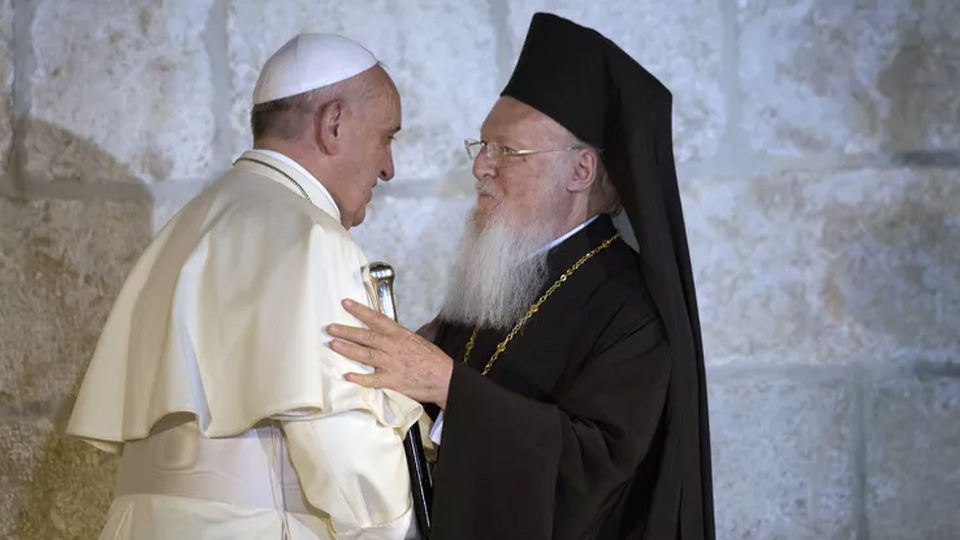

First and foremost, those Catholics who deceive themselves with the illusion of dialogue must remember that the majority of Eastern schismatics hold a unified position: they consider the Catholic Church to be heretical. Period. Moreover, many of them—just like their hierarchs—do not even regard the papacy as anything more than a historical accident. Finally, and most importantly, the ecumenical dialogue that neo-modernist Catholic theologians and hierarchs have been so enamored with has never significantly altered these convictions.
Ecumenical Exaltation
Ecumenical enthusiasm was strongly fueled by one of the events that, after the conclusion of the Second Vatican Council, seemed to signal the imminent healing of the historical schism—occurring in the year 1054—between the Catholic Church and the schismatic Eastern “Orthodox” Churches. On December 7, 1965, through simultaneous events in Rome and Istanbul, Pope Paul VI and Ecumenical Patriarch Athenagoras lifted the anathemas issued in 1054.
What the Vatican authorities seem to have never truly understood is the fact that, with a few insignificant exceptions, national “Orthodox” churches view the role of the ecumenical patriarch with great suspicion, not recognizing any de facto authority of his over their own synods. Therefore, none of his actions hold “universal” value. Moreover, autocephalous churches like the Russian Church do not recognize his authority at all. This was evident even during the aforementioned event when Metropolitan Philaret Voznesensky of the Russian diaspora community (1903–1985) explicitly condemned Ecumenical Patriarch Athenagoras for “canceling” the anathemas issued by Patriarch Michael Keroularios and Cardinal Humbert in 1054.[i] Archbishop Chrysostomos II of Athens (1880–1968) had already done the same.
It is therefore abundantly clear that the exalted gesture of Pope Paul VI and Patriarch Athenagoras was never accepted by the national Orthodox churches—whose attitude of condemnation and rejection toward the Catholic Church has remained consistently unchanged. The Dominus Iesus declaration was yet another occasion that demonstrated (if any further proof was needed) this reality.
“Every faithful (Christian) is Peter, as much and as far as they profess the faith of Peter, that is, that ‘Christ is the son of the living God’.” Essentially, this statement outright denies the very possibility of the existence of the papal office and its authority.
First Reactions: Clément, Maximos, Evdokimov
One of the most polemical responses came from the well-known French “Orthodox” thinker Olivier-Maurice Clément (1921–2009), who condemned in the strongest and most unequivocal terms the declaration approved and signed by Joseph Cardinal Ratzinger and Archbishop Tarcisio Bertone, S.D.B. Specifically, he stated that it is an “act of blasphemy against the church to say that the Eucharist celebrated by Anglicans and Protestants is empty.”[ii]
Rarely have I encountered a text more contradictory than that of Olivier Clément. On the one hand, he rejects any rapprochement with the Catholic Church in the name of “true faith.” On the other hand, he defends certain Reformed communities, seemingly forgetting that they, too, do not share the “true faith” on which he bases his stance. The explanation for this paradox is simple: it is often observed that “Orthodox” authors ally with Protestants solely to form a united front against the Catholic Church. Let us move forward.
Metropolitan Maximos of the Greek Orthodox Diocese of Pittsburgh also analyzed the Dominus Iesus declaration from an “Orthodox” perspective, concluding that the understanding of faith in this document is flawed. The argument he put forth is crucial in understanding how Eastern schismatic theologians, especially since the 19th century, have opposed both papal primacy and the doctrine of infallibility:
“Every faithful (Christian) is Peter, as much and as far as they profess the faith of Peter, that is, that ‘Christ is the son of the living God’.”[iii]
Essentially, this statement outright denies the very possibility of the existence of the papal office and its authority. If every Orthodox Christian is, at least potentially, the apostle Peter, then the Catholic teaching regarding the Pope as Peter’s successor is null. Since the entire Catholic ecclesiastical structure rests on Petrine authority, without it, the Catholic Church would simply be without foundation. The same would apply to the Catholic Magisterium and the Congregation for the Doctrine of the Faith. All of this explains why, for Metropolitan Maximos, the Dominus Iesus declaration—issued by an institution that, from his perspective, has no authority whatsoever—is a document devoid of any value. These are the anti-Catholic ideas implicit in Metropolitan Maximos’ statements.
A somewhat more moderate critique was offered by Father Michel Evdokimov, an “Orthodox” theologian active in ecumenical dialogue and extensively experienced in inter-confessional diplomacy. As with Olivier Clément, the most surprising aspect of his response is the insistence with which he refers to Reformed communities, minimizing any critical remarks about them. On the contrary, they always seem to be good allies when it comes to criticizing and attacking the Catholic Church.
After appearing to acknowledge the legitimacy of the critique of ecclesiological relativism presented in Dominus Iesus, Father Evdokimov addresses the sense of discomfort felt by the Orthodox:
“(…) the Orthodox will feel hurt when reading, between the lines, that their Church would find its full completeness if it entered into communion with the Catholic Church.”[iv]
“Orthodox” theologians also crticize the Catholic Church by lamenting the loss of the mystical dimension, which, they argue, led to an overemphasis on Catholic institutionalism. This, in turn, resulted in the dogma of infallibility and a vision in which the authority of Jesus Christ was replaced by papal authority.
In his final reflections on the communities originating from the Reformation, M. Evdokimov does not forget to challenge papal authority, though from a different perspective than that of Metropolitan Maximos of Pittsburgh. His argument is based on the mysticism of ecclesial unity:
“There is a risk of losing sight of the mystical dimension of the one and indivisible Church, where all Christians can come together because, according to Saint Paul, it is the body of Christ, who alone is its head.”[v]
Here we encounter yet another of the constant criticisms “Orthodox” theologians direct at the Catholic Church and its theology: the loss of the mystical dimension, which, they argue, led to an overemphasis on Catholic institutionalism. This, in turn, resulted in the dogma of infallibility and a vision in which the authority of Jesus Christ was replaced by papal authority. Of course, this type of perspective camouflages that terribly risky discussion (in support of which Saint Symeon the New Theologian is always invoked) about the disjunction between the spiritual-mystical and the ecclesial-sacramental hierarchy.
The Extended Critique of Fr. Ioan I. Ică Jr.
While Michel Evdokimov’s response remains relatively moderate, the same cannot be said for Father Ioan I. Ică Jr., the head of an important Romanian “Orthodox” publishing house (Deisis in Sibiu). In a substantial article dedicated to the dialogue between “Orthodox” and Catholics,[vi] he denounces aspects of Latin ecumenism that he considers ambiguous, calling on Eastern believers and authorities to react promptly. However, he does not clearly specify how they should react, though the tone of his appeal was certainly animated by an offensive spirit.
At the beginning of his article, he asserts that the Dominus Iesus declaration was made possible because Pope John Paul II was “evidently increasingly weakened and incapable of personal initiative and reaction.”[vii] Ioan I. Ică Jr. describes the Catholic environment in which the declaration was drafted as being rife with power struggles, with the ultimate goal being the papal succession. Thus, once again, as we saw in the article about Protestant reactions, the alleged struggle for power is invoked. Similarly, the Congregation for the Doctrine of the Faith is described as serving “the purpose of ensuring ‘doctrinal policing’ within the Roman Catholic Church.”[viii] Regarding the implicit message of the declaration, in Father Ică Jr.’s opinion, it is unequivocal:
“The Vatican does not abandon anything from the past dogmas, reaffirming them with energy and radicalism whenever it seems that ‘ecumenical openings’ have gone too far or have not led to the desired outcome—that of convincing all other Churches and all religions of the world to unite with and under the ‘successor of Peter’.”[ix]
The supposed “worrying but predictable evolution” of the Vatican is highlighted through three events that Ioan I. Ică Jr. presents in the same polemical tone. The first is the simultaneous beatification, on September 3, 2000, of John XXIII and Pius IX. While the Romanian author does not raise objections regarding Pope John XXIII, his criticisms against the beatification of Pope Pius IX—the initiator of the First Vatican Council—are overwhelming (and, I would add now, absolutely wrong):
“The theological and ecclesiological message of the symbolic gesture of canonizing Pius IX (1846–1878) is transparent: the openings of Vatican II are not interpreted as a real overcoming of the closures of Vatican I but merely as a continuation of them. Moreover, by beatifying Pius IX, papal primacy and infallibility are not only dogmatized but even canonized. In other words, through ecumenical dialogue, they cannot be revised or reinterpreted in their essence but only in their practical application. Therefore, they must either be accepted as they are or rejected entirely.”[x]
Quoting several excerpts from the dogmatic constitution Pastor Aeternus (promulgated on July 18, 1870), Ioan I. Ică Jr. reaches a disconcerting conclusion:
“(…) although not explicitly named, the Orthodox are, in fact, implicitly anathematized by the Catholic Church as heretics. Not only have these anathemas never been suppressed—causing a certain ambiguity to always hover over the sincerity of Catholic ecumenism, which has now become evident—but through the beatification of Pius IX, they have practically been canonized, becoming ‘the acts of a saint’.”[xi]
This assertion of the “implicit” anathematization of Eastern schismatic Christians seems incomprehensible: how could it be possible, given that the ecclesiology of their Churches denies and excludes Catholic ecclesiology (just as the Reformed communities do)? In other words, how can someone be anathematized who is no longer part of the “one, holy, Catholic, and apostolic” Church?
Whatever this dialogue may be, it certainly does not lead to any positive outcome in ecumenism. And how could it be otherwise when their primary motivation for fiercely criticizing the Dominus Iesus declaration is, as expected, its deviation from what they consider true Christian Faith?
A second unsettling event in the Catholic world, according to Ică Jr., is the Dominus Iesus declaration itself. However, he does accept (at least) its opposition to religious relativism and syncretism as a positive aspect. Nonetheless, he remains skeptical of “the ‘classic’ old assertion that the unity and uniqueness of the Church are already fully realized in the Roman Catholic Church, and that its ecumenism is merely a contemporary way of achieving its universality (in the past, this was done through the Crusades, uniatism, etc.).”[xii]
The document that attracted the most virulent criticism from Father Ioan I. Ică Jr. was not Dominus Iesus but another one that accompanied the declaration: “Notes on the Expression ‘Sister Churches’,” published by the Congregation for the Doctrine of the Faith on June 30, 2000. The most criticized articles are 10, 11, and 12, which he cites in full:
“In fact, in the proper sense, sister Churches are exclusively particular Churches (or groupings of particular Churches; for example, the Patriarchates or Metropolitan provinces) among themselves. It must always be clear, when the expression sister Churches is used in this proper sense, that the one, holy, catholic and apostolic Universal Church is not sister but mother of all the particular Churches.
One may also speak of sister Churches, in a proper sense, in reference to particular Catholic and non-catholic Churches; thus the particular Church of Rome can also be called the sister of all other particular Churches. However, as recalled above, one cannot properly say that the Catholic Church is the sister of a particular Church or group of Churches. This is not merely a question of terminology, but above all of respecting a basic truth of the Catholic faith: that of the unicity of the Church of Jesus Christ. In fact, there is but a single Church, and therefore the plural term Churches can refer only to particular Churches. Consequently, one should avoid, as a source of misunderstanding and theological confusion, the use of formulations such as ‘our two Churches,’ which, if applied to the Catholic Church and the totality of Orthodox Churches (or a single Orthodox Church), imply a plurality not merely on the level of particular Churches, but also on the level of the one, holy, catholic and apostolic Church confessed in the Creed, whose real existence is thus obscured.
Finally, it must also be borne in mind that the expression sister Churches in the proper sense, as attested by the common Tradition of East and West, may only be used for those ecclesial communities that have preserved a valid Episcopate and Eucharist.”[xiii]
Based on the above fragments, Father Ioan I. Ică Jr. strongly asserts the existence of an exclusive disjunction between Catholic and Orthodox ecclesiology:
“The ecclesiological structure of the Roman Catholic Church continues to remain firmly papal-monarchical as it has been throughout the second millennium of Christianity, dogmatized by the First Vatican Council (which implicitly anathematized the Orthodox) and now ‘beatified’ through the person of Pius IX. The profound meaning of Catholic ecumenism remains, therefore, the ‘bringing back’ of all non-Catholics to the one mother Church of Rome through dialogue and persuasion, not to achieve the unity of the Church—already embodied in the person of the Pope—but rather its universality.”[xiv]
“These two ecclesiologies (Catholic and Orthodox—my note) are irreducible to a common denominator and, therefore, at least for now, they are irreconcilable.”[xv]
This insurmountable incongruence between the Catholic Church and the autocephalous “Orthodox” Churches represents the most common opinion among schismatic clergy, hierarchs, and theologians. Since I have never seen any Vatican authority comment on such positions, I wonder if enthusiastic ecumenists are even aware of this reality. Regardless, one thing is certain: whatever this dialogue may be, it certainly does not lead to any positive outcome in ecumenism. And how could it be otherwise when their primary motivation for fiercely criticizing the Dominus Iesus declaration is, as expected, its deviation from what they consider true Christian Faith?
First and foremost, those Catholics who deceive themselves with the illusion of dialogue must remember that the majority of Eastern schismatics hold a unified position: they consider the Catholic Church to be heretical. Period. Moreover, many of them—just like their hierarchs—do not even regard the papacy as anything more than a historical accident. Finally, and most importantly, the ecumenical dialogue that neo-modernist Catholic theologians and hierarchs have been so enamored with has never significantly altered these convictions.
The Core of the Ecumenical Matter
On the other hand, the criticisms of theologians such as Olivier Clément and Ioan I. Ică Jr. also confirm that the real problems go far beyond simple reactions to documents like Dominus Iesus. The true difficulties were well highlighted by another schismatic hierarch, the Romanian Metropolitan Antonie Plămădeală (1926–2005), who clearly explained how important the attitude of those engaging in ecumenical dialogue on behalf of their Church is:
“Churches, by their very essence as instruments of salvation, operate only in absolute terms, with truth or error. Where the full truth is absent, even partial error leads to eternal condemnation. That is why, in principle, each side thinks in terms of tertium non datur—there is no middle ground, and any half-measure is a tertium. This must always be taken into account whenever we deal with Churches and ecumenism and when we engage in dialogue for unity. Each side hopes that the other will correct its errors, and if one enters into ecumenical dialogue, it is done with the firm belief that one is offering their good services to help the opponent discover their mistakes. What each side brings to the dialogue table—and only what it brings—is the true doctrine!”[xvi]
Viewing things from this “integrist” perspective, we can easily understand, for example, that Father Ioan I. Ică Jr. considers the doctrine he defends and preaches to be the only true one, just as he believes his Church to be the only true Church. Since he regards both papal primacy and infallibility as mere doctrinal innovations, it is evident that he can only conceive of Catholic ecclesiology in negative terms. Similarly, the critiques of Protestant theologians, such as the Lutheran André Birmelé, indicate the presence of similar premises. Such doctrinal positions stem from the fundamental conviction pointed out by Metropolitan Plămădeală: those involved operate only in absolute terms—truth or error.
In my opinion, the last great Saint and Doctor of the Church who fully understood this difficult issue and proposed a brilliant solution was Francis de Sales (1567–1622). In his posthumous work, The Catholic Controversy, he laid out a complete doctrine regarding the criterion for establishing revealed Truth concerning doctrine and the Church. Instead of engaging in sterile ecumenical discussions, I believe that studying and meditating on such a theological masterpiece would be far more beneficial for all those truly interested in this matter.
[i] For other details, see the article “Protest of Metropolitan Philaret against Patriarch Athenagoras about his Cancellation of the Anathemas:” https://www.rocorstudies.org/2024/01/24/protest-of-met-philaret-against-pat-athenagoras-about-his-cancellation-of-the-anathemas/ [Accessed: 16 February 2025].
[ii] Some quotations from Clément’s text can be read in “Dominus Iesus a ‘Public Relations Disaster’ for Ecumenism Say Critics,” by Edmund Doogue and Stephen Brown, in Christianity Today, September 13, 2000, p. 8. The article is available online here: https://www.christianitytoday.com/2000/09/dominus-iesus-public-relations-disaster-for-ecumenism-say-c/ [Accessed: 14 February 2025].
[iii] “Forum: About that Dominus Iesus,” by Ann Rodgers-Melnick, in PG News, september 17, 2000, p. 5.
[iv] Michel Evdokimov, “Par-delà ce qui nous divise encore, nous sommes appelés de vivre nostre appartenance à ce corps unique dont le Christ este le chef. Une réaction ortodoxe à Dominus lesus,” in Service Orthodoxe de Presse (SOP), No. 254/ Janvier 2001, pp. 21-22. Here is the original quotation: “Les orthodoxes se sentiront blessés en lisant, entre les lignes, que leur Eglise trouverait toute sa plenitude si elle entrait dans la communion de l’Eglise catholique.”
[v] Michel Evdokimov, op.cit., p. 22: “On risquiat alors de perdre de vue la dimension mystique de l’Église une et indivisible, où peuvent se rassambler tous les chrétiens car, toujours selon saint Paul, elle est le corps du Christ qui, seul, en est le chef.”
[vi] Arhid. Conf. Ioan I. Ică Jr., “Dialogul ortodoxo-catolic,” in Renașterea (Clui-Napoca), No. 10/Octombrie 2000, pp. 1-9.
[vii] Op.cit., p. 8.
[viii] Ibidem.
[ix] Ibidem.
[x] Ibidem.
[xi] Ibidem.
[xii] By the pejorative notion of “uniatism,” Fr. Ioan Ică Jr. refers to the re-entry into full communion with Rome of certain schismatic Orthodox communities, which subsequently became the Greek Catholic Churches.
[xiii] Congregation for the Doctrine of Faith, “Note on the Expression ‘Sister Churches’,” document available on the Vatican website: https://www.vatican.va/roman_curia/congregations/cfaith/documents/rc_con_cfaith_doc_20000630_chiese-sorelle_en.html [Accessed: 16 February 2025].
[xiv] Arhid. Conf. Ioan I. Ică Jr., “Dialogul ortodoxo-catolic,” in op.cit., p. 9.
[xv] Ibidem.
[xvi] Dr. Antonie Plămădeală, Ca toți să fie una. Ut omnes unum sint, Bucharest: Publishing House of the Biblical and Mission Institute of the Romanian Orthodox Church, 1979, p. 16.
