

The charity is growing cold
In the prophetic Chapter 24 of the Gospel of Matthew, our Lord Jesus Christ speaks to the apostles—according to Saint Augustine’s interpretation—about both the signs of the destruction of Jerusalem and the end of universal history. Among these, one of the most significant signs refers to the crisis of the supreme supernatural Christian virtue:
“Because iniquity hath abounded, the charity of many shall grow cold” (Et quoniam abundavit iniquitas, refrigescet caritas multorum––Matthew 24:12).
Given the multitude of troubling signs we see everywhere, I must admit that I am inclined to think that the times we are living in are those foretold by our Lord, Jesus Christ. However, no other sign of the extinguishing of charity is as terrible as the prohibition of access to the Holy Eucharist by attempting to completely eliminate the Traditional Catholic Mass from our churches. Of course, I am referring to the persecution faced by all those Catholics who wish to participate exclusively in the Gregorian Mass. Regardless of their reasons for such a radical attitude, the fact of depriving them of the most precious sacrament clearly indicates the extinguishing of charity in the hearts of those who desire to establish a liturgical dictatorship.
What justifications can be brought for depriving someone of the Holy Eucharist? I have often heard arguments based on the fact that many traditionalist Catholics reject—wholly or partially—the Second Vatican Council. Even if it is so, couldn’t our hierarchs show clemency to those they consider ‘medieval,’ ‘reactionaries,’ ‘retrograde,’ rigid, and ‘backwardists? Let’s suppose, for the sake of the argument, that they are the ones who know the truth and we, the traditionalist Catholics, are the ones who are wrong. Wouldn’t this be the best opportunity to show us understanding and, above all, charity? Why would mercy and love be denied precisely to such ‘backwardists’ as ourselves? What father would treat his ‘sick’ children in such a way?
Unfortunately, however, we all know the current state of affairs. I must acknowledge that, more than ever, I feel compelled to perceive the gravity of such a situation by reading and meditating on the words of our Savior Christ: “the charity of many shall grow cold.” For to use the deprivation of the Holy Eucharist as a means of punishing those who, out of faith and fidelity to Christian Tradition, refuse with fear and trembling to embrace the dubious teachings of the Second Vatican Council, is an act of pastoral cruelty, the consequences of which can only leave us speechless.
Behold this Heart, which has so loved mankind that it has spared nothing and has been consumed entirely to prove the love I bear for them. In return, from the majority of people, I receive nothing but ingratitude, through their disrespect and the sacrileges they commit, through their coldness and contempt for My presence in the Holy Sacrament of the Eucharist.
Professor Tolkien and the Holy Eucharist
For any true Catholic, the words of J.R.R. Tolkien can serve both as their own testimony and as the most appropriate way—which I will discuss immediately—to understand the proper relationship to the Mystery of Mysteries, the Most Holy Body and Blood of our Savior Christ:
“For me that Church of which the Pope is the acknowledged head on earth has as chief claim that it is the one that has (and still does) ever defended the Blessed Sacrament, and given it most honour, and put (as Christ plainly intended) in the prime place. ‘Feed my sheep’ was His last charge to Saint Peter; and since His words are always first to be understood literally, I suppose them to refer primarily to the Bread of Life. It was against this that the Western European revolt (or Reformation) was really launched—‘the blasphemous fable of the Mass’—and faith/works a mere red herring. I suppose the greatest reform of our time was that carried out by Saint Pius X.”[i]
As noted by the editors of the letters from which the above quote is extracted, Humphrey Carpenter and Christopher Tolkien, when the author refers to the reform of Saint Pius X (1835–1914), he is very likely thinking of the recommendation for Catholics to receive communion as frequently as possible, even daily if they can.[ii] This was probably the most important liturgical ‘reform’ of modern times. A reform that immediately brings to my mind the Devotion to the Sacred Heart of our Savior Christ. Why? Because this was the very thing God asked of Saint Margaret Mary Alacoque (1647–1690) in one of her visions: to receive communion as often as her superiors would permit. The significance of this request, as well as the devotion to the Sacred Heart itself, are the means by which God offered us a remedy for the “charity that is growing cold” about which He warned us in Chapter 24 of the Gospel of Matthew.
In a manner perfectly suited to the suffocating moral darkness of our times, the Savior Jesus Christ desires to replace our hearts, hardened by sins and a lack of love, with hearts that are sensitive, full of love and faith. This is the profound meaning of the Devotion to the Sacred Heart of the Savior, which would later be complemented—through the appearance of the Blessed Virgin Mary at Fatima—by the Devotion to the Immaculate Heart of the Queen of the Universe. Without exaggeration, I believe I can say that these two hearts, the divine heart of Jesus and the human heart of Mary, are the supports of Heaven and Earth, the poles between which the axis of love—given by God to man, and by man to God—restores the original, paradisiacal unity between the Creator and the creature. After all, what else is Paradise but the immense, Most Holy Heart of God, in which all those with pure hearts dwell? To better understand the fact that the heart of the Church is the Most Holy Sacrament, I suggest a brief meditation on the words that the Savior Jesus Christ spoke to Saint Margaret Mary.
Therefore, I ask you that the first Friday after the octave of the Feast of My Body and Blood (Corpus Christi) be dedicated to honoring My Heart, by receiving Holy Communion and performing an act of reparation for the offenses committed against My honor, so often wounded by unworthy behavior towards the Most Holy Sacrament of the altar.
The Visions of Saint Margaret Mary Alacoque
On December 27, 1673, the saint saw Jesus in the Holy Sacrament while she was in adoration before the altar. Here are the Savior’s words:
“My divine Heart is so inflamed with love for mankind, and especially for you, that it can no longer contain its burning flames; it must spread them with your help and reveal itself to humanity to enrich them with its priceless treasures. I am revealing these treasures to you. They contain the graces that will save sinners from the depths of perdition. To accomplish this great work, I have chosen you because you are an abyss of unworthiness and ignorance, so that everything will be done through Me.”
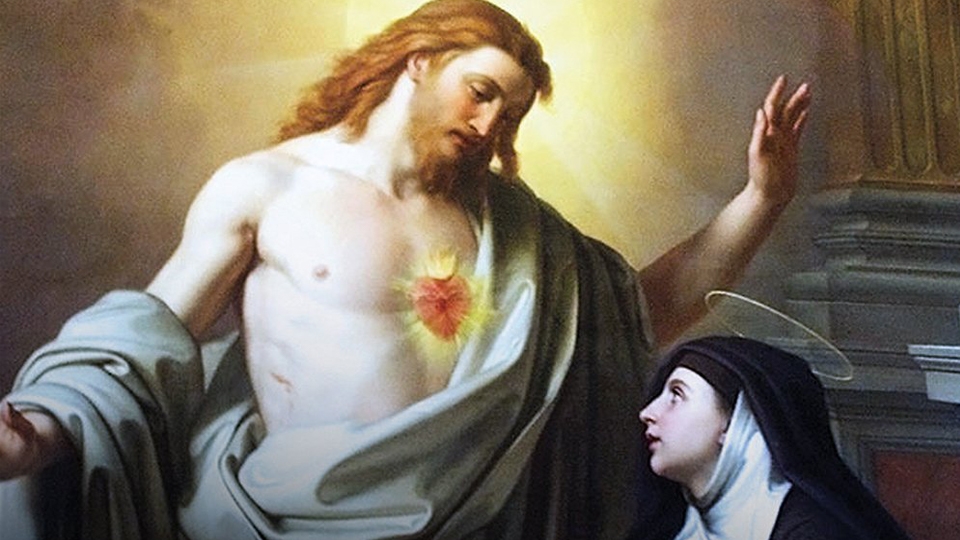
In 1674, there were other apparitions of the Savior, the most impressive of which was when Jesus appeared shining in His divine glory, with the five wounds like five suns, from which flames burst forth from His entire divine being. Through His opened chest, His Most Sacred Heart could be seen, the living source of these unquenchable flames. At that moment, the Lord Jesus said:
“These sins (of mankind) grieve Me more than all that I suffered for them in My Passion. If people would repay the Love I have for them, I would not even consider the sufferings I endured. But they show only coldness and contempt for My great concern to do them good. You, at least, My daughter, give Me this consolation, and as much as you can, make up for the ingratitude of mankind.”
In June 1675, a final private revelation would unveil to Margaret—and to the entire world through her—the unimaginable love that God has for sinners. She saw the Most Sacred Heart of the Savior emerging from His chest, burning like an oven ablaze with flames, and then heard the words:
“Behold this Heart, which has so loved mankind that it has spared nothing and has been consumed entirely to prove the love I bear for them. In return, from the majority of people, I receive nothing but ingratitude, through their disrespect and the sacrileges they commit, through their coldness and contempt for My presence in the Holy Sacrament of the Eucharist. Therefore, I ask you that the first Friday after the octave of the Feast of My Body and Blood (Corpus Christi) be dedicated to honoring My Heart, by receiving Holy Communion and performing an act of reparation for the offenses committed against My honor, so often wounded by unworthy behavior towards the Most Holy Sacrament of the altar. I promise that My Heart will pour out abundant gifts of its divine love upon all those who will honor Me in this way and will strive to have others do so as well.”
Aware of the vehement opposition from those around her, Margaret Mary contented herself with impeccably fulfilling her duties. As a result, seeing her obedience, many began to be increasingly convinced of the truth of her testimonies. Saint Claude de la Colombière (1641–1682), a Jesuit priest of great spiritual depth and profound theological knowledge, was entrusted with the task of defending Margaret Mary from the attacks of her opponents and arguing for the validity of her experiences. As always, when it comes to God’s will, the truth triumphed. Pope Benedict XV elevated her to the honors of the altars in 1920, establishing her feast day on October 17. Today, an immense painting depicting the Savior Jesus Christ showing His loving Heart to Saint Margaret Mary Alacoque adorns Saint Peter’s Basilica.
The lesson of the Vendée Martyrs
I cannot help but mention in conclusion that the counter-revolutionary fighters of Vendée chose, not by chance, the Most Sacred Heart of our Savior Christ as their emblem. As can be seen on preserved examples, beneath it was inscribed “Dieu Le Roi”—“God the King.” This detail, along with the attitude of those who gave their lives in service to the Most Sacred Heart, shows what kind of love, above all, we must not allow to be extinguished: love for God. From this love, love for our neighbor is born and grows. Then, by continually practicing charity toward our neighbor, love for God becomes ever more fervent. At the same time, only three words are needed to summarize the essence of true Catholic kingship, which, when authentic, derives from the recognition of the supreme King of all Creation, Christ the Lord, and our Queen, the Blessed Virgin Mary. The Vendéens were able to fight and give their lives for the salvation of the French monarchy only because, above any earthly king, they recognized God as King.
Cor Iesu, Filii Patris aeterni, miserere nobis!
[i] Cf. The Letters of J.R.R. Tolkien, A selection edited by Humphrey Carpenter with the assistance of Christopher Tolkien, Harper Collins Publishers, 1981, p. 339.
[ii] The Letters of J.R.R. Tolkien, ed. cit., p. 450 [250], n. 1.
