
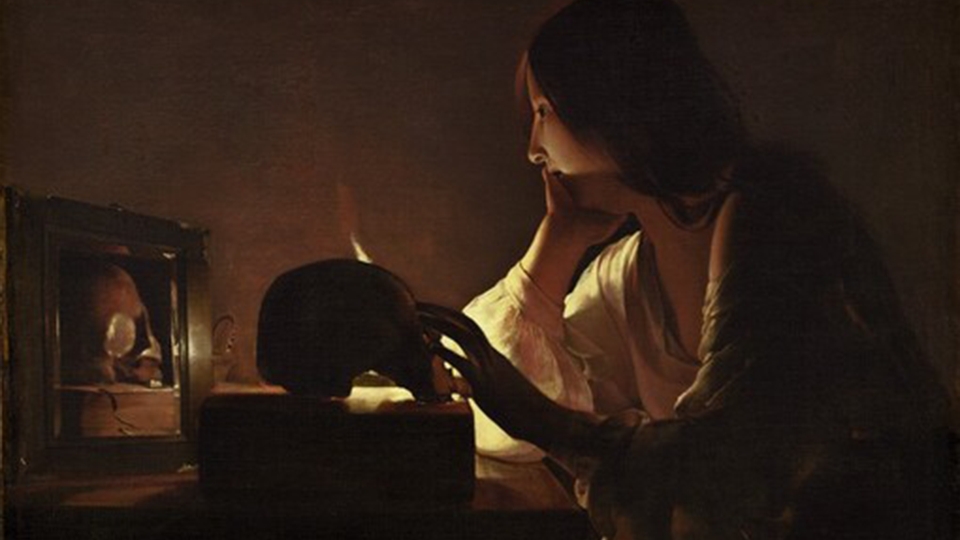

Meditation on the “four last things” – Death, Judgment, Heaven, and Hell – has always been at the heart of the spiritual life of the great Christian saints. Among these, the first two are strictly subordinated to the unseen world mentioned in the first article of the Nicene Creed. For death and judgment, through which God establishes the eternal place of each soul, are merely temporary biographical episodes in view of passing into the “world beyond.” As a well-known historian of religions, Mircea Eliade, said, death is just a passage – a gate to the otherworld. This is why faith in the existence of this unseen world is essential. For the heavenly homeland, where God can be contemplated in the beatific vision, is the ultimate goal of our Christian life.
Both private revelations and the visions recorded in the Bible always have as their main purpose the perpetual reminder of these crucial truths. Throughout history, God has allowed such mystical experiences, even in ancient pagan cultures, precisely to prevent them from being forgotten. For without a strong awareness of the existence of an eternal, imperishable world, no one can have a sufficiently strong motivation to dedicate themselves to the heroism required by holiness. This is why we must never tire, especially in times of crisis, of meditating on them. One of the simplest means of doing this is by reading those sacred texts, starting with the Holy Scriptures, which describe, as much as possible, the world beyond. By doing so, we will follow the wise advice given by Saint Augustine in one of his sermons:
“What we have set our hopes on, brothers and sisters, is nothing in this age, nor in this world, nor anything to do with this kind of success that dazzles people who are forgetful of God. The first thing we have to realize and keep firmly in mind as Christians is that we did not become Christians in order to obtain the good things of this present life, but to obtain goodness knows what else, that God is already promising us, and that we human beings cannot yet grasp” (1 Corinthians 2:9).
The visions of the imperishable world by the great prophets Isaiah and Ezekiel find their fulfillment in the Revelation of the apostle John. Here we encounter the most complete and beautiful symbolic image imaginable of the celestial Jerusalem:
“And there came one of the seven angels, who had the vials full of the seven last plagues, and spoke with me, saying: Come, and I will shew thee the bride, the wife of the Lamb. And he took me up in spirit to a great and high mountain: and he shewed me the holy city Jerusalem coming down out of heaven from God, having the glory of God, and the light thereof was like to a precious stone, as to the jasper stone, even as crystal. And it had a wall great and high, having twelve gates, and in the gates twelve angels, and names written thereon, which are the names of the twelve tribes of the children of Israel. On the east, three gates: and on the north, three gates: and on the south, three gates: and on the west, three gates. And the wall of the city had twelve foundations, and in them, the twelve names of the twelve apostles of the Lamb. (…) And the building of the wall thereof was of jasper stone: but the city itself pure gold, like to clear glass. And the foundations of the wall of the city were adorned with all manner of precious stones. The first foundation was jasper: the second, sapphire: the third, a chalcedony: the fourth, an emerald: the fifth, sardonyx: the sixth, sardius: the seventh, chrysolite: the eighth, beryl: the ninth, a topaz: the tenth, a chrysoprasus: the eleventh, a jacinth: the twelfth, an amethyst. And the twelve gates are twelve pearls, one to each: and every several gate was of one several pearl. And the street of the city was pure gold, as it were transparent glass. And I saw no temple therein. For the Lord God Almighty is the temple thereof, and the Lamb. And the city hath no need of the sun, nor of the moon, to shine in it. For the glory of God hath enlightened it, and the Lamb is the lamp thereof” (Apocalypse 21: 9-21).
Marked by the nostalgia for the Paradise lost through the original sin of Adam and Eve, while also keeping their gaze fixed on the celestial Jerusalem depicted by Saint John the Theologian, the Fathers and Doctors of the Church, along with the saints and mystics of different eras, have transmitted their own teachings and visions meant to draw our attention to a world much more beautiful and better than the corrupted and fallen one we know now.
Don Bosco was shown a garden of unimaginable beauty, which can be reached by traversing a path strewn with roses. Boldly venturing along that path, the saint quickly understands the difficulties it hides: the thorns of the wonderful flowers pierce his skin and flesh, causing his feet to bleed.
A true synthesis of Christian reflection from the patristic era was offered to us by Saint John of Damascus (c. 675–749) in the trilogy known as the Fountain of Knowledge (Gr. Pegé gnóseos). In the last part of his work, we find a special section dedicated to the original Paradise:
“But because God willed to create man from both a visible and an invisible nature, in His own image and likeness, as a king and master of the entire earth and all that is in it, He built for him beforehand a kind of royal palace, in which living, he would have a happy and fortunate life. And this is the divine paradise, planted in Eden by the hands of God, the chamber of all joy and gladness. For Eden means delight. It is situated in the eastern part, higher than all the earth. It has a temperate climate and is illuminated by a very fine and pure air, covered with ever-blooming plants, filled with pleasant fragrance, bathed in light, surpassing the notion of any sensible beauty and adornment: a truly divine land and a dwelling worthy of the one made in the image of God.”
A more detailed description of paradise is provided by another great representative of Syrian Christianity, Saint Ephrem (c.307–373). In one of the most beautiful and profound texts of the fourth century, titled Hymns on Paradise, we find a meditation on the world before the Fall. Although the text should be read in its entirety to understand its deep meanings, I will limit myself here to presenting a few small fragments:
“Who can look upon the splendors of the garden,
seeing its wonderful composition, its skillful proportions,
how spacious it is for those who dwell in it,
how bright are its dwellings?
Its springs delight with their fragrance (…);
The tongue cannot express what it is like inside Paradise,
nor is it sufficient for its outer beauties,
for even the simple adornments of its surroundings
cannot be properly described.
Its colors are cheerful, its fragrances very wonderful,
its beauties much beloved and its delights glorious;
Paradise embraces the limbs with its many delights:
the eyes with its adornments, the ears with its sounds,
the mouth and nostrils with its tastes and fragrances.”
The Christian Middle Ages were no less concerned with the unseen world than the patristic era. One of the most famous texts about the world beyond is the Purgatory of Saint Patrick. Without knowing exactly when it was written (probably towards the end of the 12th century AD), this triple description – of hell, purgatory, and heaven – enjoyed remarkable popularity. As Shane Leslie, quoted by the French historian Jacques le Goff, says, it was “one of the best sellers of the Middle Ages.” In short, it is about the journey of a knight, Owein, into the unseen world, which he reaches through the mouth of a deep cave. Regarding Heaven, the description presents it as being surrounded by a “very high and beautiful wall, with gates of pure gold and precious stones, from which a very pleasant fragrance emanated.” Inside is a marvelous city, like a jewel of great value (the allusion is, of course, to the precious stones in the description of Saint John the Apostle quoted at the beginning of my article).
Most scholastic authors share, in broad terms, this vision, although some of them, like Saint Thomas Aquinas, emphasize the content of the eternal life of those in the celestial Jerusalem, namely the beatific vision of God. For example, the monk Girolamo Savonarola (1452–1495) also presented, in the Compedium de Révélations (Compendium of Revelations), a description of paradise full of wonderful flowers, trees, and indescribable fruits, populated by gentle and friendly little animals. Above these is the hierarchy of angels, over which reigns the Holy Virgin Mary and the Holy Trinity.
The Virgin Mary, his guide, helps him understand the significance of what he has seen: the thorns are the sensitive affections, human sympathies and antipathies, as well as the sum of obstacles, troubles, and sufferings endured by the saints from the world; the roses symbolize love.
To bring us closer to modern times, I have chosen as the last illustrative example of eternal paradise, as it is conceived in the Judeo-Christian tradition, the testimony of a modern Catholic saint: Don Giovanni Bosco (1815–1888). Endowed with exceptional supernatural gifts and special talents, he experienced several extraordinary prophetic dreams. One of them, which occurred in 1847, repeated in 1848 and 1856, allowed him to know both the heaven destined for the chosen ones and the difficulties of the path leading to it.
Don Bosco was shown a garden of unimaginable beauty, which can be reached by traversing a path strewn with roses. Boldly venturing along that path, the saint quickly understands the difficulties it hides: the thorns of the wonderful flowers pierce his skin and flesh, causing his feet to bleed. Eventually, by donning a pair of sturdy shoes, he manages to reach a monumental building, a castle of beauty and wealth inconceivable in our world. The Virgin Mary, his guide, helps him understand the significance of what he has seen: the thorns are the sensitive affections, human sympathies and antipathies, as well as the sum of obstacles, troubles, and sufferings endured by the saints from the world; the roses symbolize love. The boots are all the mortifications and sufferings necessary to be able to step on thorns without being hurt. Clearly, the magnificent palace encountered at the end is the eternal city, the celestial Jerusalem, towards which every true Christian aspires.
Unlike popular images of the unseen world, the Church’s doctrine does not forget to emphasize the mystery that envelops the spiritual realities beyond our current capacity of understanding. The Holy Bible speaks in symbolic images – life, light, peace, wedding feast, the wine of the Kingdom, the Father’s house, the celestial Jerusalem, the garden. All these representations and others like them recall the surprising landscape of Paradise imagined by a Romanian author, Nicolae Steinhardt, who spoke of Paradise as “the place of light and greenery, the flowering meadow teeming with small chubby puppies and white kittens with bows, where the divertissements of Mozart resonate and the angels with the wings of Liliom strive to offer unceasingly sweets and sherbets, where God Himself is, the true God, of the children finally allowed – to come, no matter how old or burdened with heavy memories, to see: the Father with the white beard in the middle, Christ bearing the stigmata and the cross on the right, the purifying and comforting Spirit on the left.”
Indeed, while aware of the difficulty in penetrating the mysteries of faith, we also need such vivid, imaginative representations of Paradise. Even if they may be naive and childish, like the stories of Hans Christian Andersen or Frances Hodgson Burnett, they can comfort our hearts, speaking to us in images about the beauty of true life, of the true world. Without forgetting the reverse of Paradise, hell, which also represents one of the subjects of the saints’ meditation, we must, at least sometimes, remind ourselves why we are Christians: so that, at the end of our current exile, we can rejoice that we have returned home to the Heavenly Father, like the prodigal son.
Santa Maria, Auxilium Christianorum, ora pro nobis!
