
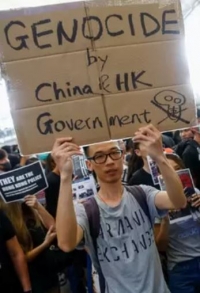

The protests in Hong Kong that are now affecting the former British colony for almost two months make us reflect on the real state of the situation, beyond the slogans of those who defend an ideology or who know China only from (although good) readings.
The people of Hong Kong, as I have said many times, do not want to have to live in the same way as people in mainland China. Hong Kong has never been democratic, but the British colonizers, in addition to guaranteeing excellent infrastructure and a well-functioning city administration, have instilled in the Chinese population that taste for certain freedoms, speech, press, religious belief and these freedoms outside the control of the central government. Democracy and freedom are not the same thing. These freedoms are very restricted in mainland China, which is very worried about foreign interference because of the fear that they might influence their own population with ideas somehow dangerous for the stability of the nation. So the violence in Hong Kong, for lack of a solution, is not decreasing but increasing.
In short, no to foreign interference and ideas that come from outside, and this is affirmed by a state governed by a party called communist. But isn’t communism an idea that comes from outside? But the Chinese reality must be read in these paradoxes. And indeed in this frenzy to sinicize everything, there is precisely this need to keep everything in an indigenous landscape, which guarantees stability and that harmonious civilization proclaimed by Hu Jintao, predecessor of Xi Jinping.
The people of Hong Kong want to continue living as Chinese but outside the recent history of China. A legitimate claim in an ideal sense but difficult, if not impossible, to carry out, also because Hong Kong depends on China for some vital things, such as water supply. Certainly the people of Hong Kong are terrified of having to defend themselves before a court in mainland China. This lack of confidence in their legal system does not seem to echo in the recent document of the Holy See on the civil registration of the clergy, a document in which it is indeed recognized “the fact that there does not appear to be a uniform praxis with regard to the application of the regulations for religious affairs”. In short, there is a lot of arbitrary behavior going on.
Carrie Lam will never withdraw the extradition law (she said recently that she cannot use the word “whitdrawal”), but everyone knows that it will no longer be pulled out. As everyone knows that now, at this stage, that is no longer the real problem. The problem is the relationship between China and the outside world, including the Vatican. Yes, the Holy See that now see as permissible what was considered inconsistent with Catholic church doctrine only a decade ago, to be part of the ‘patriotic Church’.
But let us say it honestly, China is really a mystery and so it is very useful to have a book like “The Never Ending March. China’s Religious Policy and the Catholic Church”) by Sergio Ticozzi, an Italian missionary that is living in Hong Kong for more than 50 years and that is considered one of the greatest experts on China and religion.
In his preface, Professor Stephen Baskerville has affirmed:
Father Sergio Ticozzi, a prominent Italian missionary, has produced an important new account of the religious policies of the Chinese Communist government. It is clear from his account that religion has long been a central preoccupation of the Communist government and that it continues to be so today. The government has long engaged not only in suppression of Christian and other religious beliefs but, increasingly, in campaigns to manipulate those beliefs and channel them into serving the political purposes of the state and Party.” Professor Baskerville go on saying: “Striking in his account is how the Chinese Communist Party continues trying to make ideology function as a political religion. This has an old pedigree, going back to the personality cult of Chairman Mao Zedong (Tse-tung). Today’s campaigns appear to be more sophisticated but perhaps equally repressive and futile. Alongside his own personality cult, President and Party General Secretary Xi Jinping’s “eight-point frugality code” ostensibly attempts to control “formalism, bureaucratic behavior, hedonism and extravagance” and to “ensure that workers have clear political beliefs, high professionalism, commitment and discipline.” As others have discovered, these aims can be achieved much more effectively by simply allowing people to choose their own religious beliefs from the marketplace of ideas.”
The book was published around the time of the provisional agreement between the Holy See and Chinese government, an agreement that seems today not a so happy decision. To understand the background of the whole issue, this book of father Ticozzi is certainly fundamental. Father Ticozzi observed at the end of his book: “The main obstacle for the success of the negotiations seems to be the different concern of the two parties: political concern of the Chinese Foreign Ministry that aims at the diplomatic relations in order to further isolate Taiwan, in contrast with the ecclesiastical concern of the Holy See which wants to avoid a schism in the Church in case of further illicit ordinations of bishops. Consequently, a different understanding of ‘normalization’ of relations becomes evident according to their different expectations. This creates a lot of debates. The Holy See aims at an agreement primarily on religious issues, namely freedom of religion and worship for all Catholics, end of the oppressive measures, a just way for the appointment of Bishops, a proper registration of the clergy, etc. However, the most common understanding of the Chinese authorities, of the majority of news agents and of the ordinary people underscores the political perspective. Even Catholics, including several members of the unofficial Church, look forward for the political solution of the diplomatic recognition of the two sides, since they, unrealistically, hope that it will bring the end of their troubles.” What is the situation now respect October 2018 (the time the book was released)?
It is not better, maybe even more difficult, despite the slogans coming from the official narrative. But to understand China is very difficult, and a book like this one is a very good help in doing so.
