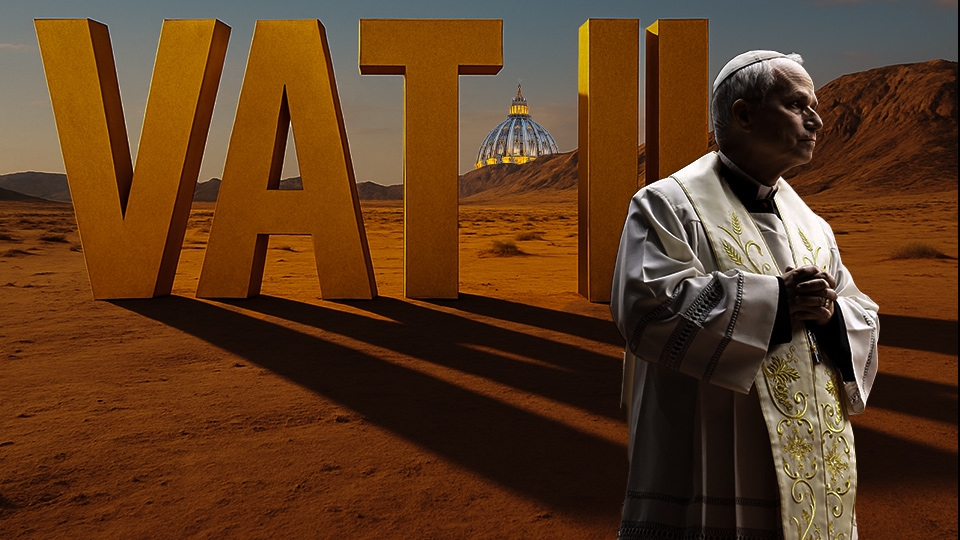

It is true: Traditional Catholics are resolved to adhere to the unadulterated Catholic Faith that for almost two thousand years stood in the way of the unholy ideologies that now reign in Rome since the Second Vatican Council. May God grant Leo XIV the grace to see this clearly and the courage to act heroically to restore what has been lost for sixty years.
“For there is but one party of order capable of restoring peace in the midst of all this turmoil, and that is the party of God. It is this party, therefore, that we must advance, and to it attract as many as possible, if we are really urged by the love of peace.” (St. Pius X, E Supremi Apostolatus, 1903)
In his recent interview with Crux’s Elise Ann Allen, Pope Leo XIV alluded to ideological divisions related to the issue of whether Rome should permit the Tridentine Mass:
“I have not had the chance to really sit down with a group of people who are advocating for the Tridentine rite. There’s an opportunity coming up soon, and I’m sure there will be occasions for that. But that is an issue that I think also, maybe with synodality, we have to sit down and talk about. It’s become the kind of issue that’s so polarized that people aren’t willing to listen to one another, oftentimes. I’ve heard bishops talk to me, they’ve talked to me about that, where they say, ‘we invited them to this and that and they just won’t even hear it’. They don’t even want to talk about it. That’s a problem in itself. It means we’re into ideology now, we’re no longer into the experience of church communion.”
Given that the bishops discussing the issue with Leo XIV presumably oppose those advocating for the Tridentine Mass, it seems that the pope might believe that Traditional Catholics are driven by an illegitimate “ideology.” However, most Traditional Catholics simply believe what the Catholic Church has always taught because it is the system of beliefs handed down from Our Lord to the Apostles and preserved today by those who refuse to abandon it. If, then, Leo XIV or others want to improperly use the term “ideology” to describe the beliefs of Traditional Catholics, our “ideology” is simply that of the “party of God” (in the words of St. Pius X above).
By practically ending the “inflexibility of the system” in Rome, the Council created opportunities for heterodox clerics and theologians to spread their influence and gain power within the Church. Naturally, this has led to the promulgation of man-made ideologies that conflict with immutable Catholic beliefs.
A similar question related to ideology and the Tridentine Mass arose in 1978, as described by Bishop Bernard Tissier de Mallerais in his biography of Archbishop Lefebvre:
“On November 18, [1978,] through an initiative of Cardinal Siri, the new Pope received the Archbishop, who said he was ready ‘to accept the Council in the light of Tradition,’ an expression used by Pope John Paul himself on November 6: ‘The Council must be understood in the light of all holy Tradition and on the basis of the constant Magisterium of the holy Church.’ The Pope said he was happy and saw the problem of celebrating the old Mass only as a disciplinary question. Then Cardinal Franjo Seper, whom the Pope had summoned, exclaimed: ‘Be careful, Holy Father, they make a banner out of this Mass!’” (p. 508)
Like the bishops today who might be telling Leo XIV that Traditional Catholics are driven by ideology, Cardinal Seper warned John Paul II that Archbishop Lefebvre and his sympathizers were making a “banner” out of the Tridentine Mass. In both cases, the implication is that those who favor the Traditional Latin Mass are driven by something illegitimate.
Archbishop Lefebvre addressed this question directly in his 1986 book, Open Letter to Confused Catholics:
“Firstly, I must dispel a misunderstanding so as not to have to return to it. I am not the head of a movement, even less the head of a particular church. I am not, as they never stop writing, ‘the leader of the traditionalists.’ They have come to describe certain persons as ‘Lefebvrists,’ as though it were a case of a party or a school. This is an abuse of language. I have no personal doctrine in the matter of religion. All my life I have held to what I was taught at the French Seminary in Rome, namely Catholic doctrine according to the interpretation given it by the teaching authority of the Church from century to century, since the death of the last Apostle which marked the end of Revelation.”
This is the firm belief for which Archbishop Lefebvre fought and was persecuted; and it is fundamentally the same as that which St. Paul insisted upon in his letter to the Galatians:
“But though we, or an angel from heaven, preach a gospel to you besides that which we have preached to you, let him be anathema. As we said before, so now I say again: If any one preach to you a gospel, besides that which you have received, let him be anathema.” (Galatians, 1:8-9)
In the eyes of those who persecute Traditional Catholics today, this surely sounds very rigid. After all, St. Paul anathematized anyone who would try to fundamentally change what the Church teaches, which means that today’s progressives are all anathema. As such, if Leo XIV and others want to judge the “ideology” of most Traditional Catholics, they should bear in mind that they are likewise judging the non-negotiable convictions of St. Paul (and most other saints) as well.
Because the heterodox clerics and theologians now hold power in Rome, they have usurped the power to judge, condemn, and label — accordingly, anyone standing in the way of their heterodox agenda does so through “ideologies” and must therefore be blocked and silenced.
What, though, can we say about the ideology of those who have denounced Traditional Catholics for roughly sixty years? Why is it that some of the most powerful men in the Church who persecute Traditional Catholics today also champion nominal Catholics such as Nancy Pelosi, Joe Biden, Gavin Newsom, Jimmy Kimmel, and AOC for their ideologies? Such figures would have risked excommunication for their public beliefs and sins prior to Vatican II, but today they are generally afforded far greater respect from Rome than those whose only “crime” is a firm resolve to follow what the Church has always taught. If Leo XIV has good will and common sense, the reality about who is actually acting based on unholy ideologies could ultimately lead him to conclude that Traditional Catholics have been unjustly maligned by those who have far less claim to being loyal sons and daughters of the Church.
Moreover, the ability of Traditional Catholicism’s enemies to hijack the apparent moral authority of the Church to advance anti-Catholic ideologies was facilitated by the Vatican II revolution that Archbishop Lefebvre adamantly opposed. We can better appreciate this if we consider Yves Congar’s triumphant explanation of how the Council undermined the pre-Vatican II safeguards for faithfully transmitting the Catholic Faith:
“By the frankness and openness of its debates, the Council has put an end to what may be described as the inflexibility of the system. We take ‘system’ to mean a coherent set of codified teachings, casuistically-specified rules of procedure, a detailed and very hierarchic organization, means of control and surveillance, rubrics regulating worship — all this is the legacy of scholasticism, the Counter-reformation and the Catholic Restoration of the nineteenth century, subjected to an effective Roman discipline. It will be recalled that Pius XII is supposed to have said: ‘I will be the last Pope to keep all this going.’” (Congar, Challenge to the Church: The Case of Archbishop Lefebvre, pp. 51-52)
By practically ending the “inflexibility of the system” in Rome, the Council created opportunities for heterodox clerics and theologians to spread their influence and gain power within the Church. Naturally, this has led to the promulgation of man-made ideologies that conflict with immutable Catholic beliefs. Because the heterodox clerics and theologians now hold power in Rome, they have usurped the power to judge, condemn, and label — accordingly, anyone standing in the way of their heterodox agenda does so through “ideologies” and must therefore be blocked and silenced.
The only solution (other than God’s intervention) is to return to what St. Pius X expressed so clearly in his Oath Against Modernism:
“I . . . . firmly embrace and accept each and every definition that has been set forth and declared by the unerring teaching authority of the Church, especially those principal truths which are directly opposed to the errors of this day. . . . I sincerely hold that the doctrine of faith was handed down to us from the apostles through the orthodox Fathers in exactly the same meaning and always in the same purport. Therefore, I entirely reject the heretical misrepresentation that dogmas evolve and change from one meaning to another different from the one which the Church held previously. I also condemn every error according to which, in place of the divine deposit which has been given to the spouse of Christ to be carefully guarded by her, there is put a philosophical figment or product of a human conscience that has gradually been developed by human effort and will continue to develop indefinitely.”
If Leo XIV wants to evaluate the question of the Tridentine Mass in terms of Traditional Catholic “ideology,” these words from St. Pius X’s Oath Against Modernism perfectly encapsulate the “ideology” he should associate with those of us who seek to faithfully follow what the Church has always taught. It is true: we are resolved to adhere to the unadulterated Catholic Faith that for almost two thousand years stood in the way of the unholy ideologies that now reign in Rome. May God grant Leo XIV the grace to see this clearly and the courage to act heroically to restore what has been lost for sixty years. In the meantime, we will do all we can to remain in the “party of God,” no matter how many powerful men in Rome tell us we are being rigid, backward, and “ideological.” Immaculate Heart of Mary, pray for us!