
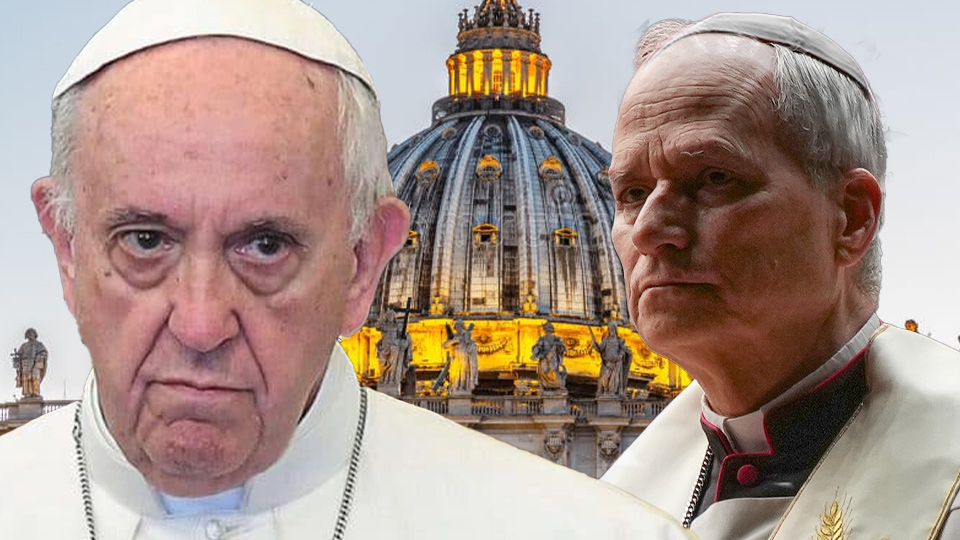

On one side, the Bergoglian apparatus continues to advance its progressive agenda; on the other, a reflective Pontiff, committed to preserving the cohesion of the Church. In the background, an elitist and politicized Vatican media system looms, threatening to influence the faithful and public opinion through prepackaged narratives.
As this scribbler has attempted to describe in many other articles, there is currently a deep dissonance within the Vatican between the Curia and the Pope. The former is entirely the work of Francis and is driven by the goal of advancing the so-called St. Gallen agenda—that is, to reform (read: revolutionize) the Catholic Church in a progressive direction, even if that means contradicting and sweeping under the rug the doctrine handed down by the apostles and their episcopal successors over two thousand years. Synodality, ecumenism, environmentalism, universal fraternity, female diaconate, homosexualism, and sexual permissivism: these are the main themes on which the accelerator is being pressed.
As is now well known, Bergoglio was the candidate backed by the St. Gallen Group in the 2005 and 2013 conclaves. However, once he ascended to the Chair of St. Peter, he acted like a “wild horse”, determined to impose his own vision of the Church—an agenda independent from that of St. Gallen, though largely compatible with it.
Tension within the Vatican is palpable. Members of the Curia hope to be confirmed in their roles, but the dossiers piling up on the Holy Father’s desk are numerous and substantial. Unlike Francis, Pope Leo is not impulsive; he is reflective, methodical, and inclined to listen to everyone and seek counsel from many.
After Bergoglio’s death, his Curia continued to operate as if he were still alive. In fact, in some respects, with even greater momentum and freedom—evidenced by the enthusiasm of Pietro Parolin, the Secretary of State appointed by Francis, who nonetheless often showed impatience with the limited room for maneuver the Argentine Pontiff allowed the Holy See’s official diplomacy. At the same time, the Bergoglian Curia is now concerned that Leo might act or teach in ways that challenge what has been painstakingly accumulated, fragmented, absorbed, and carved up until now. This is why we are witnessing a wave of media statements aimed at reassuring public opinion: there is full continuity between Francis and Leo!
Things, however, are far more complex, and tension within the Vatican is palpable. Members of the Curia hope to be confirmed in their roles, but the dossiers piling up on the Holy Father’s desk are numerous and substantial. Unlike Francis, Pope Leo is not impulsive; he is reflective, methodical, and inclined to listen to everyone and seek counsel from many. We shall see what happens when the moment of decision arrives.
It must be emphasized that, according to canon law, members of the Curia act in persona Papae — that is, they operate in the name and with the authority of the Pope. They exercise ordinary power, but in a vicarious form, as explicitly confirmed by the apostolic constitution Praedicate Evangelium (cf. II.5). In practice, this means that every official act carried out by curial officials is an integral part of the Pope’s governance or teaching activity, and must be considered as if performed by the Pope himself. This makes the current situation all the more delicate: if there is a divergence between the Pope’s intentions and those of the Curia, how can the latter remain coherent in its function? The risk is a kind of institutional schizophrenia.
If the Curia is determined to push for revolution at all costs, Pope Leo seeks instead to keep the Church “cohesive”. He seems willing to tolerate both the devil and holy water within its ranks — perhaps slightly downsizing the former. Yet such a strategy, in the long run, may leave much to be desired.
In addition to the Curia, the entire communications apparatus—firmly shaped by the Bergoglian imprint—has remained active within the Vatican. This topic, both highly sensitive and crucial, has so far been addressed by only a handful of directly involved individuals. In Italy, only journalists Nico Spuntoni and Francesco Capozza have spoken about it.
Typically, although there is no formal requirement, those who write about ecclesiastical affairs are accredited with the Holy See Press Office. All accredited correspondents may — at least in theory — attend various events in which the Pope is present, provided they give prior notice.
I say “in theory” because, according to claims made by the aforementioned Italian journalists, the situation has changed in recent years. During Francis’ pontificate, a private association was granted exclusive access to the most important and sensitive events involving the Pope, effectively sidelining thousands of accredited journalists from around the world. The name of this association is AIGAV — the International Association of Accredited Journalists in the Vatican.
An exclusive club, one might say, composed of just 250 journalists carefully selected by its president, the Mexican journalist Valentina Alazraki. A close friend of Bergoglio—needless to say—who accompanied him on all his apostolic journeys. He used to call her, quite significantly, “the dean”. Alongside her, a very small executive board leads AIGAV and assists in choosing its members. According to Vatican analyst Francesco Capozza, writing in Il Tempo, those selected to join this club are exclusively correspondents “of declared progressive faith”.
In short, it appears that the Vatican’s communications world remains closely tied to the still Bergoglian Curia.
Nico Spuntoni, Vatican correspondent for La Nuova Bussola Quotidiana, has voiced criticism of this elite media circle since the earliest days of the new pontificate. Following Pope Leo’s meeting with media representatives gathered in Rome for the Conclave, Spuntoni wrote that “the Dicastery for Communication, one of the most expensive departments of the Holy See, proved inadequate—even at the most crucial moment”. Despite the inefficiency shown by the Press Office and its Sant’Egidio-affiliated director, Matteo Bruni, “the heavyweights of Vatican communications from the Bergoglian era were front and center, celebrating themselves” before Prevost, even though “most of them had assumed (and hoped) that the more familiar face of Pietro Parolin would appear on the central balcony”.
Spuntoni further pointed out that “the front rows were carefully reserved for television executives, editors of formerly anti-clerical newspapers, and a handful of Vatican journalists (mostly Italian)”. A similar account was offered by Capozza in Il Tempo, who reported that during Pope Leo XIV’s first meeting with the press corps, “only a select few—naturally from AIGAV—were admitted to the front row (separated by a barrier from the others) and granted access to the papal handshake”. According to Capozza, even at the “Mass in the gardens of Castel Gandolfo attended by Ukrainian President Zelensky, only five journalists were present—all of them exclusively affiliated with AIGAV”.
In short, it appears that the Vatican’s communications world remains closely tied to the still Bergoglian Curia. Incidentally, according to my sources, among the names “drawn” by the AIGAV leadership to occupy the front rows during Pope Leo’s first audience with the press was that of Elise Ann Allen — Crux correspondent and newly appointed biographer of Pope Leo, chosen (or perhaps suggested by someone) for the role. A coincidence, to say the least, that raises eyebrows.
It is the reign of orchestrated ambiguity, which sows confusion among the faithful and undermines their trust in the Church. If Leo XIV truly wishes to safeguard ecclesial cohesion—and even defend the integrity of the faith—he must necessarily intervene on this front as well, restoring dignity and freedom to the Vatican’s communications sphere.
During Francis’s pontificate, Vatican communications operated in a way that concealed scandals and amplified the voices of the most radical modernists. Today, this media structure is no longer an autonomous entity; it exists in symbiosis with the Curia, which—as has been noted repeatedly—still bears Francis’ imprint. This media caste mirrors the Curia’s logic and safeguards their interests. As long as that Curia endures, its media apparatus will continue to wield influence and power.
Understandably, Pope Leo XIV faces far more pressing challenges to address and resolve. Nevertheless, the issue of Vatican communications and the monopolization of information cannot be overlooked, as it poses a problem of immense ecclesial and pastoral significance. If the Church is, by divine institution, the guardian and teacher of Truth, it cannot afford to delegate the management of its public image to narrow media elites that are clearly ideologically driven.
The Holy Father should find the time and strength to address this matter seriously and verify whether what has emerged thus far corresponds to the truth — because this is not merely about journalistic dynamics, but about genuine discrimination against “less aligned” reporters, namely those who refuse to conform to a prepackaged progressive framework. The Bergoglians are well aware that controlling public opinion means influencing millions of faithful and shaping—at least in appearance—the image of the Church.
The information age is, above all, the age of disinformation. With control over communication channels, false narratives can be constructed, speeches and documents distorted, and it can be made to appear as though the Pope said something when, in fact, he uttered the exact opposite. It is the reign of orchestrated ambiguity, which sows confusion among the faithful and undermines their trust in the Church.
If Leo XIV truly wishes to safeguard ecclesial cohesion—and even defend the integrity of the faith—he must necessarily intervene on this front as well, restoring dignity and freedom to the Vatican’s communications sphere. This is not merely a matter of transparency, but of justice and fidelity to the mission Christ entrusted to His Church: to proclaim the truth of the Gospel without veils or hypocrisy, without manipulation or censorship.