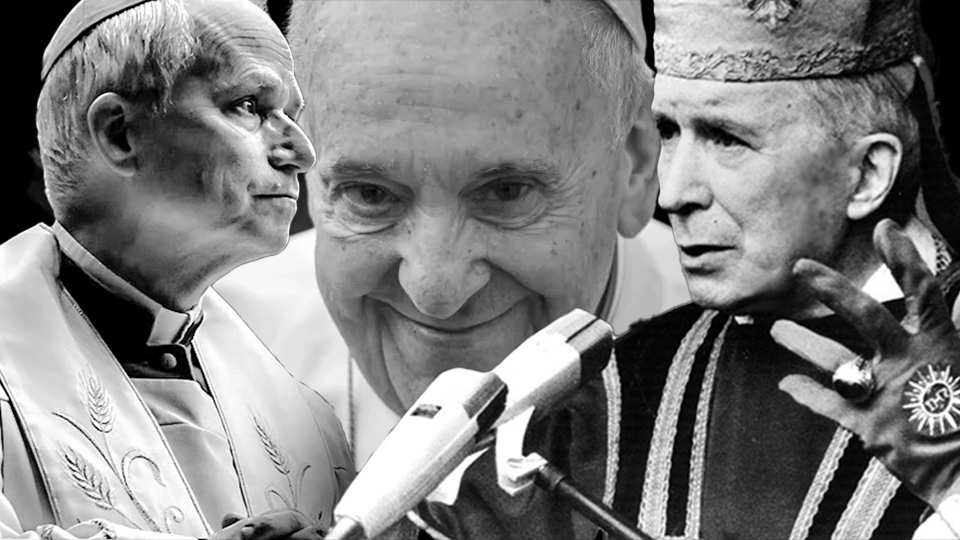

Archbishop Lefebvre’s exceptional spiritual vision allowed him to see the wrong-way signs on the path of the Vatican II revolution sooner than most. As those wrong-way signs became so clear with Francis, and many others opened their eyes. As those wrong-way signs fade, we face a real challenge in trying to restore the unadulterated Catholic Faith. This process is not nearly as attention-grabbing as declaring Leo XIV to be Francis 2.0, or as soothing as imagining the crisis to be over, but it is the only process that can effectively fight the errors plaguing the Church and world today.
In his famous 1974 Declaration, Archbishop Marcel Lefebvre set forth a response to the Vatican II revolution that, for many Traditional Catholics, contains some of the most important guidance on how we ought to understand, and react to, the crisis in the Church:
“This Reformation, born of Liberalism and Modernism, is poisoned through and through; it derives from heresy and ends in heresy, even if all its acts are not formally heretical. It is therefore impossible for any conscientious and faithful Catholic to espouse this Reformation or to submit to it in any way whatsoever. The only attitude of faithfulness to the Church and Catholic doctrine, in view of our salvation, is a categorical refusal to accept this Reformation. That is why, without any spirit of rebellion, bitterness or resentment, we pursue our work of forming priests, with the timeless Magisterium as our guide. We are persuaded that we can render no greater service to the Holy Catholic Church, to the Sovereign Pontiff and to posterity. That is why we hold fast to all that has been believed and practiced in the faith, morals, liturgy, teaching of the catechism, formation of the priest and institution of the Church, by the Church of all time; to all these things as codified in those books which saw day before the Modernist influence of the Council. This we shall do until such time that the true light of Tradition dissipates the darkness obscuring the sky of Eternal Rome.”
As Archbishop Lefebvre expressed so well, the best service we can render to the Holy Catholic Church and the Sovereign Pontiff is to categorically reject the Vatican II revolution that has caused so much devastation and confusion. This remains the case whether the pope is overtly opposed to genuine Catholicism (such as Francis), or shows at least superficial signs of wanting to bridge the gap between genuine Catholicism and the Vatican II revolution (such as Leo XIV). The crisis in the Catholic Church will persist until God intervenes directly or uses human instruments to overcome the Vatican II revolution, and we must continue the fight for the unadulterated Faith until that happens.
There arose profound disagreements among serious Catholics about what Francis’s attacks on the Catholic Faith meant: was Francis simply taking the Vatican II revolution to its next logical point of development, or was he instead diverging from a post-Conciliar path that had been completely orthodox?
If we agree with Archbishop Lefebvre’s 1974 Declaration and the implications that flow from it, it would be difficult to favorably view any pope who does not do all he can to counteract the Vatican II revolution. Sincere Catholics may disagree on what a pope can actually accomplish in combatting the current crisis but, at a minimum, the pope has a duty to condemn all of the errors plaguing the Church and censure heretics — popes have always done this and we arguably need it more than ever now. And yet many of the greatest errors facing the Church, including false ecumenism and religious liberty, were promoted (rather than condemned) by Paul VI and each of his successors. As we know, though, many Catholics who deplored the evils afflicting the Church long before any of us heard of Jorge Bergoglio also esteemed John Paul II and Benedict XVI as great defenders of Catholic truth.
There have been various reasons for this reluctance (or refusal) to assign serious blame for the crisis in the Church to the popes overseeing it, but those reasons often have praiseworthy roots, such as obedience and respect for the hierarchy. Some Catholics also believe that calling into question the orthodoxy of the pope, or Vatican II, tends to undermine what the Church has taught about its indefectibility. Archbishop Lefebvre and those who agreed with his 1974 Declaration had the same general concerns, but they could not look past the tragic reality that the post-Conciliar popes had allowed previously-condemned errors to flourish.
With Benedict XVI’s resignation and the election of Francis, the dynamic changed for some Catholics. Whereas his predecessors showed comparative reserve in implementing the revolution, Francis seemed to delight in explicitly developing all of the most dangerous aspects of the Council and its aftermath. As a result, even those Catholics who thoroughly disagreed with Archbishop Lefebvre’s resistance to Paul VI and John Paul II found themselves resisting Francis in much the same way.
Even so, there arose profound disagreements among serious Catholics about what Francis’s attacks on the Catholic Faith meant: was Francis simply taking the Vatican II revolution to its next logical point of development, or was he instead diverging from a post-Conciliar path that had been completely orthodox? For Catholics who agreed with Archbishop Lefebvre’s 1974 Declaration, Francis’s sinful missteps were simply unmistakable wrong-way signs on the path of the same Vatican II revolution that began decades ago; for Catholics who had found little or no problem with Benedict XVI or his predecessors, it appeared as though Francis was attempting to chart a new, impermissible course for the Church.
The real significance of the fact that Leo XIV currently appears to be “more Catholic” than Francis is not that we think the crisis has ended. Rather, the importance is that it suggests that he might be more willing and able to cooperate with God’s grace to cause Rome to eventually abandon the path of the Vatican II revolution.
The difference between these perspectives naturally shapes how we evaluate Leo XIV. From the standpoint of Traditional Catholics who agree with what Archbishop Lefebvre wrote in his 1974 Declaration, the real significance of the fact that Leo XIV currently appears to be “more Catholic” than Francis is not that we think the crisis has ended. Rather, the importance is that it suggests that he might be more willing and able to cooperate with God’s grace to cause Rome to eventually abandon the path of the Vatican II revolution. And, because Leo XIV has expressed his respect for St. Augustine and Pope Leo XIII, we can also attempt to persuade him that the Vatican II revolution is fundamentally opposed to the ideas of Augustine and Leo XIII (as the Remnant has done, here and here). Because the conclave’s cardinals never would have knowingly elected a man who showed signs of returning to Tradition, we do not think he will reverse course absent a miracle; but we can hope, pray, and do all we can to follow what Archbishop Lefebvre expressed in the 1974 Declaration. We have acted in this manner for decades and will continue until Rome returns to the unadulterated Catholic Faith.
Conversely, those who think that the crisis essentially began in earnest with Francis face new challenges with Leo XIV, which we can consider in terms of two opposing viewpoints already evident: should they treat the new pope as Francis 2.0 until he definitively rejects the worst of Francis’s unholy initiatives, or will they be persuaded by Leo XIV’s Catholic appearances that the crisis has come to an end?
We may ultimately discover that the former viewpoint is somewhat accurate on some level but, even if it is, seeing Leo XIV as Francis 2.0 does not begin to account for the deepest evils that have been afflicting the Church for over sixty years. As discussed in a previous article, it is evident that Francis was a faithful son of the Vatican II revolution. Obviously we should care both about Leo XIV’s scandalous actions and his failure to reverse Francis’s evil works, but the worst thing that we can say about Leo XIV is that he is continuing to advance the Vatican II revolution. Those who condemn Leo XIV without reference to the evils of the path that Rome has taken since the Council almost invariably attack the symptoms while striving to protect the cancer.
The other common viewpoint — that Leo XIV has ended the crisis — will likely become more prevalent if the pope takes one or more of the following actions: reversing Traditionis Custodes, correcting Fiducia Supplicans or Amoris Laetitia, “regularizing” the Society of St. Pius X, or neutering the disastrous Synod on Synodality. While any of these actions could certainly be beneficial, the risk is that they could come at the expense of silencing opposition to any of the evil works from Francis that Leo XIV would let stand. If this happens, the cancer will be protected (as with the viewpoint above) but so will a number of the life-threatening symptoms.
Archbishop Lefebvre’s exceptional spiritual vision allowed him to see the wrong-way signs on the path of the Vatican II revolution sooner than most, even during the first session of the Council. As those wrong-way signs became so clear with Francis, many others began to open their eyes. Now that those wrong-way signs have faded to some extent, we face a real challenge in trying to remain focused on restoring the unadulterated Catholic Faith in its entirety. This process is not nearly as attention-grabbing as declaring Leo XIV to be Francis 2.0, or as soothing as imagining the crisis to be over, but it is the only process that can effectively fight the errors plaguing the Church and world today. Immaculate Heart of Mary, pray for us!