
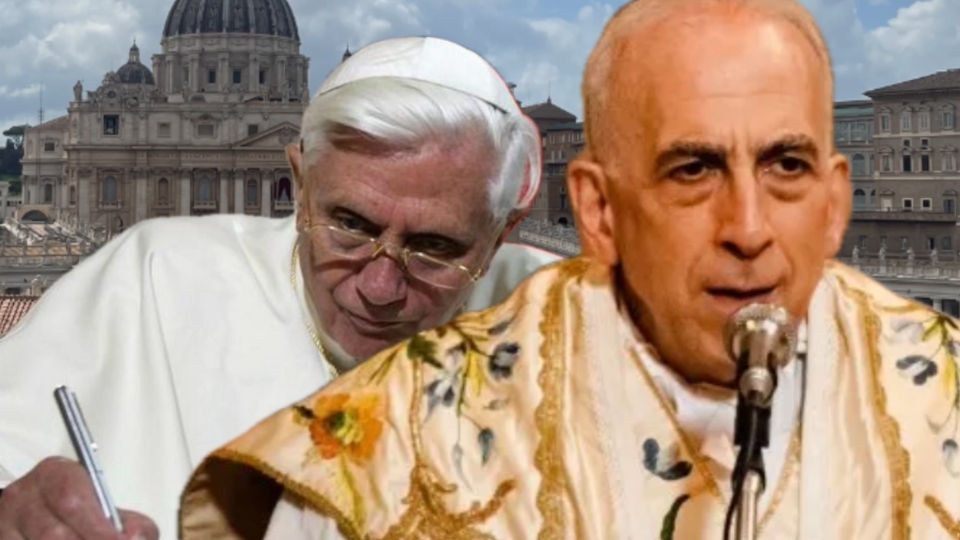

From the correspondence, it emerges quite clearly that Benedict XVI considered his resignation to be free, valid, and complete. Consequently, he also deemed Francis’s election to be valid. From what can be gathered from the correspondence analyzed, Benedict XVI believed he had resigned (also) from the papal office as Head of the Catholic Church because he had renounced the ministry of Bishop of Rome.
The Italian publishing house Omni Die has released a book authored by Nicola Bux and Vito Palmiotti titled Realtà e Utopia nella Chiesa. Giovanni Paolo II e Benedetto XVI vs don Tonino Bello e Francesco (‘Reality and Utopia in the Church. John Paul II and Benedict XVI vs Don Tonino Bello and Francis’). Within this book, previously unpublished correspondence (although known to some) between Benedict XVI and Fr. Nicola Bux has been made public, dating back to the aftermath of Ratzinger’s resignation from the ministry of Bishop of Rome.
Bux’s letter is dated July 19, 2014, but according to Bux himself, it was handed to the “Pope Emeritus” during a private audience granted on July 21 at 12:15 p.m., at the Mater Ecclesiae Monastery in the Vatican, where Benedict resided. Ratzinger’s reply is dated August 21, 2014. This publication has reignited, at least in Italy, the debate over the validity of Benedict XVI’s resignation and the subsequent papal election of Francis.
In truth, the topic is not new, since a few months before his reply to Fr. Bux, Benedict XVI himself, responding to a letter partly similar to that of the Italian prelate — sent to him by journalist and current editorial director of the Dicastery for Communication of the Holy See, Andrea Tornielli — reaffirmed that his resignation was valid and urged an end to speculation on the matter.
The truth is that the idea of resigning from the papacy had always been present in Benedict XVI’s mind since the very beginning of his pontificate, as suggested by his very first words: “Pray for me, that I may not flee for fear of the wolves” (Inaugural Homily, April 24, 2005).
It should be noted that the topic of the correspondence, at least at first glance, does not seem to align with the theme of the book. In fact, the book does not address Benedict XVI’s resignation from a historical, canonical, or theological perspective, but rather contrasts the realism of governance adopted by Popes John Paul II and Benedict XVI with the opposing utopianism—legitimate offspring of the theology of the people—adopted in the governance and magisterium of Francis. The correspondence in question was therefore published as an appendix to the book.
Bux addressed Benedict XVI with a respectful yet very direct appeal, born out of concern for the consequences of the papal resignation and, above all, the creation of the figure of the Pope Emeritus. Ratzinger’s resignation appeared problematic both in form and in its effects, because it differed from those made in the past and even from those merely drafted by more recent popes such as Paul VI and John Paul II.
The Pope’s resignation from his office is recognized and regulated by canon law (cf. can. 332 §2). However, on February 11, 2013, Ratzinger declared that he would renounce the “ministry of Bishop of Rome” starting at 8:00 p.m. on February 28, thereby creating an apparent conflict both with what the canon prescribes (which requires an explicit renunciation of the office—munus—of Roman Pontiff) and with the juridical nature of the resignation itself, which—as legal scholars say—is a pure act. That is, an act whose legal effects must be immediate, and not deferred as Benedict XVI did. Similar to marriage, the effects of a resignation must be immediate, otherwise the act is null.
As for the problematic nature of the form, however, Bux seems to place it in the background compared to the problematic nature of its effects. He merely notes that, “according to other theologians” (not specifically named, though likely referring to the prelates who assisted him in drafting the letter), Benedict XVI could not “consider himself to have renounced only the exercise of the ministry and not also the munus, because this risks a schism.” We do not know who these “theologians” are—perhaps a reference to Cardinals Burke and Brandmüller? Fr. Nicola should clarify the mystery.
The truth is that the idea of resigning from the papacy had always been present in Benedict XVI’s mind since the very beginning of his pontificate, as suggested by his very first words: “Pray for me, that I may not flee for fear of the wolves” (Inaugural Homily, April 24, 2005). Moreover, Fr. Nicola Bux has recalled on several occasions that Pope Ratzinger, in 2006, asked the Pontifical Council for Legislative Texts for an opinion regarding papal resignation. According to Bux’s testimony, his response was that a pope could indeed resign for grave reasons, but that doing so would be inappropriate.
Bux preferred to dwell on and seek clarification directly from Benedict XVI regarding the effects of the resignation on the resigning subject—that is, on Benedict himself. As is well known, Benedict created ex nihilo the institution of the Pope Emeritus, further confusing the faithful. If the Petrine ministry is unique and indivisible, and there cannot be two popes at the same time, what is the meaning of establishing such a title?
Brandmüller, for his part, was deeply disappointed by Ratzinger’s resignation and by his decision to establish the figure of the Pope Emeritus without prior consultation, to the point of repeatedly and severely criticizing the choice. In fact, according to various reports, both Bux and the cardinals in question had urged Benedict XVI—while still reigning—to clarify, from a normative standpoint, what would happen if a pope freely decided to resign from his office. However, this request was never answered.
For this reason, rather than focusing on the form, Bux preferred to dwell on and seek clarification directly from Benedict XVI regarding the effects of the resignation on the resigning subject—that is, on Benedict himself. As is well known, he created ex nihilo the institution of the Pope Emeritus, further confusing the faithful. If the Petrine ministry is unique and indivisible, and there cannot be two popes at the same time, what is the meaning of establishing such a title? What is the point of instituting a figure analogous to that of the Bishop Emeritus, given that the episcopate consists in the perfection of holy orders and, as such, implies an indelible character that goes beyond any resignation from pastoral leadership of a diocese, and even beyond the death of the individual?
In other words, the episcopate has a sacramental nature and therefore modifies the subject in a substantial way, whereas the papacy does not have a sacramental nature and thus modifies the subject only in an accidental way: when the pope dies, he ceases to be pope.
Saint Pius V, for example, is—strictly speaking—not still pope in Heaven, even though he is commemorated by the Church militant with his papal name. Yet he remains a bishop for all eternity, since the episcopate has imprinted on his soul, in an indelible way, the sacramental character.
Bux therefore poses six observations to Joseph Ratzinger regarding the figure of the Pope Emeritus. Only three of them receive a response—and even then, rather succinct and incomplete (as Bux himself acknowledges in his commentary on the correspondence)—since, as we shall see, Benedict XVI did not intend to clarify the meaning of Pope Emeritus, asserting that “the question as such, from a theological and juridical point of view, is clear.”
On the legitimacy and completeness of the resignation.
Bux’s first observation, according to Benedict XVI himself, is the most important. In his reply letter, Benedict notes: “The true answer to the questions you raise is found in the first six lines of point number 1 of your text. Everything else—you yourself say—is not an objective problem, but only ours, a mental one.”
In the lines in question, Nicola Bux wrote: “Dogmatically and canonically, it has always been unquestionable and beyond doubt that the Pope can freely resign and that his resignation is fully valid; his is also an office, which can be accepted and exercised, and from which one can also resign with full and complete effect—meaning the office and everything connected to it is left vacant. This is a certainty not only from a canonical standpoint, but also from a philosophical and anthropological one (otherwise it would amount to slavery).” In this way, Ratzinger would have implied that, at least in his intentions, the resignation was free, full, and valid.
It was precisely this mistaken conception of the papacy that allowed Benedict XVI to “invent” the canonical status of the papal emeritus, analogous to that of a bishop emeritus. Moreover, in his Declaratio, Benedict XVI explicitly renounced only the simple episcopal see of Rome, and not the primatial office of the Pope as Head of the Catholic Church.
Bux, for his part, added that although a papal resignation is legitimate, it should always be considered “inconvenient, inopportune, and potentially harmful.” Indeed, it is difficult to deny—more than twelve years later—that Ratzinger’s resignation has caused a series of very serious problems for the Catholic Church. Bux noted that “confusion is growing,” and warned: “One hopes it does not reach the point of irreparability, given that people are beginning to write and speak of a creeping schism and of antipopes.”
In response, Benedict XVI wrote: “To say that in my resignation I left only the exercise of the ministry and not also the munus is contrary to clear dogmatic-canonical doctrine,” and that “if some journalists speak of a creeping schism, they deserve no attention.” In truth, at the time no journalist had yet publicly questioned the validity of Francis’s canonical election. The debate surrounding the figure of the emeritus pope was still largely confined to academic circles, and even then without denying the legitimacy of Francis’s election. It was only on October 3, 2014—less than two months after Ratzinger’s letter—that Italian journalist Antonio Socci published his book Non è Francesco (Mondadori).
In the book, the author questioned the canonical validity of Bergoglio’s papal election, triggering a sort of domino effect in the years that followed. Several scholars, journalists, and even prelates—especially in Italy, but not only—began to put forward theories and reconstructions, with varying degrees of detail, all aimed at demonstrating that Benedict XVI’s resignation was not valid and that Francis was, in fact, an antipope or at least a so-called doubtful pope.
The Parallel Between a Diocesan Bishop and the Bishop of Rome
Nicola Bux continued in his letter by asking whether the Pope could resign from his ministry like any diocesan bishop. Benedict XVI responded by affirming the validity of this parallel. On this point, Ratzinger added: “Obviously, there is a difference [between a bishop and the Pope] – not theological but pastoral.”
This, in my view, is the pivotal point of the entire Bux–Ratzinger correspondence. In fact, what seems “obvious” to Benedict XVI is not at all obvious within Catholic theological tradition. It is simply not true that there is no theological difference between a bishop and the Pope. On the contrary, we can say that the difference between the Pope and a bishop is not only pastoral, but above all theological. The Pope is, in fact, the apex of the hierarchy of jurisdiction, whereas the bishop represents the fullness of the sacred Order. Now, these two hierarchies or powers are distinct, though not disjoined or separable.
This letter, then, confirms what has long been recognized in academic circles, but which struggles to emerge beyond them. This difficulty is due to a kind of aura of sanctity and idealization that has surrounded the figure of Joseph Ratzinger in wide sectors of more conservative and traditionalist Catholicism. Such veneration has often hindered a clear and critical reading of the limits of his theology, making it difficult to engage in a serious and in-depth discussion of his thought.
The asserted “non-theological but pastoral” difference between the figure of the Pope and that of the bishop is the keystone for understanding the true meaning of the “Pope Emeritus” in the mind of theologian Joseph Ratzinger. The “Pope Emeritus”, according to the Rahnerian–Ratzingerian lexicon, is synonymous with “passive or contemplative subject of the shared Papacy”.
Benedict XVI has always retained an erroneous conception of the papacy, stemming from his well-known neo-modernist formation (later significantly toned down) and from his youthful friendship with theologian Karl Rahner. Rahner, in fact, in at least two books (Das Bischofsamt in der Kirche [‘The Office of Bishop in the Church’], 1964; and Vorfragen zu einem ökumenischen Amtsverständnis [‘Preliminary Questions on an Ecumenical Understanding of Ministry’], 1974), argued—against the Church’s two-thousand-year-old teaching—that the papacy was not merely the highest office of governance within the ecclesiastical institution, but the fourth degree of the Sacrament of Holy Orders (after the diaconate, priesthood, and episcopate). Consequently, according to Rahner, one would not be pope from election until death or resignation, but forever.
Furthermore, based on this sacramental conception of the papacy, Rahner proposed an idea of an expanded or shared papacy—that is, an office split into two subjects: the active Pope and the passive (or contemplative) Pope. The echo of this doctrine is clearly present in Benedict XVI’s last General Audience:
“The real gravity of the decision [to accept the papal election, Editor’s note] was also due to the fact that from that moment on I was engaged always and forever by the Lord. […] The “always” is also a “for ever” – there can no longer be a return to the private sphere. My decision to resign the active exercise of the ministry does not revoke this. I do not return to private life, to a life of travel, meetings, receptions, conferences, and so on. I am not abandoning the cross, but remaining in a new way at the side of the crucified Lord. I no longer bear the power of office for the governance of the Church, but in the service of prayer I remain, so to speak, in the enclosure of Saint Peter.” (February 27, 2013)
Moreover, in a lecture at the Gregorian University in 2016, the then personal secretary of Pope Ratzinger, Monsignor Georg Gänswein (now Apostolic Nuncio), clearly spoke of a “shared papacy” between an active and a contemplative subject. Evidently, what was said by Monsignor Gänswein must be considered as certainly agreed upon and approved by the “Pope Emeritus.”
It was precisely this mistaken conception of the papacy that allowed Benedict XVI to “invent” the canonical status of the papal emeritus, analogous to that of a bishop emeritus. Moreover, in his Declaratio, Benedict XVI explicitly renounced only the simple episcopal see of Rome, and not the primatial office of the Pope as Head of the Catholic Church. While it is true that the office of the pope includes the Roman see—so that renouncing the former also entails renouncing the latter—the reverse is not equally true: renouncing the episcopate of Rome does not automatically mean renouncing the Petrine primacy. This is analogous to what happened with Saint Peter, who remained pope even after renouncing the episcopal see of Antioch to move to Rome.
Conclusion of the Bux–Ratzinger Correspondence Analysis
From the correspondence, it emerges quite clearly that Benedict XVI considered his resignation to be free, valid, and complete. Consequently, he also deemed Francis’s election to be valid. This is not surprising, although, to be fair, he never explicitly stated that Bergoglio was the only pope. However, in the case of papal resignation—as with any resignation from an ecclesiastical office—intention alone is not sufficient to guarantee validity: the act must be consistent with and proportionate to its juridical nature. This principle is enshrined in the Code of Canon Law itself (cf. can. 126), which states that substantial error invalidates the act of resignation.
In my view, Bergoglio’s pontificate can only be judged by historians and canonists of future generations, who did not experience these events firsthand and will therefore be able to look back with the emotional detachment necessary to evaluate them objectively.
From what can be gathered from the correspondence analyzed, Benedict XVI believed he had resigned (also) from the papal office as Head of the Catholic Church because he had renounced the ministry of Bishop of Rome. In fact, according to his view, there would be no theological differences between the figure of the Pope and that of a bishop—only pastoral ones. However, as we have seen, this is not correct. Furthermore, within the correspondence, there is no mention of the issue of the pure act, whose violation could perhaps even more clearly constitute a substantial error that might have invalidated the resignation.
The asserted “non-theological but pastoral” difference between the figure of the Pope and that of the bishop is the keystone for understanding the true meaning of the “Pope Emeritus” in the mind of theologian Joseph Ratzinger—a conception that is, in itself, consistent with the theological and ecclesiological formation of the Bavarian theologian. The “Pope Emeritus”, according to the Rahnerian–Ratzingerian lexicon, is synonymous with “passive or contemplative subject of the shared Papacy”.
As stated in the appendix of the book Realtà e Utopia nella Chiesa, Bux chose to publish this correspondence only now because “with the death of Francis and the election of Pope Leo XIV, he considers the emotional phase opened by Benedict XVI’s resignation to be concluded.” However, the reactions in the journalistic sphere—both supportive and critical—are numerous and suggest that emotions are still very much alive.
Indeed, it is hard to imagine that such a complex and, in many respects, unclear chapter in Church history—namely Benedict XVI’s resignation from the Papacy—could be considered closed with the election of Leo XIV, who was chosen also with the aim of healing the many fractures caused by Francis and addressing the unfinished processes he initiated during his twelve-year reign. In my view, Bergoglio’s pontificate can only be judged by historians and canonists of future generations, who did not experience these events firsthand and will therefore be able to look back with the emotional detachment necessary to evaluate them objectively.
Bux himself acknowledged in his letter to Ratzinger that the resignation would influence “his successors,” and thus not only Francis. Significantly, as early as 2018, in a notable interview with journalist Aldo Maria Valli, he urged an investigation into that resignation.
b