
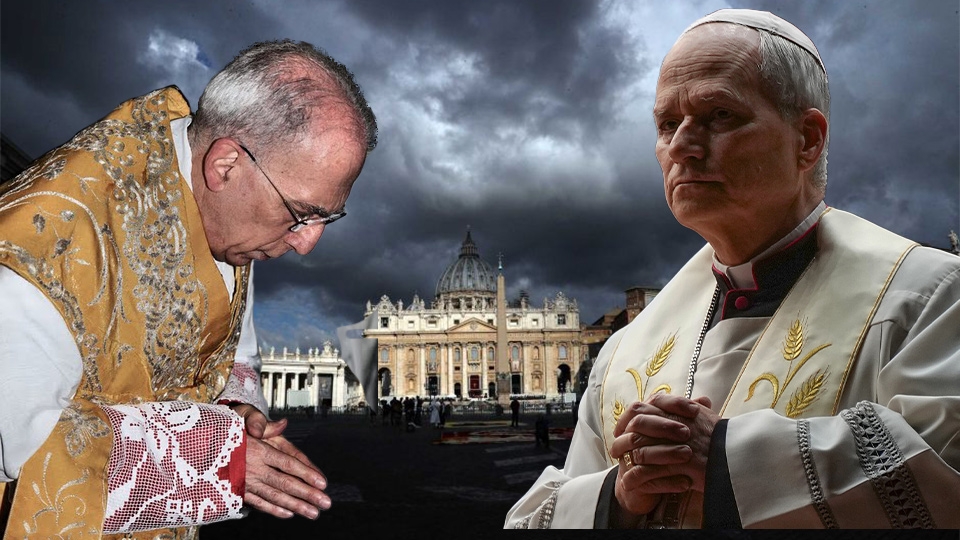

“The absolute first step for the Pope is to return to proclaiming Jesus Christ as the one true Savior. Leo has already done this in his first three addresses: to Rome and the world from the Blessing Loggia, to the Cardinals in the Sistine Chapel the day after the Conclave, and during the Mass inaugurating his pontificate.” – Fr. Nicola Bux
Fr. Nicola Bux is a distinguished Italian Catholic priest and theologian. He has been Consultor at the Congregation for the Causes of Saints (1998-2019), the Sacred Congregation for the Doctrine of the Faith (2002-2013), the Office for the Liturgical Celebrations of the Supreme Pontiff (2008-2013), and the Congregation for Divine Worship (2010-2018); assistant to the Special Secretary in the Synod of Bishops on the Eucharist (October 2-23, 2005) and in the Synod on the Middle East (2010). Jurist and Doctor in Eastern Ecclesiastical Sciences, he has been a professor of Eastern Liturgy and Sacramental Theology at several prestigious universities (Jerusalem, Rome, Bari). Consultant and personal friend of Pope Benedict XVI, and currently of Cardinal Raymond Leo Burke, under whose patronage, along with the assistance of other distinguished theologians, he founded the ‘Ecclesia Mater’ School. Through this institution, he promotes Catholic doctrine in Italy, respecting Apostolic Tradition and, in particular, devotion to the Traditional Latin Mass (TLM). Lastly, to satisfy my vanity—may God and the reader forgive me!—I note that Fr. Bux authored the preface to my book ‘La Tiara e la Loggia: la lotta della Massoneria contro la Chiesa’ (Verona: Fede & Cultura, 2023).
G. Masciullo: Dear Monsignor Nicola Bux, thank you for granting this interview for The Remnant Newspaper. On May 8, the cardinals elected Cardinal Robert F. Prevost as Pope, who chose the name Leo. The Conclave was remarkably swift—only four ballots. In your opinion, how did the consensus around this name come about?
Fr. Bux: Thanks to the interventions of the cardinals during the Pre-Conclave—an insightful initiative by John Paul II in the Constitution Universi Dominici Gregis—a thorough analysis of the Church’s situation after the last Pontificate emerged, highlighting the urgent need to restore unity and communion. The Holy Spirit guided the reflections and convictions of the cardinals, who, it seems, remained receptive to His inspiration. This harmonious interaction between human freedom and divine guidance fostered broad consensus around the name of Cardinal Robert Francis Prevost.
G. Masciullo: The crisis in the Church is a dramatic reality, yet many self-proclaimed Catholics fail to recognize it. In your view, if Pope Leo wishes to initiate processes to heal this crisis, what should be the first steps?
Fr. Bux: The absolute first step is to return to proclaiming Jesus Christ as the one true Savior. Leo has already done this in his first three addresses: to Rome and the world from the Blessing Loggia, to the Cardinals in the Sistine Chapel the day after the Conclave, and during the Mass inaugurating his pontificate.
Significantly, in his audience with the Pontifical Mission Societies on May 22, he stated that Jesus Christ must be made known because without Him, there will be no peace in the world. The Church has often endured dramatic periods, sometimes due to the unfaithfulness of its pastors, yet the faithful do not always recognize it—especially in an age where emotions dominate knowledge, and the realism of Saint Thomas Aquinas is often lost among Church leaders.
Lists of doctrinal ambiguities already circulate, such as: accompanying people in their fragilities rather than calling them to convert from sin; equating all religions instead of proclaiming the true faith in Jesus Christ; and more. There is hope that the new Pope will bring doctrinal clarity and not yield to the pressures of the world and the media, which remain hostage to the dictatorship of relativism.
Perhaps this is a blessing in disguise, as the people possess a simple faith and do not always perceive doctrinal ambiguities in their pastors’ teachings, starting with the Pope. Thankfully, not all pastors have lost sight of Catholic doctrine, as evidenced by the two sets of Dubia raised by the Cardinals—questions to which the new Pope must at least indirectly respond. This will help heal divisions.
Lists of doctrinal ambiguities already circulate, such as: accompanying people in their fragilities rather than calling them to convert from sin; equating all religions instead of proclaiming the true faith in Jesus Christ; and more.
There is hope that the new Pope will bring doctrinal clarity and not yield to the pressures of the world and the media, which remain hostage to the dictatorship of relativism.
G. Masciullo: I believe one of Pope Leo’s greatest challenges will be preserving or promoting unity. However, I fear that one of the Church’s greatest risks today is confusing unity—rooted in the same faith—with the mere coexistence of differing opinions and sensibilities, which may contradict one another and even the Gospel of Christ. How can this risk be avoided?
Fr. Bux: Seventeen hundred years ago, the Fathers of the Council of Nicaea framed the debate on Christ’s identity—both Man and God—around a Symbol (from the Greek term meaning “to bring together”) of the Catholic faith. This is far removed from the coexistence of differing or even opposing philosophical and theological opinions. Difference implies opposition, whereas diversity can be harmonized into unity, but only in relation to the truth of Jesus Christ.
As Pope Leo XIV’s Augustinian motto states: In illo uno unum—“In the one Christ, we are one.” Otherwise, the Church risks becoming “anglicanized” and disintegrating, as has happened to the so-called Anglican Communion and to Protestant communities, whose leaderships have renounced the one true Church.
True religion and the true Church rest upon the truth of Christ. Only in this way can they communicate the truth about humanity and the world, as John Paul II taught.
G. Masciullo: Another dimension of the Church’s current crisis concerns right. In my view, there is a widespread loss of the sense of right as an expression of truth and justice. In the past, canon law was seen as a means to safeguard the faith, ensure order, and correct abuses. Today, however, it is often relativized, regarded as secondary to ‘pastoral care,’ as if love could exist without truth and justice. Pope Leo, on the other hand, is not only a canonist but also a theologian, philosopher, and even a mathematician. Is this a hopeful sign?
Fr. Bux: The present crisis stems from right, in the sense that the rights of God have been obscured—starting with the worship due to Him and the moral life of mankind. Today’s sin is against God the Creator, as seen in attacks on natural law—acknowledged only in discussions about the environment and animals but not about human life, such as in cases of abortion and euthanasia.
Misunderstandings about synodality risk dismantling the Church, whose structure is built upon the collegiality of bishops united with the Pope and the obedience of the baptized. Together, they must be guided by the sensus fidei of the Catholic Church—each fulfilling their role without secularizing the clergy or clericalizing the laity.
As a result, judgments are increasingly detached from natural law, leading to the creation of unjust laws. Pope Leo has studied and taught canon law, and this is evident in the structured and rational thinking that underpins his speeches. I know he has sought assistance in reasserting the importance and observance of right, especially within the Church.
Right forms the backbone of pastoral action, as it preserves truth and justice and helps to spread genuine and ordered love, as taught by St. Augustine and St. Thomas Aquinas.
G. Masciullo: Another serious dimension of the Church’s crisis—perhaps the most serious of all—concerns the crisis of the Magisterium. Popes no longer define doctrine, and by failing to define, they no longer distinguish between what is true and what is false. The result is the risk we discussed earlier: confusing unity with relativism. How can this crisis of the Magisterium be gradually overcome?
Fr. Bux: Teaching, or doctrine—a term that unsettles some, as it implies an indisputable, systematic body of knowledge—is nothing more than the ‘nourishment’ that pastors are meant to provide (the word ‘pastor’ itself derives from Latin pascere, meaning ‘giving meal’). This is affirmed by Saint Gregory Nazianzen, one of the great Eastern Fathers.
When theology and pastoral actions are disconnected from doctrine, they become tasteless and unpalatable, leading the flock to seek sustenance elsewhere in the world—at the risk of spiritual illness or even death. Theologians must deepen their understanding of truth and engage with the Magisterium of the pastors united with the Pope.
Saint Irenaeus asserts that the unity of faith is essential to the unity of the Church. Pastors across the world must teach the same doctrine, and the Pope must confirm the faith. Misunderstandings about synodality risk dismantling the Church, whose structure is built upon the collegiality of bishops united with the Pope and the obedience of the baptized. Together, they must be guided by the sensus fidei of the Catholic Church—each fulfilling their role without secularizing the clergy or clericalizing the laity.
G. Masciullo: What are, in your opinion, the prospects for the Traditional Mass under Pope Leo XIV?
Fr. Bux: The Church is always in need of reform, but not in the foundational elements of its faith—liturgy being one of them. Like Saint Joseph, the Pope is the guardian of the universal ecclesial family, just as bishops and other pastors are for their respective territories. Therefore, he must safeguard Tradition and the liturgical traditions of both the East and the West, as Pope Leo affirmed when receiving the Eastern Catholic Churches that attended the beginning of his ministry and, earlier, his election through the patriarchs and cardinal archbishops. New wineskins with new wine are valid, but the old ones with aged wine remain precious and valid as well.
If, as Benedict XVI stated, the ecclesial crisis is largely due to the collapse of liturgy—celebrated as if God neither speaks nor listens—then it is essential to recognize the “rights of God.” These rights, established in both the Old and New Testaments, indicate how He desires to be worshiped, avoiding all forms of idolatry.
Pope Leo XIV has extensive knowledge and experience regarding the sacred nature of liturgy, which must not be reduced to a theatrical performance, like the Israelites’ dance around the golden calf. Liturgy remains sacred when it upholds both the rights of God and moral life (ethos). Jesus himself taught this, prescribing reconciliation with one’s brother before bringing an offering to the altar (cf. Mt 5:23-24).
The Traditional Mass, when celebrated in communion with the one, holy, catholic, and apostolic Church, preserves all these elements and transmits them—as we see—to new generations. Thus, the Pope will need to gradually enhance the value of the ancient Roman rite, which, like the Eastern rites, must contribute to the revival of faith, mission, and vocations. I also hope that the Holy Father will gradually initiate the “reform of the reform.”
Benedict XVI questioned whether the liturgical reform had deviated from the conciliar mandate or whether the reform itself had inflicted a wound (vulnus) on the observance of fundamental norms of Roman liturgy or even on the very principle of liturgical law. To clarify the causes, it is necessary to study and publish the works of the Consilium that Paul VI established for the implementation of the conciliar Constitution Sacrosanctum Concilium.