
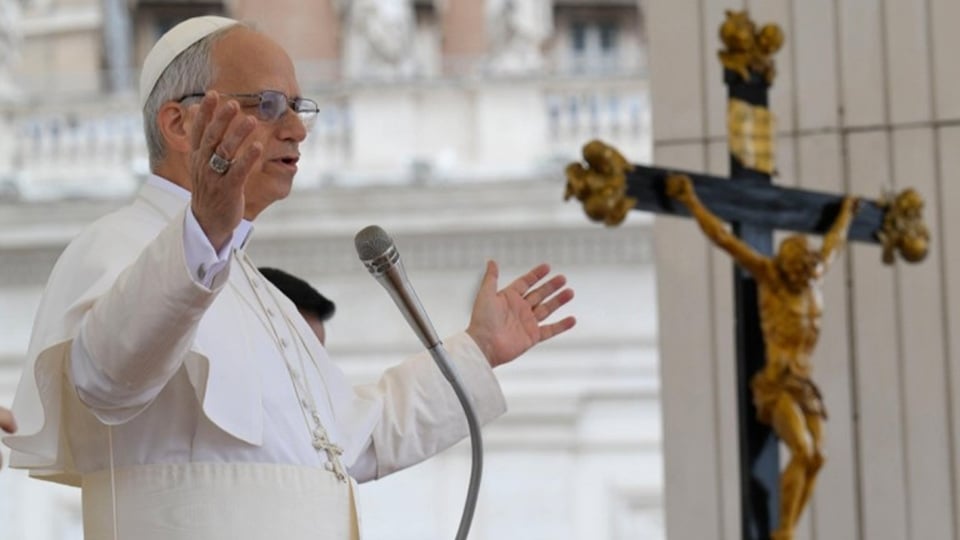

On May 17, 2025, in the Clementine Hall, Pope Leo XIV received the members of the Centesimus Annus pro Pontifice Foundation, a Vatican organization that promotes the study and dissemination of the Church’s social doctrine. Speaking precisely about this, the Pope took the opportunity to clarify what he means by “doctrine.”
It seems to be a very important theme—indeed, a fundamental one—given the urgency and relevance Pope Leo attributes to the concept of unity. As he himself stated on May 19, during a meeting with representatives of various religions who had gathered in Rome for the inaugural Mass of his pontificate the day before: “We recognise that this unity can only be unity in faith”; and again: “What is more, our communion is realised to the extent that we meet in the Lord Jesus. The more faithful and obedient we are to him, the more united we are among ourselves.”
These words bode well for the future, insofar as unity is understood as unity in truth, and not as a confederation of diverse religious doctrines—a Church reduced to a kind of UN of religions.
Dialogue is not a concept contrary to traditional Catholicism; indeed, it belongs to its very nature. Catholicism spread in the early centuries not by the violence of domination or the sword, but by the power of truth. The same cannot be said of other religions, such as Islam or Protestantism, which spread through the sword and the violence of secular powers.
Pope Leo explicitly stated that the Church’s doctrine “is not the same as an opinion.” Now, if Catholic doctrine is not merely one opinion among many, it means it is a certainty. This initial clarification marks a significant departure from what has often been reiterated in recent years, especially by the highest ranks of the Church’s hierarchy. So, what does Pope Leo mean when he speaks of “doctrine”?
“When we hear the word ‘doctrine’,” the Pope said, “we tend to think of a set of ideas belonging to a religion. The word itself makes us feel less disposed to reflect.” It becomes urgent to show that there is “another, more positive meaning, without which dialogue itself would be meaningless. ‘Doctrine’ can be a synonym of ‘science,’ ‘discipline’ and ‘knowledge.’ Understood in this way, doctrine appears as the product of research, and hence of hypotheses, discussions, progress and setbacks, all aimed at conveying a reliable, organized and systematic body of knowledge about a given issue.”
Just like the medieval Catholic theologians, we too must reclaim the understanding of theology as a “science” — that is, as a reasoned discourse about God first of all, and then about the world and man in light of God. Just as a natural science develops from certain and evident data provided by the senses, so too Catholic doctrine begins from trustworthy data — namely, Revelation, what God Himself has made known to humanity in Jesus Christ.
This parallel between faith and doctrine, and between doctrine and argumentation, is deeply Catholic and profoundly biblical. Scripture itself declares that “faith is the substance of things hoped for, the argumentation of things not seen” (Hebrews 11:1). By defining faith as argumentum, the Sacred Author emphasizes the importance of deepening — with the help of grace — both the premises and implications of revealed truths, which resonate throughout every aspect of individual and social life.
From this perspective, the concept of “dialogue” takes on a different meaning — a term much abused by liberal theologians and modernists over the last two centuries, reduced to a pitiful exchange of personal impressions about divinity, where everyone accepts the other’s position without seeking where truth lies.
Even Saint Peter, the first pope, emphasizes in his letter that a Christian must not impose the truth without charity upon those who do not believe, but rather must persuade and demonstrate that the Catholic religion is not unreasonable; on the contrary, it perfects and fulfills the human intellect: “Always be ready to give a reason for the hope that is in you” (1 Peter 3:15). To satisfy man’s thirst for truth, it is necessary to know the deposit of faith in “a reliable, ordered, and systematic way”.
From this perspective, the concept of “dialogue” takes on a different meaning — a term much abused by liberal theologians and modernists over the last two centuries, reduced to a pitiful exchange of personal impressions about divinity, where everyone accepts the other’s position without seeking where truth lies. This, however, is not authentic dialogue, which Scripture itself promotes, as it says: “Learn to do good; seek justice, (…) Come now, and let us reason together, says the Lord. (…) If you are willing and obedient, you shall eat the good of the land” (Isaiah 1:17-19).
Dialogue is not a concept contrary to traditional Catholicism; indeed, it belongs to its very nature. Catholicism spread in the early centuries not by the violence of domination or the sword, but by the power of truth which, supported by grace, addresses the intellect and freely moves the soul to assent through persuasion, as Saint Thomas Aquinas would teach centuries later. The same cannot be said of other religions, such as Islam or Protestantism, which spread through the sword and the violence of secular powers.
The Catholic cannot ignore the reasons for his faith and is called to transmit, in charity, the reasons—that is, the arguments—of his faith. In this way, Catholic doctrine is not a cold monolith, a mere package in the vast supermarket of religions to be accepted or rejected, but—as Pope Leo himself said—“a reliable, ordered, and systematic knowledge.”
The Pope stated: “Doctrine, as a serious, serene and rigorous discourse, aims to teach us primarily how to approach problems and, even more importantly, how to approach people. It also helps us to make prudential judgements when confronted with challenges.”
Dialogue must have persuasion as its goal. It should not merely convince the intellect, but prepare the will for the action of grace, which alone gives faith. One cannot engage in dialogue with the non-Christian arrogantly demanding immediate conversion to one’s claims. Above all, because the one who truly converts hearts is God alone, and man is but an instrument—albeit an effective one—of His Word. All Catholics are called to live like Saint John the Baptist, the model of believers: “I am the voice of one crying out in the desert” (John 1:23)—a voice, not the Word itself.
For this reason, truth and charity must always be united when teaching or witnessing to the Catholic faith. Indeed, the Lord Himself employed this very method with humanity: revealing Himself through history to Israel, and above all in Christ Jesus, He consistently explained the reasons for His Law and doctrine. When authority moves both the mind and heart of the subject, it awakens docility and obedience.
We see the same anthropological dynamic at work within the family, in the relationship between father and son. Saint John Bosco, the founder of what we might call the quintessential Catholic pedagogy, taught educators and parents that to be truly heard by young people, instruction must be founded on three pillars: religion, reason, and affection. If any one of these pillars falters, the very mission of the educator—and by extension, the evangelizer—is destined to fail.
The Pope stated: “Indoctrination is immoral. It stifles critical judgement and undermines the sacred freedom of conscience, even if erroneous. It resists new notions and rejects movement, change or the evolution of ideas in the face of new problems. Doctrine, on the other hand, as a serious, serene and rigorous discourse, aims to teach us primarily how to approach problems and, even more importantly, how to approach people. It also helps us to make prudential judgements when confronted with challenges. Seriousness, rigour and serenity are what we must learn from every doctrine”.
Today we live in a pagan society again. Many who formally call themselves Christians are not truly so, because they know nothing of Catholic doctrine and, in fact, have been raised not with an education in the faith, but with a gnostic formation given to them by public schools, states, parents, and even parishes.
If indoctrination is the imposition of truth without charity—that is, without providing the “reasons for the hope” Saint Peter speaks of, or without patiently allowing the seeds of truth to take root in the human heart according to God’s timing and circumstances (cf. 1 Corinthians 3:6)—then it is certainly immoral.
The Christian must respect the conscience of others, even when it is erroneous. But let this be clear: respecting an erroneous conscience does not mean justifying it. If a brother’s judgment is mistaken, it must be recognized as such.
Correcting error, admonishing the sinner, teaching the ignorant, or advising the doubtful are precious spiritual works of mercy. To respect an erroneous conscience means—just as the very etymology of the word ‘respect’ implies—to look attentively, that is, to accompany and foster the growth of truth within the human heart. Scripture itself warns us: “I do not desire the death of the sinner, but that he turn from his way and live” (Ezekiel 18:23).
Saint Augustine teaches that a man can do everything against his will, but he believes only by willing. Now, the will cannot be coerced. Therefore, one cannot force a man to faith except through truth. And how will the seed of truth be planted in the human heart if not through charity?
Moreover, Saint Thomas Aquinas teaches that the blind and irrational imposition of ideas, without respect for the freedom of the human conscience, is contrary to the dignity of man created in the image of God—that is, free and rational. However, conscience—especially when erroneous—must be enlightened and corrected with charity, according to truth. Not every action based on conscience is just, but every conscience must be respected in its fundamental orientation toward the good.
Not every development is true continuity with what the Apostles handed down, nor is every listening genuine dialogue in the fullest Catholic sense. Only a Church that knows clearly—reliably, orderly, and systematically—the content of its faith can proclaim and teach it effectively and with charity.
Saint Thomas does not defend freedom of conscience in the modern sense, rightly condemned by the Syllabus of Pius IX and other magisterial documents. Such freedom, which moderns even present as a “right,” presupposes that all judgments the human conscience is capable of formulating are of equal value; but this cannot be so. Saint Thomas, on the other hand, teaches that one must prudently tolerate the error of others, so as not to create a greater scandal—not only in the individual who errs but also, and above all, in society.
“Among the infidels,” Saint Thomas writes, “there are some who have never received the faith, such as the pagans and the Jews. These must not in any way be forced to believe, since believing is an act of the will. However, if possible, they must be restrained by the faithful from obstructing the faith, neither by blasphemies, nor by evil persuasions, nor by open persecutions. For this reason, the faithful of Christ wage war against the infidels, not to force them to believe (because even if they were to defeat and capture them, they would leave them free to decide whether to believe or not), but to prevent them from obstructing the Christian faith.” (S.Th., II-II, q.10, a.8)
Today we live in a pagan society again. Many who formally call themselves Christians are not truly so, because they know nothing of Catholic doctrine and, in fact, have been raised not with an education in the faith, but with a gnostic formation given to them by public schools, states, parents, and even parishes. Even those who formally commit apostasy and abandon the Catholic Church cannot truly be considered apostates or heretics, because an apostate is one who once knew and professed the Catholic faith in its entirety. Today, however, the majority of those who leave Catholicism do so because they never truly knew it or confused it with a weak and childish spirituality, incapable of giving meaning to life.
The First Vatican Council also inherited this Thomistic teaching: it infallibly condemns those who deny the freedom of the assent of faith (cf. Dei Filius, canons, sect. III, no. 5). Ultimately, man does not believe because he is compelled by an external force—neither by the state nor by others—nor simply because he is convinced by purely rational arguments, but because he wills to believe, and this will is moved by God, who assists man with the initial grace.
In a time when Catholic identity often risks being diluted by compromise or by the fear of appearing exclusive, the words of Pope Leo XIV, read in the light of Tradition, offer the opportunity to rediscover a living doctrine—friendly to reason and capable of educating toward authentic freedom and saving faith. Yet, it is necessary to remain vigilant so that this language is not misunderstood or twisted by worldly or media interpretations. Not every development is true continuity with what the Apostles handed down, nor is every listening genuine dialogue in the fullest Catholic sense. Only a Church that knows clearly—reliably, orderly, and systematically—the content of its faith can proclaim and teach it effectively and with charity.