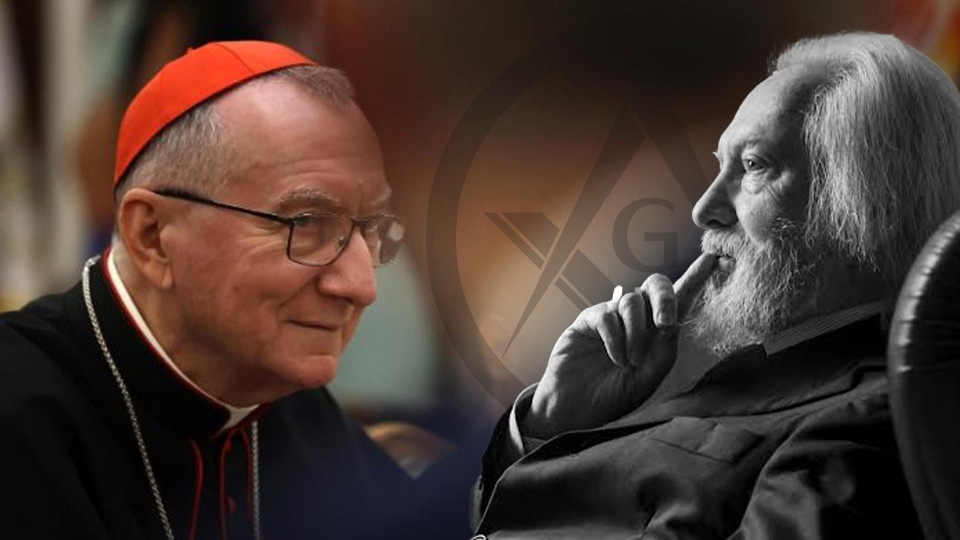

Just days before the Conclave, Giuliano Di Bernardo—an influential Freemason and former Grand Master of the Grand Orient of Italy—makes a seemingly sensational endorsement of Cardinal Parolin. However, his support now risks backfiring. Is this truly naivety? Furthermore, he raises the possibility that Bergoglio may have been a Freemason.
Last Saturday, May 3, 2025, an interesting interview by Lorenzo Giarelli with Giuliano Di Bernardo, one of the world’s leading Masonic authorities, appeared in the well-known Italian progressive newspaper Il Fatto Quotidiano. In this interview, the Italian Grand Master reaffirmed and elaborated on statements he had previously made about Pietro Parolin, whom he described as a “friend”, even a “collaborator”, and—hopefully for him—the “next pope”. This is a significant interview, worthy of deeper analysis, especially considering that it was released just days before the start of the Conclave, scheduled to begin on May 7.
Let us briefly recall that Giuliano Di Bernardo has an impressive Masonic background. Former Grand Master of the Grand Orient of Italy, he is a leading figure in the British-style Freemasonry—more elitist, anti-democratic, traditional, and religiously inspired, in contrast to the French-style approach. He has traveled the world, building relationships with key Masonic and para-Masonic circles, including those within the Vatican halls. Di Bernardo is a rather unconventional Freemason, but also a custodian of some of the most sensitive and unsettling secrets of recent history, both in Italy and beyond—much of which has inevitably passed through Masonic lodges. For decades, he has waged a “war” against other Freemasons, whom he considers betrayers of true Masonic principles. Due to this ideological conflict, he left the leadership of the Grand Orient and first founded the Regular Grand Lodge of Italy (currently Italy’s third most significant Masonic obedience). Later, disillusioned even with this experience, he established in 2002 the initiatory para-Masonic Dignity Order and its operational counterpart, the Academy of the Illuminati.
“If the Church still has a shred of rationality,” Di Bernardo states, “it must elect Pope Pietro Parolin. It is the only way to restore its authority.”
The first observation to make about this interview is the following. It seems highly unlikely, if not outright absurd, to believe that a sharp, refined, and clever figure like Di Bernardo has not realized that his endorsement of Pietro Parolin might be used within the Church to oppose the very election he would intend to support. “If the Church still has a shred of rationality,” he states, “it must elect Pope Pietro Parolin. It is the only way to restore its authority.” Yet, inevitably, some high-ranking prelates could use these very words to undermine Parolin’s votes. More likely, this endorsement was not made to directly promote his election but rather to legitimize Parolin’s potential election in certain circles. In this sense, Di Bernardo vouches for him, as if to say: “This is not a threat. It is functional.“
There are also other very interesting elements in the interview. “The Church,” admits Di Bernardo, “began its decline with the Second Vatican Council. Wojtyla had already destroyed the Church from its foundations, Ratzinger tried to do something, but when he realized the depth of the abyss, he preferred to step aside. And Bergoglio continued dismantling the papal structure—that is, the institution of the Church.” He goes on to say, “When [Bergoglio] first appeared from the balcony of St. Peter’s Square, he immediately stated that he would be the Bishop of Rome. His entire program was there.” That is, he did not present himself as Pope but simply as a bishop. It is striking to read these statements—shared by many traditionalist Catholics and a significant portion of conservatives worldwide—coming from one of the most influential Freemasons in the world.
What would the “destruction from the foundations” carried out by John Paul II consist of? Di Bernardo does not specify this in the interview, but it is easy to infer. Wojtyla effectively contributed—perhaps more than any other post-conciliar pope—to consolidating one of the most serious aspects of the Church’s crisis, namely the crisis of the Magisterium. Since Vatican II, the Church has renounced its role as magistra (“teacher”), meaning its responsibility to define what is true and what is false, or more precisely, to distinguish between what is Catholic and what is heretical.
Abbé Claude Barthe explained that all post-Vatican II popes ultimately failed to restore unity in the Church, whether they were restorationist popes (John Paul II and, especially, Benedict XVI) or a progressive pope like Francis.
Abbé Claude Barthe explained this point brilliantly in a recent article published in ResNovae, stating that all post-Vatican II popes ultimately failed to restore unity in the Church, whether they were restorationist popes (John Paul II and, especially, Benedict XVI) or a progressive pope like Francis. According to Barthe, even a moderate progressive pope would fail in this effort. The fundamental problem, Barthe argues, is precisely the crisis of the Magisterium, more specifically the failure to exercise the Magisterium as such. This manifests in the omission of the condemnation of heresy, which has led to the current situation of latent schism—arguably worse than an open schism—because the faithful are no longer able to discern the boundary between faith and error.
The mark of the Church’s unity (Credo in unam Ecclesiam) has traditionally always been understood as unity in truth, unity in Faith. If Catholic doctrine weakens, unity weakens as well, and the Church becomes fragile. Revolutionaries of all kinds have always known this, and Di Bernardo confirms it. Catholics, however, suffer from a serious amnesia on this matter. Barthe’s analysis is impeccable: “Today, de facto, the authority refrains from playing the role of instrument of unity, and instead presents itself as the manager of a certain consensus in diversity. Its role has become more to federate than to unite.“
Anyone who has studied modernist and neo-modernist thought knows that, for the past two centuries, one of the primary strategies adopted by revolutionaries within the Church has been linguistic manipulation: using traditional Catholic terminology, stripping words of their original meaning, and redefining them with an altered interpretation. Francis has consistently employed this strategy—recently transforming the meanings of words like “synod,” “dignity,” and “Sacred Heart.” However, he was certainly not the first. Readers should not be shocked: Ratzinger, for instance, contributed to redefining the word “Pope.” Likewise, Vatican II reshaped the meaning of “ecumenism.” And so on. “Unity” is another Catholic traditional word redefined in such a sense.
During a judicial interrogation regarding mafia infiltrations within the Grand Orient of Italy, Di Bernardo stated that he had collaborated with the former Vatican Secretary of State to resolve “a Chinese matter.”
According to Di Bernardo, the Church, which has been plunged into confusion since Vatican II, needs a leader who can, if not fully restore its authority, at least halt its decline. In his view, that man should be Pietro Parolin. However, The Remnant has already outlined reasons why Parolin, along with Tolentino de Mendonça and Jean-Marc Aveline, is completely unfit for the role of restorative Pope. In fact, there are strong arguments suggesting that even progressive elector cardinals should avoid voting for him in the upcoming Conclave.
During a judicial interrogation regarding mafia infiltrations within the Grand Orient of Italy, Di Bernardo stated that he had collaborated with the former Vatican Secretary of State to resolve “a Chinese matter.” I cannot say for sure what he might have been referring to, but let us remember that Parolin was the architect of the secret agreements between the Holy See and the Communist regime in Beijing, which effectively legitimized state interference in the appointment of bishops and restricted the Catholic Church’s freedom in China. These agreements humiliated the underground Church loyal to Rome, favoring a compromise with an atheist and persecutory power, contrary to Catholic doctrine on the social kingship of Christ. For these and other reasons, he is not a suitable shepherd to “confirm his brothers in the faith” in times of confusion and apostasy.
The last intriguing element of the interview concerns Bergoglio’s alleged Masonic initiation. The journalist asks the Grand Master: “There are strange letters circulating in which, before becoming Pope, Bergoglio signed his name on multiple occasions, placing three black dots in the shape of a triangle at the end—a symbolism linked to Freemasonry.”
One of Bergoglio’s most frequently employed strategies over the past twelve years of his reign has been to openly denounce evil in words while enabling it in practice. Additionally, it is noted that Masonic influence permeates Francis’ so-called “magisterium”.
The reference is, in fact, to a series of signatures Bergoglio used—while still bishop of Buenos Aires—at the bottom of various documents, both private and official, where he consistently added three dots arranged as the three vertices of a triangle. This signature style is typical of Freemasons who have achieved at least the third degree of Master within the Ancient and Accepted Scottish Rite. Below are three examples of such signatures.
Di Bernardo does not explicitly state in the interview that these are Masonic signatures, but he implies that they are. “I believe I know the truth behind this,” he writes. “In South America, Freemasonry is very powerful and widespread, but many Freemasons are also Catholic—there is no incompatibility. Therefore, Bergoglio, as a cardinal, certainly had connections with Freemasonry.” Indeed, in Latin America, unlike in Europe, the so-called dual membership (Church and Freemasonry) is seen as normal. Bergoglio completed his priestly formation in the 1970s, when Liberation Theology was at its peak, strongly influenced by the philosophical works of Dominican theologian Gustavo Gutiérrez [1928–2024]. It is not entirely unlikely that the young Bergoglio, like many South American priests of his time, may have chosen to be initiated into a Masonic lodge, believing that the philanthropy promoted there was compatible with Catholicism.
If someone were to object that Pope Francis renewed the condemnation of Freemasonry on November 13, 2023, it could easily be pointed out that one of Bergoglio’s most frequently employed strategies over the past twelve years of his reign has been to openly denounce evil in words while enabling it in practice. For example, on one hand, he repeatedly condemned the existence of a gay lobby within the Church, while on the other hand, he appointed key figures from this same lobby to high-ranking positions within dioceses and beyond. Additionally, it is noted that Masonic influence permeates Francis’ so-called “magisterium”, from the encyclical Fratelli tutti to the Abu Dhabi Declaration—which asserts that God willed all religions as different paths to reach Him—and Dignitas infinita.