
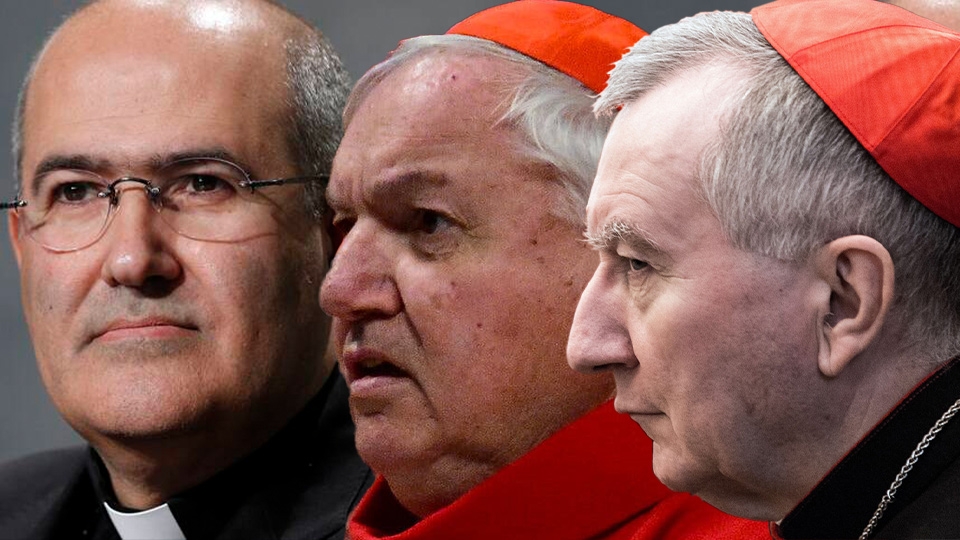

Voting for Parolin or Tolentino today, with all due respect for their persons, means risking handing the Church over to a pontificate that may be refined but powerless and dangerous; perhaps inspired in words but divisive in actions; perhaps diplomatic or poetic but disconnected from the pastoral and geopolitical realities that our time demands.
Cardinal José Tolentino de Mendonça, who undoubtedly shines for his humanistic culture and poetic spirit, presents a fascinating profile for many—not only progressives but also more moderate figures. After twelve years of an “energetic”—to put it euphemistically—and highly centralizing pontificate, as Cardinal Beniamino Stella pointed out, it is prudent to consider whether it is wise to elect another pope very similar to Bergoglio, but with the possibility of a long reign.
Tolentino’s vocation is primarily cultural rather than pastoral, theological, or political, which may not fully address the concrete needs of a global Church—wounded and often disoriented. These needs are recognized across the board by the cardinals, regardless of their ecclesiological orientation.
Youth in itself is not an obstacle. On the contrary, a relatively young pope with ecclesial maturity, concrete experience, and mediation skills could be a providential gift to mend the many divisions caused in recent years. Tolentino’s problem is not so much his age but rather his lack of concrete experience and his inability to counter the intra-ecclesial polarization of our time. He is a man of libraries and conferences, not of the “field hospital,” as Bergoglio used to say.
At a time when the Christian people need clarity, secure guidance, and pastoral decisiveness, a pontificate too closely tied to aesthetic, literary, and interpretative dimensions risks leaving the Church adrift in narratives rather than effective directives. Faith is not merely expression but also adherence, obedience, and clear praxis.
The hope is that even the most progressive cardinals will recognize that Tolentino is not a good choice for the Church, even from their perspective. Although his figure seems to reconcile openness and spirituality, Tolentino is actually supported by a well-defined faction within the Church—one that advocates doctrinal transition rather than synodality or pastoral reforms.
Tolentino has never led a diocese, formed a presbytery, or had direct responsibility for the daily care of God’s people. In this limitation, Tolentino and Parolin are equivalent. His formative path may seem noble, but it has unfolded in academic and curial settings, without concrete knowledge of parish hardships, liturgical and moral conflicts, clergy formation, or operational confrontation with secularization.
After a pontificate that has strongly personalized curial dynamics, there is a risk of transitioning to another form of centralization.
The hope is that even the most progressive cardinals will recognize that Tolentino is not a good choice for the Church, even from their perspective. Although his figure seems to reconcile openness and spirituality, Tolentino is actually supported by a well-defined faction within the Church—one that advocates doctrinal transition rather than synodality or pastoral reforms.
His election, therefore, instead of fostering unity, would exacerbate the tensions between reformist demands and voices loyal to Tradition—perhaps even more than Francis has managed to in his twelve years of reign. In a conclave already marked by fragility and suspicion, his candidacy risks dividing rather than uniting.
Is this truly what the cardinals want? Today, the Church urgently needs unity, attentive listening, and charity—not only toward the world but especially toward its own bishops, priests, and the people of God within it, who have long felt unheard. Without unity, the Church will suffer immensely in every aspect, including economically.
This financial concern is studied by electors in these days, and understandably so. The doctrinal and disciplinary division has already led to a sharp decline in economic confidence in the Church. Large dioceses are struggling, donations are decreasing, and benefactors are becoming ever more hesitant to support an institution perceived as uncertain and contradictory—just another voice in the crowd.
Refined in communication and attentive to dialogue with Islam, Cardinal Aveline has never demonstrated a solid theological depth or a clear attachment to the living Tradition of the Church.
Francis’ pontificate has led to visible fragmentation: divided dioceses, confused episcopates, discordant liturgies, disoriented clergy, and laypeople left abandoned and disillusioned. The Church cannot afford another pontificate marked by division. Given his intellectual and cultural profile, Tolentino is unlikely to serve as a figure of broad unity. He is widely perceived as “a man of one side,” which puts him at risk of exacerbating polarization rather than resolving it.
Even the French Cardinal Jean-Marc Aveline could prove to be a poor compromise if neither Parolin nor Tolentino manage to gain traction in the first two or three days of voting. His inclusive pastoral style—favored by more progressive electors seeking a softer continuity with Francis—lacks the doctrinal authority that the Chair of Peter demands in times of confusion.
Today, the Church needs not only dialogue but also clarity, identity, and firmness in faith. The reasons why Aveline might appeal are clear: the Archbishop of Marseille is a gentle man, open to interreligious dialogue, deeply connected to the Mediterranean, and committed to themes of inclusion and universal fraternity. However, given the grave needs of the Church today, his election could represent an uncertain, perhaps even risky, step in the process of healing and reconciliation so fervently desired by the people of God.
Aveline is also known for being one of the few bishops publicly identified by Pope Francis as an ideal successor. This direct connection, at a time when the Church urgently needs to pacify and reconcile, risks being perceived as rigid and partisan continuity.
In this sense, even Aveline’s election as Pope would not succeed in generating—or even merely facilitating—the much-needed mending of the ecclesial tissue. The Church cannot afford further division; it needs a leader who speaks to everyone, including those who have felt marginalized in recent years.
Today, the Church faces wars, global crises, and civilizational clashes. It does not need a man of administration, like Parolin; nor a man of academia, like Tolentino; nor someone who sees the condition of Catholics as a “minority” in a positive light, like Aveline. Instead, it needs a man who knows the cross and the hope lived in places where faith is under siege—one who can speak with equal clarity in Jerusalem and Beijing, Abu Dhabi and Moscow.
Refined in communication and attentive to dialogue with Islam, Cardinal Aveline has never demonstrated a solid theological depth or a clear attachment to the living Tradition of the Church. In an era marked by confusion on moral, anthropological, and liturgical issues, doctrinal vagueness cannot be a desirable quality for the one who sits on the Throne of Peter. The Pope must be a principle of unity—not only affective but also effective and doctrinal.
Furthermore, Cardinal Aveline is deeply rooted in multicultural and post-Christian France. However, he has not acquired direct experience in the international contexts that are crucial for the universal Church today: the Middle East, Africa, Asia, and Latin America. At a time when ecclesial geopolitics is essential—relations with China, Ukraine, Islam, and persecuted Christian minorities—the next Pope must be someone who has personally lived the world’s tensions, not just a more or less theoretical scholar of religious pluralism.
Many admire Aveline for his cordiality and inclusive style. Yet within this lies a potential risk: a pastoral approach without doctrine, firmness, or identity—resembling spiritual humanitarianism more than true ecclesial fatherhood. The crisis we face is not only social but, above all, theological. Clear words are needed, not just welcoming ones. A leader is required—not just a mediator.
More than ever, the Pope must be the Bishop of the Church in the world. Under Francis, the world has often perceived the Church more as a humanitarian NGO than as the visible sacrament of salvation. Today, the Church faces wars, global crises, and civilizational clashes.
The next Pope must unite faith and realism, doctrine and discernment, pastoral experience and geopolitical wisdom. Not an ideologue, but a witness.
It does not need a man of administration, like Parolin; nor a man of academia, like Tolentino; nor someone who sees the condition of Catholics as a “minority” in a positive light, like Aveline. Instead, it needs a man who knows the cross and the hope lived in places where faith is under siege—one who can speak with equal clarity in Jerusalem and Beijing, Abu Dhabi and Moscow.
The next Pope must unite faith and realism, doctrine and discernment, pastoral experience and geopolitical wisdom. Not an ideologue, but a witness. Today, the Church does not only need a kind face, but a pillar—a beacon in the night—a successor of Peter who can speak with authority to both rulers and pastors, to both the poor and the learned.
Of course, I do not think the cardinals will read my reflections (they have more important things to think about), but as a son of the Church, I pray and implore the Princes of the Bride of Christ: the stakes are incredibly high. Voting for Parolin or Tolentino today, with all due respect for their persons, means risking handing the Church over to a pontificate that may be refined but powerless and dangerous; perhaps inspired in words but divisive in actions; perhaps diplomatic or poetic but disconnected from the pastoral and geopolitical realities that our time demands.
The responsibility of the cardinals before God and history is immense. The future of the Church does not need “dreams” or worldly appeasements—it needs a guide.
Latest at RTV — The Pope & the Conclave: Can the Church Survive Francis II?