
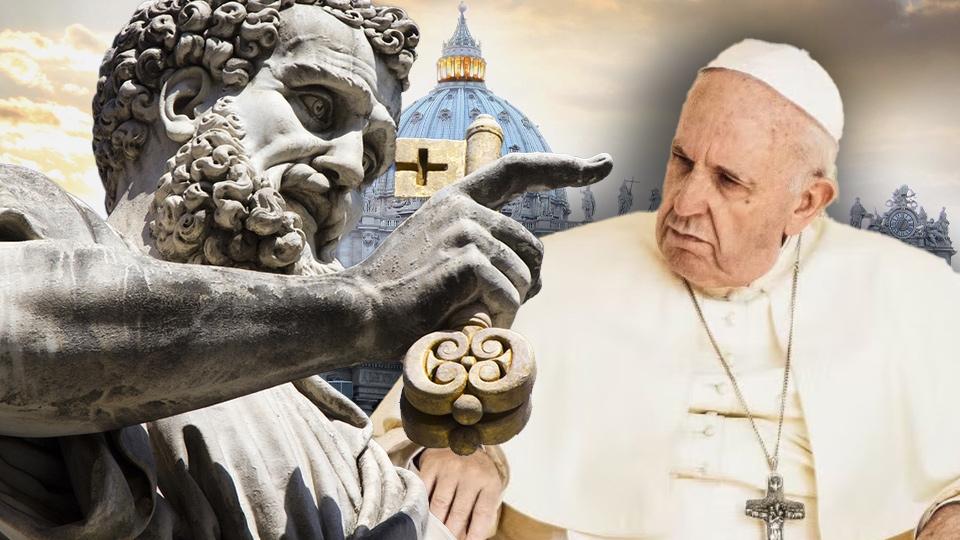

The Pope’s intervention and the changes to the Synod’s Final Document raise serious questions about the effectiveness and clarity of this new magisterial approach. Presented in this way, the approach risks further weakening the already severely compromised role of papal authority.
The recent Final Document of the Synod on Synodality has raised significant questions, particularly regarding its classification as part of the Pope’s “ordinary magisterium.” The accompanying note, published a month after the document’s official release, clarified that while the document is the result of a synodal process, it participates in the ordinary magisterium of the Successor of Peter. However, it also raises doubts about the coherence and effectiveness of this declaration within the life of the Church. The ambiguity surrounding this statement invites deeper reflection on the implications of such a claim and the normative status of the document. In this regard, the reflections of Luis Badilla, a well-known Chilean commentator and critic of Pope Francis, on the blog Messainlatino.it are particularly interesting.
Before delving into the heart of the matter, it is important to recall that Pope Francis’ apostolic constitution Episcopalis Communio (2018) already established in article 18, paragraph 1, that the Final Document of a Synod, once approved by the Pope, becomes part of the “ordinary magisterium” of the Successor of Peter. However, the novelty introduced by Pope Francis in this norm is significant: the mere approval of the Final Document by the Pope is sufficient to confer it the status of ordinary magisterium. This change presents noteworthy theological risks because it seems to blur the distinction between ordinary magisterium and authentic magisterium—a fundamental distinction in the Church.
The uncertainty over how to define the status of the Final Document is further compounded by the papal note of November 24, 2024. In it, Pope Francis reiterates that the Synod’s Final Document is part of the ordinary magisterium, but without clarifying what this statement means in the context of a well-established canonical and theological tradition.
According to the definitions implied in canons 747-755, ordinary magisterium refers to a type of infallible magisterium, meaning it cannot err on matters of faith and morals due to Christ’s promise of divine assistance. Ordinary magisterium, whether exercised by the Pope or by bishops united with him, is “which is manifested by the common adherence of the Christian faithful under the leadership of the sacred magisterium” (canon 750 §1). In essence, it reaffirms what Scripture and Tradition teach or what has already been infallibly defined by the solemn magisterium of previous popes. For instance, if a future Pope Pius XIV were to issue an encyclical on the Immaculate Conception, it would constitute ordinary magisterium because it reaffirms what was already solemnly defined by Pius IX in 1854 and has since become the “common adherence of the faithful.”
Authentic magisterium, on the other hand, is a category aside from infallible magisterium. It is characterized as the doctrinal proposal on faith or morals made by a specific Pontiff. The Church asks the faithful to give such magisterium “although not an assent of faith, a religious submission of the intellect and will” (canon 752). In normal circumstances, authentic magisterium, when consistent with the broader Catholic doctrinal corpus, would demand the highest degree of submission of intellect and will, that is, faith and obedience. However, in its prudence, the Church has not excluded the possibility that the authentic magisterium of a Pontiff may lack infallibility and thus may contain errors. In such cases, the level of submission is lowered to study, listening, respect, limited obedience, or similar, depending on the gravity of any error present in the act of authentic magisterium issued by a specific pope or bishop.
The confusion surrounding the status of the Final Document is, finally, exacerbated by some statements made by Monsignor Riccardo Battocchio. In a press conference, Battocchio stated that the Final Document “is not normative, even though it is part of the Pope’s ordinary magisterium.”
The claim that a Synod’s Final Document automatically becomes ordinary magisterium through papal approval clearly raises concerns. The essence of ordinary magisterium, as we have seen, should be based on continuity and a commitment to discerning the living Tradition of the Church. The issue becomes even more problematic when one considers that the Synod’s Final Document results from a broad consultative process that does not guarantee doctrinal clarity.
The uncertainty over how to define the status of the Final Document is further compounded by the papal note of November 24, 2024. In it, Pope Francis reiterates that the Synod’s Final Document is part of the ordinary magisterium, but without clarifying what this statement means in the context of a well-established canonical and theological tradition. The note, according to the Pope, is necessary to prevent the document from being treated as a mere set of proposals or recommendations, as if it lacked an evident binding force. This papal intervention seems intended to forestall overly liberal interpretations, particularly by diocesan bishops who might reduce the document to a mere list of suggestions with no obligation of implementation.
Let us also recall that the Pope initially stated there was no need for any post-synodal Apostolic Exhortation and that the Final Document stood on its own.
However, as Badilla aptly points out, the need for this note raises further questions: if the Final Document is already ordinary magisterium, why does the Pope feel the need to explicitly reaffirm it? His insistence suggests widespread confusion about its actual nature. The reality seems to be that the document has not been sufficiently understood—or, perhaps more troubling, that its nature and application remain unclear even to Pope Francis. The need for mediation and adaptation in various contexts, as emphasized in the note, indicates that the authority of the document is not as clear-cut as the Pope would like it to appear.
The Church, after all, needs doctrinal clarity and an authority that does not dissolve into personal interpretations by individual bishops or, worse, parish priests, nor into ambiguity.
The issue of editorial changes to the Final Document, made after its initial publication on October 26, 2024, adds further complexity. While the reasons for these changes are unclear, the papal statement that the document “is not strictly normative” suggests that its implementation will require mediation by local authorities. This raises additional doubts, as ordinary magisterium should, by its nature, have broader and more direct universal applicability.
The confusion surrounding the status of the Final Document is, finally, exacerbated by some statements made by Monsignor Riccardo Battocchio, appointed by the Pope as Member and Special Secretary of the XVI General Assembly of the Synod of Bishops (July 7, 2023). In a press conference, Battocchio stated that the Final Document “is not normative, even though it is part of the Pope’s ordinary magisterium.”
The Pope’s intervention and the changes to the Synod’s Final Document raise serious questions about the effectiveness and clarity of this new magisterial approach. While there is an effort to avoid treating the document as a mere proposal, there is also a risk of muddying the waters between authentic and ordinary magisterium. Presented in this way, the approach risks further weakening the already severely compromised role of papal authority. The Church, after all, needs doctrinal clarity and an authority that does not dissolve into personal interpretations by individual bishops or, worse, parish priests, nor into ambiguity.