
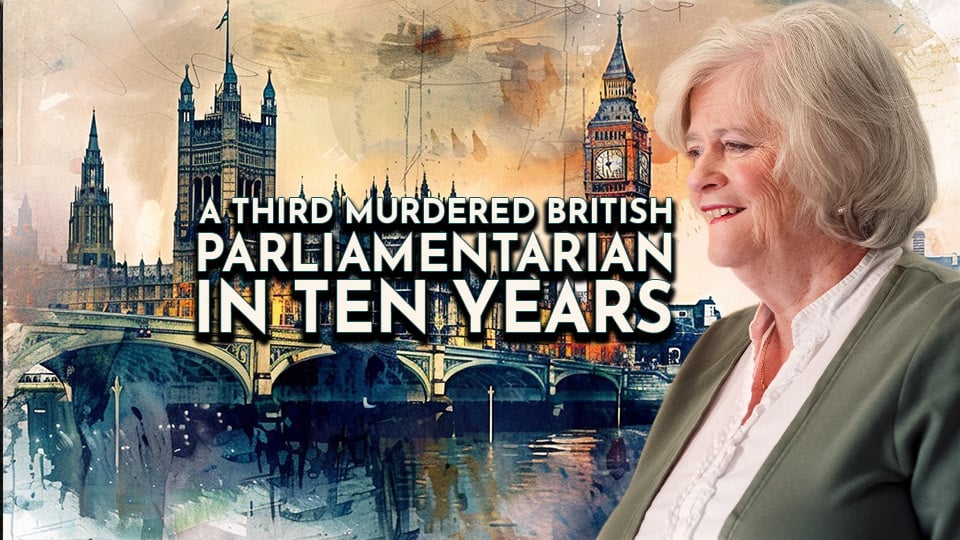

Ann Widdecombe is dead. The former Conservative MP, prisons minister, and later a voice for Reform UK, was discovered in her remote home near Haytor, on the edge of Dartmoor, having sustained mortal injuries. She was 78.
Counter-terrorism police in the United Kingdom are presently spearheading the investigation, with Assistant Commissioner Laurence Taylor, who leads national counterterrorism efforts, stating that investigators are evaluating the level of planning, preparation, and motive involved in the gruesome attack.
However, what is known is grisly enough on its own terms. Widdecombe is the third British parliamentarian to be violently murdered in a decade, after Labour’s Jo Cox, shot and stabbed by an extremist in 2016, and the Conservative Sir David Amess, stabbed to death in 2021 by a man radicalized toward ISIS-linked violence. Three killings, three different ideological currents behind them, and one common theme: British political life, hitherto considered a byword for civility, presently occasionally features certain characters who wrongly think that murder is the solution to dissent.
A civilization that no longer regards every human life as sacred will inevitably find violence becoming less shocking—and eventually, more acceptable.
To her credit, Widdecombe was never a woman who concealed her convictions to make herself safer. She was unapologetically Catholic and pro-life in a political culture that has grown steadily less patient with vocal Catholics. Strikingly, Widdecombe resisted the broadening of abortion access and the redefinition of marriage. For decades, this tenacious lady was articulating her views on television and in Parliament, notwithstanding the brickbats she earned from her religious and ideological opponents.
As the website Nuntiatora said:
“Ann Widdecombe was among the last British politicians of national prominence for whom conviction meant something more than the position adopted after consultation with advisers, opinion polls, and the morning’s newspapers. She could be combative, severe, and occasionally mistaken. She was also brave, articulate, intellectually coherent, and remarkably indifferent to the social penalties imposed upon those who continued to speak plainly after plain speech had ceased to be fashionable. The quality most frequently identified in the immediate discussion following her death was courage. She had often stood as a lone voice, endured organized denunciation long before “cancel culture” acquired its name, and voted according to conscience on questions on which many professedly Catholic politicians had learned to separate their sacramental identity from their legislative conduct. She did not always say what others wished to hear, but neither did she pretend to believe what she did not believe.”
As of this moment, the public does not know if Widdecombe’s murder was associated with her faith, her politics, or her decades of plain speaking on the sanctity of all human life. However, what we can conclude, regardless of her killer’s motive, is that the United Kingdom (UK), the country the late Widdecombe has left behind, has become an increasingly hostile place for the beliefs she held.
Consider Isabel Vaughan-Spruce, a Catholic pro-life campaigner from Birmingham. As of the moment, Vaughan-Spruce has been arrested for silently standing on a public street near an abortion facility and praying. Twice the charges were dropped with an apology from the West Midlands Police and a compensation of £13,000 for wrongful arrest. Yet she was charged again in 2025 as per Section 9 of the Public Order Act 2023—the new national “buffer zone” law that took effect in October 2024 and banned anyone from trying to impact a woman’s plan to abort her unborn child within 150 meters of an abortion clinic.
Ann Widdecombe spent a lifetime refusing to surrender her convictions. Her death should challenge Britain to recover the civility and reverence for life that once defined it.
Moreover, Adam Smith-Connor, an army veteran, was convicted and fined for standing silently and praying near a Bournemouth clinic for the son he and a former partner had aborted decades earlier.
In 2023, Father Sean Gough was charged for silent prayer and for showcasing a bumper sticker stating that “Unborn Lives Matter.”
Likewise, Livia Tossici-Bolt, a retired scientist in her sixties, was persecuted for displaying a placard that offered only conversation: “Here to talk, if you want.”
And the list goes on.
Such is the Britain that Widdecombe left behind—a country that has decided that the “right” to murder innocent unborn life exceeds a citizen’s right to stand on a public pavement with a rosary in hand. It is a country in which a woman can be investigated by police about “the nature of her prayer” as if thought itself has to be policed and monitored.
Also, Widdecombe’s death is a sober reminder that violence is not an abstraction. When a public figure like Widdecombe perishes under violent circumstances, the event unravels more than one crime but unearths the condition of a culture. Britain, like much of the modern West, increasingly lives with a numbed or deadened moral imagination, one that has grown used to insult, cruelty, and aggression until violence no longer seems shocking and reprehensible. This tragedy brings to mind this pertinent question: what has become of a society in which violence is gradually more and more plausible? The collapse of civility both online and offline, the hardening of political language, and the culture of contempt all give rise to environments in which human beings are more easily regarded as disposable statistics instead of creatures formed in the image of God. Once a society begins to treat human persons as disposable, it moves along a path that leads from contempt to actual physical harm. Such a slippery slope is evident in Britain’s descent into abortion, into trying to legalize assisted suicide, into the depravity of everyday language, and in the casual celebration of vengeance.
Before her killer’s motive is ever fully known, one truth is already evident: violence flourishes most easily in cultures where contempt for human dignity has become commonplace.
Even if people (such as Jeremy Corbyn) were to sincerely believe in their own political or ideological convictions (however messed up these beliefs may be), none of these reasons should justify any act of violence against Jo Cox, nor David Amess, nor Ann Widdecombe. A violent death is never merely a matter of politics, headlines, or curiosity; it is a serious moral tragedy that besieges every person with the reality of sin, suffering, and judgment. For faithful Catholics, particularly those who oppose violence and the unjust taking of human life, Widdecombe’s murder calls for prayer, sobriety, and a refusal to turn tragedy into a factional spectacle.
It should be noted that public grief for Widdecombe’s murder is not a license for manipulation. Some opportunists may attempt to use this tragedy to vindicate a political camp or denounce another. Others will try to downplay her death with euphemisms, as though harsh realities become less palpable when softened by language. That Widdecombe has been grisly murdered is an evil that demands truth, justice, and prayer. A proper Catholic reaction to such tragic news cannot be ideology, speculation, or opportunism. It must be reverence for the dead and a refusal to exploit tragedy for partisan ends.
When we adopt a supernatural perspective on this matter, we can see that Widdecombe’s murder is not only a crime in the legal sense but also a glaring example of the disorder of sin and how far the human heart can fall when it turns away from God. And for that reason alone, Catholics should speak of her death with gravity instead of theatrical emotion or with political vendettas. We should pray for Ann Widdecombe’s soul, for her family, and for those culpable if and when the truth is fully known.
Maria, Mater Dolorosa, Our Lady of Walsingham, pray for us.