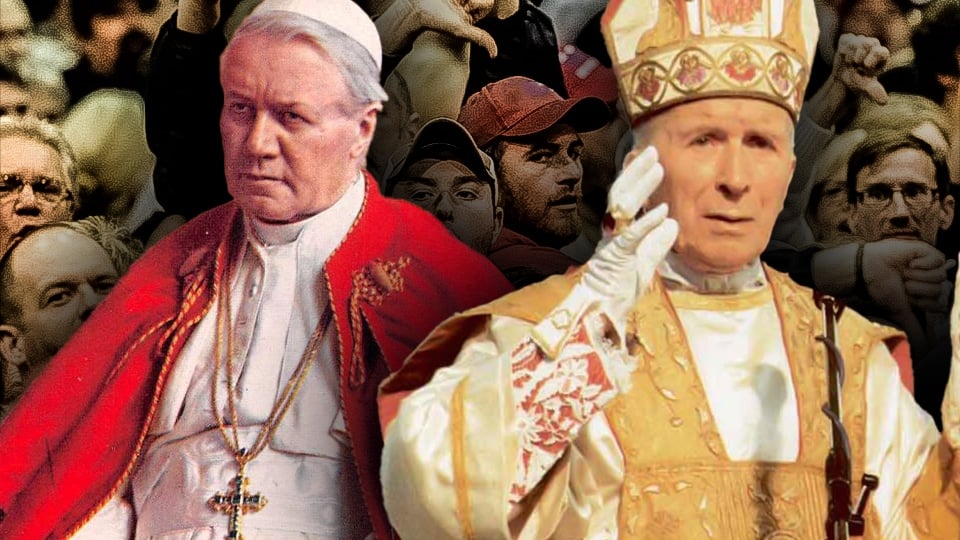

In his first papal encyclical, E Supremi Apostolatus, St. Pius X set forth his plan “to restore all things in Christ and to lead men back to submission to God.” In that encyclical, St. Pius X not only exhorted Catholics to combat doctrinal errors but also counseled against a bitter zeal that threatens the entire apostolic work.
St. Pius X wrote:
“[I]n order that the desired fruit may be derived from this apostolate and this zeal for teaching, and that Christ may be formed in all, be it remembered, Venerable Brethren, that no means is more efficacious than charity. ‘For the Lord is not in the earthquake’ (III Kings xix., II) — it is vain to hope to attract souls to God by a bitter zeal. On the contrary, harm is done more often than good by taunting men harshly with their faults, and reproving their vices with asperity. True the Apostle exhorted Timothy: ‘Accuse, beseech, rebuke,’ but he took care to add: ‘with all patience’ (II. Tim.iv., 2). Jesus has certainly left us examples of this. ‘Come to me,’ we find Him saying, ‘come to me all ye that labor and are burdened and I will refresh you’ (Matth. xi., 28). And by those that labor and are burdened He meant only those who are slaves of sin and error. What gentleness was that shown by the Divine Master! What tenderness, what compassion towards all kinds of misery!”
When we recall that we can do nothing good without God’s grace, it should be clear that St. Pius X was correct in asserting that we can have no real hope of serving God and His Church if we set aside the need to act with charity. Indeed, as the saintly pope observed, more harm than good is done through bitter zeal.
It has never been sufficient to have the “right answers” if charity is lacking, but that is even more the case today because only fools imagine that they have all the right answers to the challenges facing the Church now.
Archbishop Marcel Lefebvre commented on this passage in his Against the Heresies:
“The advice given here is really important. Think of the problems that many traditionalists have experienced in their parishes . . . Priests who lack charity have a tendency to judge men as they should be and not as they are; they close their eyes to the realities. If a young priest comes into contact with souls, and has categories in mind, thinking a priori what Christians should be like, he will not receive the sinner who comes to him (and we are all sinners!) as a physician — a physician of souls — but as a judge. Then he will condemn, rebuke, and scold the penitent, with the result, of course, that people will flee. Imagine that in a hospital a doctor were to say to the patient, You are too sick, I can’t treat you, you have only to die. Or else a doctor who would have recourse to drastic measures right away: your leg must be amputated . . . . Such a doctor might do analyses, but he would have no feel for diagnosis . . .” (p. 15)
Archbishop Lefebvre was the most important physician of souls in the post-Conciliar crisis because he was animated by a true charity. He knew that even minor venial sins could put an obstacle before God’s work, so he tried to always act in a way that was pleasing to God.
In a November 8, 1979 statement from Archbishop Lefebvre, we can see the way in which he balanced the spirit of combating error with this need to avoid bitter zeal:
“It is clear, however, that fewer and fewer Masses are valid these days, as the faith of priests is destroyed and they possess no longer the intention to do what the Church does – an intention which the Church cannot change. The current formation of those who are called seminarians today does not prepare them to celebrate Mass validly. The propitiatory Sacrifice of the Mass is no longer considered the essential work of the priest. Nothing is sadder or more disappointing than to read the sermons or teachings of the Conciliar bishops on the subject of vocations, or on the occasion of a priestly ordination. They no longer know what a priest is. Nevertheless, in order to judge the subjective fault of those who celebrate the New Mass as of those who attend it, we must apply the roles of the discernment of spirits given us in moral and pastoral theology. We (the priests of the Society) must always act as doctors of the soul and not as judge and hangmen. Those who are tempted by this latter course are animated by a bitter spirit and not true zeal for souls. I hope that our young priests will be inspired by the words of St. Pius X in his first encyclical, and by the numerous texts on this subject to be found in such works as The Soul of the Apostolate by Dom Chautard, Christian Perfection and Contemplation by Garrigou-Lagrange, and Christ the Ideal of the Monk by Dom Marmion.”
Of course Archbishop Lefebvre condemned errors and spoke clearly about those spreading the Vatican II revolution, but he always did so as a physician of souls rather than a “judge or hangman.” While the distinction may seem difficult to make in practice, it seems that we can often discern the right balance by observing fruits: those who habitually err on the side of playing judge and hangman almost invariably spark hatred and division.
Even worse, our toxic “social media” culture offers instant gratification for those who want to use the “right answers” as daggers to wound those who disagree; but this often brings far more gratification to Satan.
Because the plague of bitter zeal has become so widespread and lethal in our present day, it is worth considering the passages from the three authors Archbishop Lefebvre cited (in addition to that from St. Pius X above).
The Soul of the Apostolate by Dom Chautard. “If the apostle has not humility, he will go to one of two extremes. It will be either a matter of careless and excessive familiarity, with all its free-and-easy licenses, or else of domineering over everybody else. The latter case is the more likely. Leaving questions of doctrine to one side, let us suppose that the apostle has enough sense to protect his mind from an unlimited tolerance on one hand and, on the other, from a harsh and bitter zeal of which the excesses would be very displeasing to God. Let us credit him with good, sane principles and correct knowledge. When all this has been granted, we still affirm that without humility, the apostle will not be able to hold a middle course between the two extremes, and that his behavior will either betray weakness or, more likely, overweening pride.”
Christian Perfection and Contemplation by Garrigou-Lagrange. “To desire justice, perfect order, is the effect of the virtues; but to hunger and thirst after it, to be tormented by this hunger, is the fruit of a loftier inspiration. This thirst for justice should not become a bitter zeal with regard to the guilty; consequently our Lord says: ‘Blessed are the merciful: for they shall obtain mercy.’ Attentive to the sufferings of others, the merciful are able to give that counsel which reanimates and encourages. Accordingly the spirit of counsel corresponds to this beatitude. This union of justice and mercy is one of the most striking signs of the presence of God in the soul; for He alone can intimately harmonize virtues that are apparently so contrary.”
Christ the Ideal of the Monk by Dom Marmion. “Other forms of evil zeal, taking the appearance of good, are to be met with. There is, for example, the zeal of the Pharisees, strict observers of the outward law. This ‘bitter’ zeal . . . has its source, not in the love of God and of our neighbor, but in pride. Those who are tainted with it are filled with inordinate esteem for their own perfections; they do not conceive of any other ideal than their own; all that does not accord with it is necessarily blameworthy; they want to bend everyone to the own way of seeing and doing; hence arise dissensions. This zeal tends to hatred.”
If we want to serve God, we (current author included) should instead heed the saintly words of St. Pius X: “In order that the desired fruit may be derived from this apostolate and this zeal for teaching, and that Christ may be formed in all, be it remembered, Venerable Brethren, that no means is more efficacious than charity.”
These holy men fought for truth with charity because they loved God and knew there was no way to properly serve Him without always striving for charity. Archbishop Lefebvre had the same spirit, as we can tell from Bishop Bernard Tissier de Mallerais’s biography:
“Although both prudent and strong, this leader was also a priest who was possessed of a fine and delicate pastoral zeal which was wholly supernatural in its effectiveness. One day one of his seminarians told him about the difficult situation of his grandfather. The man was a friend and benefactor of Ecône, but he had formerly lost the Faith and, wanting to be consistent, he no longer practiced. Now, however, he was seriously ill, and the family was concerned about his salvation. At the request of the young cleric, the Archbishop made a detour during a round of confirmations to visit the old man.” (p. 582)
Upon returning to Ecône, Archbishop Lefebvre told the seminarian that he had not spoken to the old man about converting or even of the four last things. The Archbishop explained:
“You see, it’s not worth it. The one thing you risk is provoking him to refuse. And if unfortunately he were to be damned, you would only have made his case worse. You would risk a blasphemy, and a positive refusal; and you must avoid that above all!” (pp. 582-583)
The seminarian was concerned by this and raised the matter with his spiritual director who assured him that Archbishop Lefebvre was praying for the man and all would be well. In the end, shortly before the old man fell into a coma, a priest friend offered him absolution. After receiving absolution, the dying man kissed the priest’s hands and said: “I have confidence in what these hands have done.” As Bishop Tissier wrote, God had given a sign that the pastoral prudence of Archbishop Lefebvre had succeeded:
“The prayers and pastoral prudence of Archbishop Lefebvre had succeeded where a less discreet zeal would no doubt have failed. He was the kind of fair and level-headed priest that the Church always looks for, a minister of God who brings order into souls and keeps his own soul and body in order.” (p. 583)
All who seek to follow St. Pius X’s program of restoring all things in Christ need to have this same spirit of charity and order if they will be successful. It has never been sufficient to have the “right answers” if charity is lacking, but that is even more the case today because only fools imagine that they have all the right answers to the challenges facing the Church now. Even worse, our toxic “social media” culture offers instant gratification for those who want to use the “right answers” as daggers to wound those who disagree; but this often brings far more gratification to Satan. If we want to serve God, we (current author included) should instead heed the saintly words of St. Pius X: “In order that the desired fruit may be derived from this apostolate and this zeal for teaching, and that Christ may be formed in all, be it remembered, Venerable Brethren, that no means is more efficacious than charity.” Immaculate Heart of Mary, pray for us!