
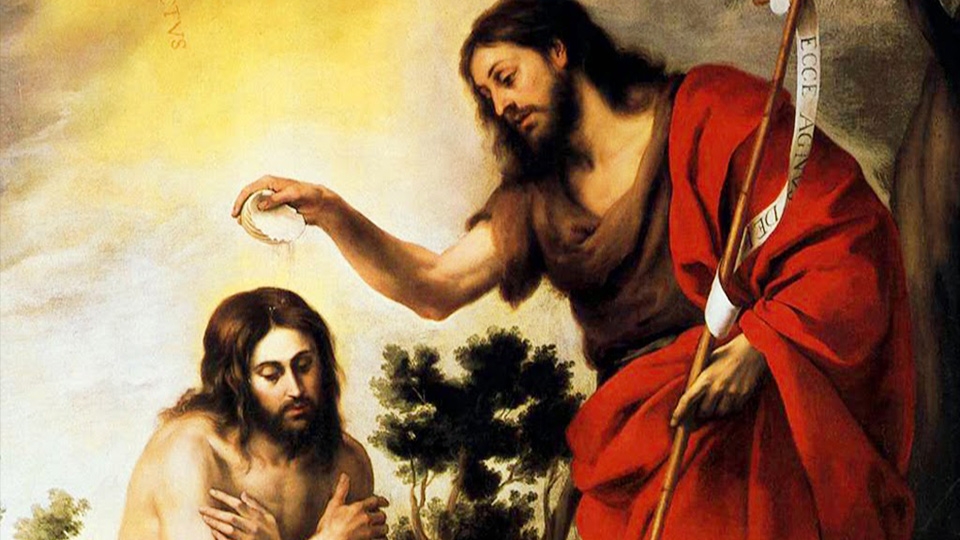

Pope Francis is fond of directing his Synodal musings at “all the Baptized”. Does this (perhaps intentionally) include Protestants of all denominations? This article discusses the validity of baptisms of non-Catholics. The intent of the article is to ask theologians to explain serious inconsistencies and apparent arbitrariness which suggests errors in reasoning and conclusions on validity of non-Catholic baptisms.
Specifically, non-Catholics do not have the same meaning of “the Son” as the Catholic Church when they baptize due to their rejection of the Most Holy Eucharist (as well as other teachings like the Dogmatic teaching of the Incarnation within the womb of the Immaculately Conceived Blessed Virgin Mary; however, this article focuses on the Most Holy Eucharist).
A discussion of a response to a Dubium by (now Cardinal) Fr. Luis Ladaria, S.J providing reasons why Mormon baptisms are invalid although they baptize “in the name of the Father, and of the Son, and of the Holy Spirit” is provided; it seems that Lutheran and other non-Catholic baptisms should be invalid if Fr. Ladaria’s reasoning against Mormons is applied to those non-Catholics.
The Catechism states:
1271 Baptism constitutes the foundation of communion among all Christians, including those who are not yet in full communion with the Catholic Church: “For men who believe in Christ and have been properly baptized are put in some, though imperfect, communion with the Catholic Church. Justified by faith in Baptism, [they] are incorporated into Christ; they therefore have a right to be called Christians, and with good reason are accepted as brothers by the children of the Catholic Church.”80 “Baptism therefore constitutes the sacramental bond of unity existing among all who through it are reborn.”81 [In text citation 80 is Unitatis Redintegratio 3 and 81 is Unitatis Redintegratio 22 § 2]
For non-Catholics, being “properly baptized” is said to partially depend on the minister’s intention. The Code of Canon Law describes the Minister of Baptism as follows:
When an ordinary minister is absent or impeded, a catechist or another person designated for this function by the local ordinary, or in a case of necessity any person with the right intention, confers baptism licitly. Pastors of souls, especially the pastor of a parish, are to be concerned that the Christian faithful are taught the correct way to baptize. [Emphasis added]
The Compendium of the Catechism published by the Vatican explains that “the right intention” is “doing what the Church does”:
The ordinary ministers of Baptism are the bishop and the priest. In the Latin Church the deacon also can baptize. In case of necessity any person can baptize provided he has the intention of doing what the Church does. This is done by pouring water on the head of the candidate while saying the Trinitarian formula for Baptism: “I baptize you in the name of the Father and of the Son and of the Holy Spirit”.
This is also explained by (now Cardinal) Fr. Luis Ladaria, S.J. in a response to a Dubium published by the Vatican. He implies that there is at least one entity, Mormons, who use the Trinitarian Formula (“I baptize you in the name of the Father, and of the Son, and of the Holy Spirit”) but the meaning of those words is contrary to Catholic meaning and thus the baptism is invalid.
Mormons do not validly baptize because the “words Father, Son and Holy Spirit, have for the Mormons a meaning totally different from the Christian meaning” and the “differences are so great that one cannot even consider that this doctrine is a heresy which emerged out of a false understanding of the Christian doctrine.”
First, he provides the following discussion of having the requirement of having the “right intention” for non-Catholic Baptisms to be valid:
Right intention is the intention to do what the Church wants, what Christ wants
Even non-Catholics can validly administer Baptism. In every case, however, it is the Baptism of the Catholic Church, which does not belong to those who separate themselves from her but to the Church from which they have separated themselves. This validity is possible because Christ is the true minister of the sacrament: Christ is the one who truly baptizes, whether it is Peter or Paul or Judas who baptizes. The Council of Trent, confirming this tradition, defined that Baptism administered by heretics in the name of the Father, the Son and the Holy Spirit, with the intention of doing what the Catholic Church does is true Baptism. [Citations omitted]
Fr. Ladaria continues in the article explaining that Mormons, even though they use the “Trinitarian Formula,” do not validly baptize:
The formula used by the Mormons might seem at first sight to be a Trinitarian formula. The text states: “Being commissioned by Jesus Christ, I baptize you in the name of the Father, and of the Son, and of the Holy Spirit”. The similarities with the formula used by the Catholic Church are at first sight obvious, but in reality they are only apparent. There is not in fact a fundamental doctrinal agreement. There is not a true invocation of the Trinity because the Father, the Son and the Holy Spirit, according to the Church of Jesus Christ of Latter-day Saints, are not the three persons in which subsists the one Godhead, but three gods who form one divinity […] As is easily seen, to the similarity of titles there does not correspond in any way a doctrinal content which can lead to the Christian doctrine of the Trinity. The words Father, Son and Holy Spirit, have for the Mormons a meaning totally different from the Christian meaning. The differences are so great that one cannot even consider that this doctrine is a heresy which emerged out of a false understanding of the Christian doctrine. The teaching of the Mormons has a completely different matrix. We do not find ourselves, therefore, before the case of the validity of Baptism administered by heretics, affirmed already from the first Christian centuries, nor of Baptism conferred in non-Catholic ecclesial communities, as noted in Canon 869 §2. [Citations omitted; emphasis added]
Thus, he explains that Mormons do not validly baptize because the “words Father, Son and Holy Spirit, have for the Mormons a meaning totally different from the Christian meaning” and the “differences are so great that one cannot even consider that this doctrine is a heresy which emerged out of a false understanding of the Christian doctrine.”
The reasoning there seems to be accurate. “Right intention” when using words depends on the communicator’s meaning of the words. To “invoke” the Trinity, the communicator must intend to use proper meaning of the words. For Mormons, though, the “Father, Son and Holy Spirit, have…a meaning totally different from the Christian meaning.” In other words, Mormons intend to do what Mormons do when baptizing, not what Catholics do when Baptizing.
First, a comment on Fr. Ladaria’s statement that “[t]he differences are so great that one cannot even consider that this doctrine is a heresy which emerged out of a false understanding of the Christian doctrine” seems to be false. It seems that one could actually accurately say that Mormon teaching is indeed a heresy which “emerged out of a false understanding of the Christian doctrine,” but that that Mormons simply diverge in different ways than other non-Catholics.
If they said they intend to do what Catholics do, then in many locations one could respond by saying, “well why didn’t you tell the people to go get Baptized at the Catholic Church down the street?” In other words, the availability of Catholic Churches and the refusal to send a person to those Churches might suggest intentions of doing something other than what the Catholic Church does.
Mormons begin with the word “Trinity” which is Christian doctrine. They then describe the Trinity as “Father, Son, and Holy Spirit,” which is also Christian doctrine. Mormons also use Christian doctrine of the words of Jesus from the Gospel which “commission” one to go out to all the world and baptize (“Being commissioned by Jesus Christ, I baptize you in the name of the Father, and of the Son, and of the Holy Spirit”). Baptism itself is Christian doctrine. Thus, Mormons apparently do indeed begin with Christian doctrine but then the diverge in different ways than other non-Catholics.
One could easily say that Lutheran and other Protestant divergences, though, are still significant enough to suggest that they do not believe in the same Jesus Christ that Catholics do, and therefore they do not have the right intention when attempting to invoke the Trinity during baptism. It seems that Fr. Ladaria and others might be arbitrary in saying that Mormon baptisms are invalid while other non-Catholic baptisms are valid.
(The previous statement is not intended to imply that the author is trying to imply validity of Mormon baptisms or any other non-Catholic baptisms; instead, the statement suggests that it seems likely that most, if not all, non-Catholic baptisms are invalid if Fr. Ladaria’s reasoning in opposition to Mormons is also applied to other non-Catholics.)
Some redundancy is necessary for emphasis because of the significance of the subject: Fr. Ladaria’s conclusion is that “the similarity of titles there does not correspond in any way to a doctrinal content which can lead to the Christian doctrine of the Trinity. The words Father, Son and Holy Spirit, have for the Mormons a meaning totally different from the Christian meaning.” Similarly, according to Fr. Ladaria, when Mormons use the Trinitarian Formula to attempt to baptize, “There is not a true invocation of the Trinity” because of the different meanings.
The question, though, is why does that same reasoning above not apply to entities like Lutherans and other Protestants? Obviously, Lutherans intend to do what Lutherans do when they baptize. The same goes for other Protestants. If one asked them what they intend to do when they baptize, it is very unlikely that they would say, “we intend to do what the Catholic Church does when Baptizing.” If they said they intend to do what Catholics do, then in many locations one could respond by saying, “well why didn’t you tell the people to go get Baptized at the Catholic Church down the street?” In other words, the availability of Catholic Churches and the refusal to send a person to those Churches might suggest intentions of doing something other than what the Catholic Church does.
“The other sacraments,” including Baptism, “are bound up with the Eucharist” – meaning, it seems, they are united with the Most Holy Eucharist. It is a principle that when one rejects something that is a condition necessary for something else which is a unity, one rejects the whole unity.
Additionally, applying Fr. Ladaria’s reasoning in opposition to Mormons, the “words Father, Son and Holy Spirit, have for the Mormons a meaning totally different from the Christian meaning” could be applied to many, if not all, non-Catholics. It is likely that several teachings could be provided as examples of significant differences, but some of the most obvious teachings are the authentic Catholic teachings on the Most Holy Eucharist and the Immaculate Conception of the Blessed Virgin Mary as they relate to all Persons of the Trinity.
To explain this, one could provide Scripture and theology – for example, Fr. Ladaria cites Romans 6:3-11 and Colossians 2:12-13 to say that the intention of the Catholic Church when Baptizing is “the conferral of the sacrament of Baptism instituted by Christ, which means participation in his death and resurrection.”
Fr. Ladaria does not mention this, but what is the Most Holy Eucharist? Several quotations from the Catechism could be provided, but only a few follow:
1368 The Eucharist is also the sacrifice of the Church. The Church which is the Body of Christ participates in the offering of her Head. With him, she herself is offered whole and entire. She unites herself to his intercession with the Father for all men.
And:
1359 […] In the Eucharistic sacrifice the whole of creation loved by God is presented to the Father through the death and the Resurrection of Christ.
Finally:
1324 The Eucharist is “the source and summit of the Christian life.” “The other sacraments, and indeed all ecclesiastical ministries and works of the apostolate, are bound up with the Eucharist and are oriented toward it. For in the blessed Eucharist is contained the whole spiritual good of the Church, namely Christ himself, our Pasch.” [Citations omitted]
All non-Catholics reject the Most Holy Sacrifice of the Mass and the Most Holy Eucharist. But the Most Holy Eucharist and the Most Holy Sacrifice of the Mass are the source and summit of Catholic life. “The blessed Eucharist is… Christ himself.” Non-Catholics reject the source and summit of the Catholic Church, “Christ Himself.”
When baptizing, then, non-Catholics likely intend to reject the Catholic meaning of “the Son” and, applying words from Fr. Ladaria, it seems that “there is not a true invocation of the Trinity” when such non-Catholics attempt to baptize.
Also, as the quotations from the Catechism above mention, “the other sacraments,” which includes Baptism, “are bound up with the Eucharist” – meaning, it seems, they are united with the Most Holy Eucharist. It is a principle that when one rejects something that is a condition necessary for something else which is a unity, one rejects the whole unity. The Most Holy Eucharist, that is, “Christ Himself,” is a condition necessary for the Trinity and for the other sacraments. In other words, in rejecting the Most Holy Eucharist, for Lutherans and other Protestants, it seems that “the similarity of titles there does not correspond in any way a doctrinal content which can lead to the” Catholic “doctrine of the Trinity.” The Eucharist and Baptism are united. Rejecting the Most Holy Eucharist – or not intending to baptize with “the Son” meaning “the Most Holy Eucharist” – ultimately seems to result in different intentions than the Catholic Church.
The Baptism of the Catholic Church and that of the Church of Jesus Christ of Latter-day Saints differ essentially, both for what concerns faith in the Father, Son and Holy Spirit, in whose name Baptism is conferred, and for what concerns the relationship to Christ who instituted it.
Many words, including “significant” and “essential,” are insufficient in describing the Most Holy Eucharist and the Trinity. Even so, it is True that the Most Holy Eucharist, Christ Himself, is such an essential and significant part of the Most Holy Trinity that in rejecting the Most Holy Eucharist, it seems that one necessarily rejects the Trinity. Thus, the words Father, Son and Holy Spirit, have for the [all non-Catholics] a meaning totally different from the Catholic meaning.
It also seems that Jesus made this very clear in the Bread of Life Discourse in the Gospel of John. Those who rejected the Most Holy Eucharist were not with Jesus; they went away from Him. Peter says Jesus “has the Words of eternal life” and calls Him “the Holy One of God.” It seems that belief in the Bread of Life, the Holy One of God, is necessary for Catholic meaning of the Most Holy Trinity.
Baptisms in which the minister intends to invoke “the Son” as what one could say is “anti-Most Holy Eucharist” thus invoke the “anti-the Son” and therefore seems to necessarily be a rejection of the Trinity.
Mormon baptisms are obviously invalid even though they use the Trinitarian formula because they do not have the same meaning of the Trinity as Catholics and thus cannot possibly intend to do what the Catholic Church does. Fr. Ladaria, S.J. summarizes the reasoning in the response to the Dubium:
Summing up, we can say: The Baptism of the Catholic Church and that of the Church of Jesus Christ of Latter-day Saints differ essentially, both for what concerns faith in the Father, Son and Holy Spirit, in whose name Baptism is conferred, and for what concerns the relationship to Christ who instituted it. As a result of all this, it is understood that the Catholic Church has to consider invalid, that is to say, cannot consider true Baptism, the rite given that name by the Church of Jesus Christ of Latter-day Saints. [Emphasis added]
The problem is that, the Most Holy Eucharist is “essential” (“in the blessed Eucharist is contained the whole spiritual good of the Church, namely Christ himself,” CCC 1324) to the Catholic teaching on the Most Holy Trinity. Borrowing some of Fr. Ladaria’s words, then it should follow that “the Baptism of the Catholic Church and that of” all non-Catholics “differ essentially…for what concerns…the Son.” Even though Mormon teaching on the Trinity is somewhat more bizarre than other non-Catholics, the “essential difference” is still there, thus seemingly making non-Catholic baptisms invalid. Any other conclusion would seem to be arbitrary.
How, then, can it be said that non-Catholics, all who reject “Christ Himself” (the Most Holy Eucharist, CCC 1324) validly baptize?
