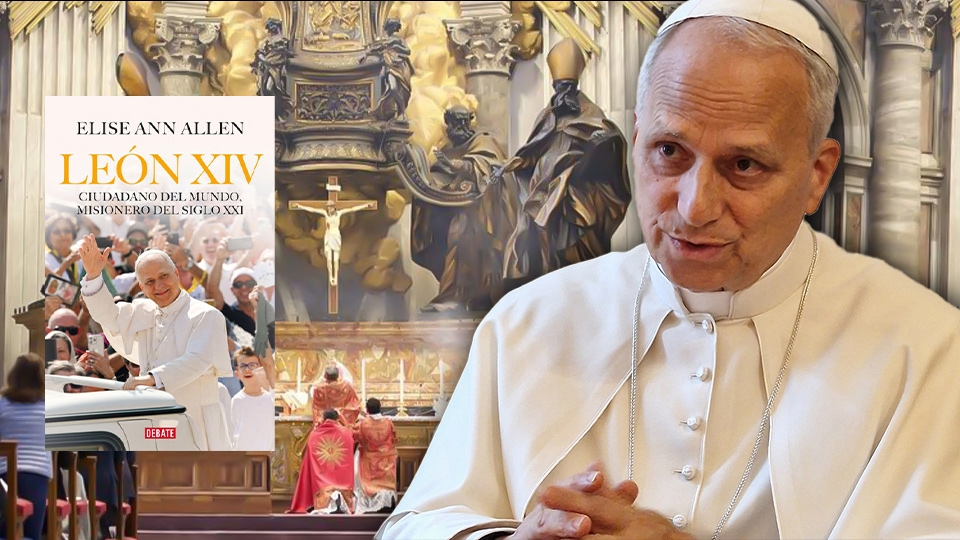

Pope Leo XIV reassured Catholics in his first published interview that he will not change Church doctrine on gay marriage and women deacons. He was also asked about the TLM debate which dominates our world, but which did not figure prominently in the life of the Pope when he was head of the Augustinians down in Peru for the past twenty-five years. Leo lived his entire priestly life without a dog in this particular fight. He told the inerviewer, Elise Ann Allen, that he needs to discuss this issue further, and he could very well mean it!
As you read the following excerpt from the new book-interview of His Holiness Pope Leo XIV, please keep in mind that the Pope is not a YouTuber whose livelihood depends on running his mouth. At the moment, he is under intense pressure to be Francis II and, let’s face it, he’s a post-conciliar priest with a post-conciliar formation. In addition, the TLM debate which dominates our world did not figure prominently in the life of the head of the Augustinians down in Peru these past twenty-five years. In many ways, Leo has lived his entire priestly life without a dog in this fight. When he says that he needs to discuss this issue further, he means it! It’s not “his thing,” and it never has been; but neither does he have the anti-Latin Mass baggage of the 88-year-old Pope Francis.
In light of that, let’s consider what is conspicuous by its absence from Leo’s words on this most contentious debate: Any reference to his predecessor’s contention that the Latin Mass is inherently divisive and in need of cancelation. Why not? If Leo is Francis 2.0, why not just remind his interviewer of Traditionis Custodes and say: “Rome has spoken?”
Instead, Pope Leo calls for further discussion. Good! I agree, especially since Francis had shut down all discussion before simply locking the people out of their Tridentine Mass centers. So, has Rome spoken, or not?
Leo then tells Crux that there is “no problem” with using Latin in the New Mass. But there certainly had been a problem – Leo’s immediate predecessor had prohibited the use of Latin, even in the New Rite! So, I guess “Rome hasn’t spoken” on that, either.
It seems that Pope Leo is far more interested in taking a pastoral approach—rather than that of a tyrannical dictator—on all of these hot button issues. How can this not be a step in the right direction, and why would any serious Traditionalist feel obliged to preemptively attack Pope Leo for simply taking a pastoral approach to the issue of the Latin Mass? Such an attack would be, it seems to me, either sufficiently myopic to border on the moronic, or a smokescreen for closet sedevacantism.
Either way – and especially after Pope Leo granted Cardinal Burke permission to offer the Traditional Latin Mass IN HIS OWN BASILICA next month – I will continue to give the Holy Father every opportunity to hear us out before attacking him for what he “might” do in the future. As I see it, there is nothing gained from jumping either the gun or the shark. I want the Catholic world to see that when it came to Pope Leo XIV, The Remnant did indeed wait and see.
Let’s continue to pray for Pope Leo. And for more on this evolving story, including Leo’s take on the LGBTQRS controversy, check out this weekend’s Remnant Underground. – Michael J. Matt
Excerpt on the Latin Mass Issue from Pope Leo XIV’s Interview:
[Elise Ann Allen]: Regarding the study group on liturgy, what is being studied? How much of the reason for establishing this was related to divisions surrounding the Traditional Latin Mass, for example, or issues such as the new Amazonian rite?
[Leo XIV]: My understanding of what the group came out of is primarily from issues that have to do with the inculturation of the liturgy. How to continue the process of making the liturgy more meaningful within a different culture, within a specific culture, in a specific place at any given time. I think that was the primary issue.
There is another issue, which is also another hot-button issue, which I have already received a number of requests and letters [about]: The question about, people always say ‘the Latin Mass.’ Well, you can say Mass in Latin right now. If it’s the Vatican II rite there’s no problem. Obviously, between the Tridentine Mass and the Vatican II Mass, the Mass of Paul VI, I’m not sure where that’s going to go. It’s obviously very complicated.
I’ve heard bishops talk to me, they’ve talked to me about that, where they say, ‘we invited them to this and that and they just won’t even hear it’. They don’t even want to talk about it. That’s a problem in itself. It means we’re into ideology now.
I do know that part of that issue, unfortunately, has become – again, part of a process of polarization – people have used the liturgy as an excuse for advancing other topics. It’s become a political tool, and that’s very unfortunate. I think sometimes the, say, ‘abuse’ of the liturgy from what we call the Vatican II Mass, was not helpful for people who were looking for a deeper experience of prayer, of contact with the mystery of faith that they seemed to find in the celebration of the Tridentine Mass. Again, we’ve become polarized, so that instead of being able to say, well, if we celebrate the Vatican II liturgy in a proper way, do you really find that much difference between this experience and that experience?
I have not had the chance to really sit down with a group of people who are advocating for the Tridentine rite. There’s an opportunity coming up soon, and I’m sure there will be occasions for that. But that is an issue that I think also, maybe with synodality, we have to sit down and talk about. It’s become the kind of issue that’s so polarized that people aren’t willing to listen to one another, oftentimes. I’ve heard bishops talk to me, they’ve talked to me about that, where they say, ‘we invited them to this and that and they just won’t even hear it’. They don’t even want to talk about it. That’s a problem in itself. It means we’re into ideology now, we’re no longer into the experience of church communion. That’s one of the issues on the agenda.
Related — THE POPE’S WINDOW: Michael Matt’s Open Letter to Leo XIV