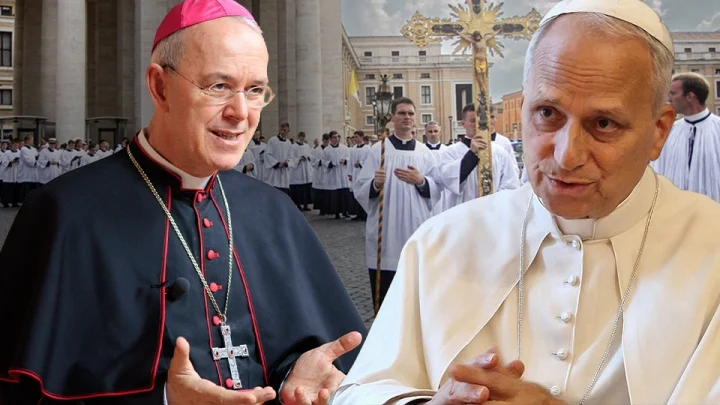

Today’s appeal of His Excellency Athanasius Schneider, the Auxiliary Bishop of Astana in Kazakhstan, to His Holiness, Pope Leo XIV 1 represents a balanced plea in favor of granting the pontifical mandate that would defuse the tensions between the Vatican and the Fraternity of Saint Pius X. The text is not only an appeal visibly animated by authentic Christian charity, but also a mini theological-historical essay in which Bishop Schneider provides arguments in favor of understanding the position of the SSPX. Clearly, we are dealing with a true disciple of Pope Benedict XVI—who is quoted in the Bishop’s text.
Bishop Schneider does not forget to mention that episcopal elections and consecrations were not always carried out with papal approval, showing that there are situations—emergencies—when such approaches are necessary.
First of all, all the “arguments” of the proponents of total hyper-papalism are dismantled through well-chosen examples from Church history. For example, one of the greatest saints and most refined Doctors, Athanasius the Great (c.296–373), entered into direct conflict with Pope Liberius (310–366), refusing to obey his order to re-establish communion with Arian or semi-Arian bishops. The outcome was the excommunication of the great Doctor of Alexandria. Therefore, one can violate the (mistaken) order of a pope, be excommunicated, and yet remain a Saint and demonstrate the qualities of a true Doctor of the Church.
Beyond this famous case, Bishop Schneider does not forget to mention that episcopal elections and consecrations were not always carried out with papal approval. Without questioning the authority of Peter’s successors, he merely wishes to show that there are situations—emergencies—when such approaches are necessary. Moreover, he points out that there is no dogma stating that “the Pope’s consent to a bishop’s consecration is of divine right, and that a consecration carried out without this consent, or even against a papal prohibition, constitutes in itself a schismatic act.” Clearly, through such strong statements, Bishop Schneider opposes any form of papolatry. He also notes that in certain historical situations, episcopal consecrations without a pontifical mandate did not provoke any reaction from the Vatican. After all, is it not said that “desperate times call for desperate measures”? Certainly, this is a truth that cannot be denied. But if things stand this way, where lies the issue?
At first glance, it seems to be a matter of interpreting the current situation. What I intend to show in this article, beyond welcoming Bishop Athanasius Schneider’s truly Christian intervention, is that the real problem is what we might call the “messianic syndrome.” To clarify its meaning, I will first quote and discuss one of the most interesting points in Bishop Schneider’s appeal.
The tensions between the SSPX and the Vatican are connected to the greatest problem imaginable: the rise of the modern world which, from the Protestant and French Revolutions up to the present day, has generated the birth of a type of state that excludes from public life the supernatural Christian religion as represented fully, exclusively, and authentically only in the Catholic Church. The pressure that the modern world exerts upon the Church, through laws that directly deny the absolute Monarchy of God and the social kingship whose existence in history only He can sustain, is enormous.
Indeed, the fundamental differences between the Society of Saint Pius X and the Vatican concern the way the enormous “fire” burning throughout the modern world should be addressed.
If we think only of France at the end of the nineteenth and the beginning of the twentieth century, when Catholics were literally outside the law, or of legislation favoring divorce, abortion, euthanasia, and so on, we immediately understand what is at stake. In short, a tremendous crisis of the pre-modern society and culture, replaced by a world in which unbelief and heresies of every kind are dominant. Not coincidentally, this world generated the modernist heresy, about which Saint Pius X told us that it is the synthesis of all heresies. Such a desperate situation cannot be better described than by the parable of the fire proposed by Bishop Athanasius Schneider:
“But the situation in the life of the Church today can be illustrated with the following parable: A fire breaks out in a large house. The fire chief allows only the use of new firefighting equipment, even though it has been shown to be less effective than the old, proven tools. A group of firefighters defies this order and continues to use the tried-and-tested equipment—and indeed, the fire is contained in many places. Yet these firefighters are labeled disobedient and schismatic, and they are punished.
To extend the metaphor further: the fire chief permits only those firefighters who acknowledge the new equipment, follow the new firefighting rules, and obey the new firehouse regulations. But given the obvious scale of the fire, the desperate struggle against it, and the insufficiency of the official firefighting team, other helpers—despite the fire chief’s prohibition—selflessly intervene with skill, knowledge, and good intentions, ultimately contributing to the success of the fire chief’s efforts.
Faced with such rigid and incomprehensible behavior, two possible explanations present themselves: either the fire chief is denying the seriousness of the fire, much like in the French comedy Tout va très bien, Madame la Marquise!; or, in fact, the fire chief desires that large parts of the house burn, so that it may later be rebuilt according to a new design.”
Indeed, the fundamental differences between the Society of Saint Pius X and the Vatican concern the way the enormous “fire” burning throughout the modern world should be addressed. As Cardinal Ratzinger had already suggested in his classic 1968 work Introduction to Christianity, through a parable borrowed from the Danish thinker Søren Kierkegaard (1813–1855), the cities of the modern world are engulfed in the flames of widespread vices. The one who draws attention to the fire and calls the inhabitants to action is the clown from a nearby circus who, because of his costume and status, is taken seriously by no one. The Pope, the hierarchs, the priests, and lay faithful are like this clown in the eyes of a world that laughs when they announce disaster and call for action. What, then, is to be done? Some have proposed changing the clothing: would that be enough?
In the case of the conciliar and post-conciliar reformers, their conviction is that only a complete change of the Church’s “clothing” can make the Christian message credible (again). This is why not only the Holy Liturgy but absolutely everything—the Creed, morality, biblical exegesis and hermeneutics, spiritual theology, and so forth—must be changed, must be “updated.”
The Second Vatican Council, through its massive “aggiornamento,” proposed such a solution. However hesitant we may be, we must acknowledge—and we can read this in the aforementioned work—that Joseph Ratzinger questioned such a project. Likewise, the Fraternity of Saint Pius X categorically rejected such a solution. Those who follow the “reformist” solution, however, stubbornly maintain that only in this way can the immense fire that has engulfed the modern world be extinguished.
The time has come to detect the true problem hidden beneath the surface of the entire debate. It may be called the “messianic syndrome.” What does this represent? The conviction that someone may have that only he and his group possess the correct solution, while everyone else is wrong. Obviously, once one enters upon such a path, debates, struggles, and ultimately ruptures and divisions will multiply exponentially. For each group, each “prophet,” each “messiah” will consider himself uniquely justified by the solution he proposes.
In the case of the conciliar and post-conciliar reformers, their conviction is that only a complete change of the Church’s “clothing” can make the Christian message credible (again). This is why not only the Holy Liturgy but absolutely everything—the Creed, morality, biblical exegesis and hermeneutics, spiritual theology, and so forth—must be changed, must be “updated.” From here arises—among other things—the obsession with modifying the Liturgy in Archbishop Bugnini and his disciples. All of them are strongly convinced that today’s world no longer understands anything of the Church’s evangelical message; therefore everything must be reformulated, re-clothed, and, if necessary, even completely replaced.
We could endlessly discuss the symptoms of the “messianic syndrome” and its devastating consequences. Yet what interests us most is the solution. And this, in no case, lies within human power. To understand this, it is worth recalling the figure of one of the most famous saints of the modern world: Cardinal Charles Borromeo (1538–1584). As I have already shown in an article dedicated to the brilliant son of Lombardy, 2 when the first cases of plague began to appear—in 1576—in Milan and its surroundings, the city’s secular authorities sought to assure the Cardinal that everything was under control. He, sad and calm, replied that the manifestation of God’s wrath cannot be stopped by any man, by any leader. Father John Peter Giussano, author of an exceptional biography of the saint, described what he did in order to obtain from God the end of the pandemic:
“Being fully persuaded that this visitation had been sent as a chastisement for sin, he gave himself up to prayer with greater frequency and fervor than usual to avert the anger of God, and to ask for light to know and grace to do His holy will. These prayers he accompanied by increased fasts and austerity of life, depriving himself of his straw pallet, sleeping upon bare boards, with only a sheet for coverlet, and spending great part of his nights in prayers and tears, chastising in himself the sins of others in order to appease the indignation of God against his flock.”3
This is what all hierarchs (just like political leaders) affected by the “messianic syndrome” must understand and accept: no human project will do anything but worsen the situation. Have we not already seen this? For decades the Vatican avoided fulfilling the request of the Blessed Virgin Mary, the messenger of Heaven, who asked for the consecration of Russia to her Immaculate Heart—a consecration to be made by the Pope in communion with all the bishops of the world.
We may call it whatever we like, but it amounts to one thing: the mistaken human conviction that certain situations can be resolved by leaders—ecclesiastical or political—without God’s special intervention.
As we all know, the request was transmitted through Sister Lucia on June 13, 1929. Even assuming (for the sake of argument) that Pope John Paul II fulfilled this request in 1984, we may ask: after 55 years? Was that how long it took the Vatican to accept that no human solution and no kind of Ostpolitik can help if, first of all, the one and only truly important thing is not accomplished? Clearly, the Vatican erred by delaying the fulfillment of the most important act that had to be done, at God’s request, in the twentieth century. Why did it err? I believe the only possible explanation is crystallized in the formula already mentioned: the “messianic syndrome.” We may call it whatever we like, but it amounts to one thing: the mistaken human conviction that certain situations can be resolved by leaders—ecclesiastical or political—without God’s special intervention. Such a thing, as Saint Charles Borromeo told his contemporaries from the very beginning, is impossible.
Until this is accepted, no crisis, no tension (including that between the Society of Saint Pius X and the Vatican) will be resolved. The key(s) lies, as always, with the successor of Peter. Let us pray with faith that God may inspire Pope Leo XIV to follow the solution proposed by Bishop Athanasius Schneider—a worthy successor of Saints Athanasius the Great and Charles Borromeo. Amen!
- The full text can be read online here: https://dianemontagna.substack.com/p/exclusive-bishop-schneider-appeals [Accessed: 24 February 2026]. ↩︎
- “The Colossus of Lombardy: Saint Charles Borromeo:” https://onepeterfive.com/the-colossus-of-lombardy-saint-charles-borromeo/ [Accessed: 24 February 2026]. ↩︎
- John Peter Giussano, The Life of Saint Charles Borromeo, Cardinal Archbishop of Milan, With Preface by Henry Edward Cardinal Manning, Vol. I, London-New York: Burns and Oates, 1884, pp. 369-370. ↩︎
