
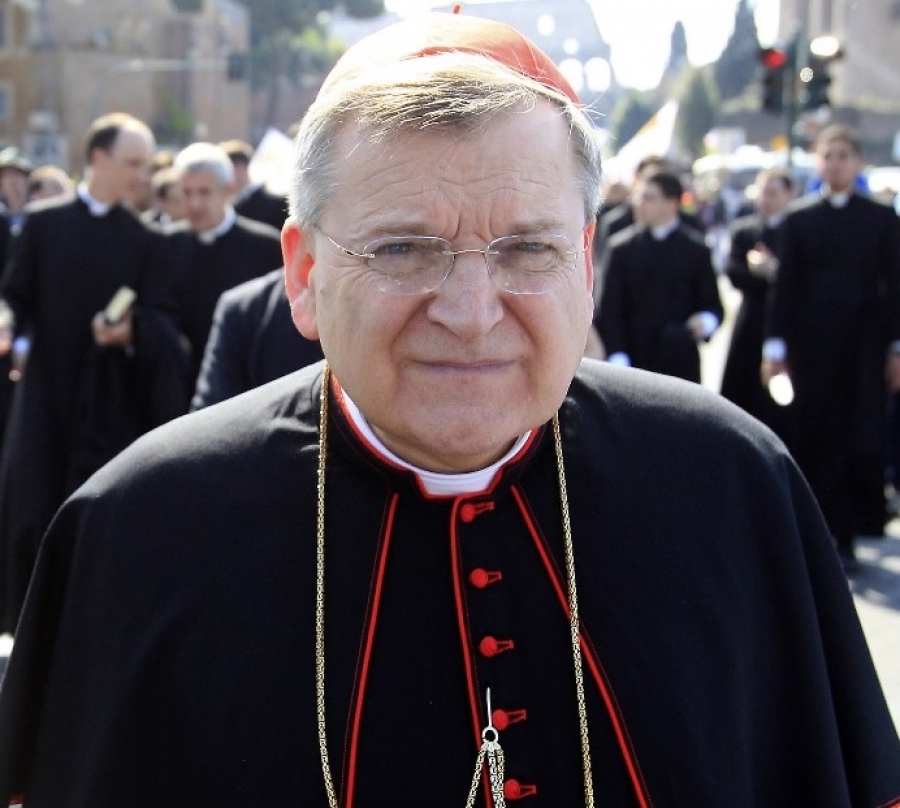

October 25, 2025. The day of Cardinal Raymond Burke’s scheduled Traditional Latin Mass at St. Peter’s Basilica in the afternoon began rather leisurely for me. After saying my morning prayers and one Rosary , I made my way to the Minor Basilica of Santi Celso e Giuliano near The Vatican to recite a second rosary with thousands of fellow pilgrims of the 2025 Summorum Pontificum pilgrimage and to pray for various intentions.
The 2025 pilgrimage—centered around the solemn celebration of the Traditional Latin Mass by Cardinal Raymond Leo Burke at the Altar of the Chair in St. Peter’s Basilica—was more than just any other Jubilee Year event.
Rather, this pilgrimage, characterized by a milieu of pious prayer and devotion to the Traditional Latin Mass, marked a great opportunity for all participants to express filial devotion to Holy Mother Church and to the papacy.
The long line of pilgrims acted like a physical sense of continuity and a link connecting the courageous martyrs who gave their lives up for Jesus Christ in and beyond Rome to the sea of pilgrims comprising young Gen Z, adults, teenagers, and wailing babies.
Just as with every trip I previously made to Rome, this past weekend in the Eternal City felt like a long-awaited homecoming and an endearing reminder of what it means to belong to the universal Roman Catholic Church, the only church founded by our Lord Jesus Christ.
In many areas around central Rome, I noticed throngs of pilgrims trudging along weather-beaten paths, with rosaries in hand, and colorful religious banners bearing the images of our Lady and the saints.
Some of Rome’s magnificent churches also afforded me the opportunity to hear voices from every continent – Italians, Americans, Poles, Mexicans, French, Germans, Chinese, Africans—blending together in prayer or chant, once again reminding me of the universality of the Catholic religion.
The pilgrimage crosses the Angel Bridge and heads toward St. Peter’s Basilica
Following the group recitation of the Holy Rosary in heartfelt pleas to the Blessed Virgin Mary, I, together with thousands of other Summorum Pontificum pilgrims (prelates and laity alike), made our way through Rome’s cobblestone streets towards St. Peter’s. Among these pilgrims were families with small children clutching rosaries and missals also, priests and seminarians in cassocks, and elderly faithful who had most likely witnessed decades of tumultuous changes within Holy Mother Church, particularly in the years following the Second Vatican Council.
Notably, the overall atmosphere of the procession to St. Peter’s was replete with devotion and expectation, as the welcoming melody of Gregorian chant reverberated through the ancient yet resilient stone buildings that paved the way for pilgrims to behold the majestic St. Peter’s Dome –the latter a stunning piece of architecture that is also redolent with history.
Moreover, the immense crowds and long line of pilgrims acted like a physical sense of continuity and a link connecting the courageous martyrs of the days of yore who gave their lives up for Jesus Christ in and beyond Rome to the sea of pilgrims comprising young Gen Z, adults, teenagers, and wailing babies.
The colossal space of the interior of St. Peter’s seemed to soak in the Gregorian melodies chanted as Cardinal Burke begin to celebrate the much-anticipated Mass with great dignity and reverence.
Symbolically, the huge procession from Rome’s traffic-laden streets towards St. Peter’s signified a transition from the profane into the sacred, from chaos towards contemplation of God.
The colossal space of the interior of St. Peter’s seemed to soak in the Gregorian melodies chanted as Cardinal Burke begin to celebrate the much-anticipated Mass with great dignity and reverence.
“Introibo ad altare Dei…”
“Judica me Deus…”
“Confiteor Deo omnipotenti…”
His Eminence’s prayers, recited at the foot of the main altar of St. Peter’s, were not vestiges of a forgotten past but living petitions uttered by a prominent prince of Holy Mother Church.
Furthermore, each gesture made by the cardinal—such as bows and the Sign of the Cross, contained immense theological meaning, with every action aimed heavenward.
Strikingly, Cardinal Burke’s sermon, preached with the doctrinal and pastoral clarity for which the prelate is known for, focused on a fidelity to Catholic tradition, the teachings of the Roman Catholic Church, and ultimately to Our Lord Jesus Christ through the Blessed Virgin Mary. The cardinal’s sermon reminded me how Summorum Pontificum, issued by Pope Benedict XVI almost twenty years earlier, had been a Godsend meant to unite not divide the Church, through promotion of the Usus Antiquor as a treasure belonging to Roman Catholic Church.
Cardinal Burke celebrates the TLM in St. Peter’s at the Altar of the Chair
“The Church celebrates the 18th anniversary of the promulgation of the motu proprio Summorum Pontificum with which Pope Benedict XVI made possible the regular celebration of the Mass in this form, in use since the time of St Gregory the Great,” Cardinal Burke said.
“In the privilege of participating today in the Holy Sacrifice of the Mass, we cannot help but think of the faithful who, over the Christian centuries, have met the Lord and deepened their lives in Him through this venerable form of the Roman Rite. Many were inspired to practise the heroism of holiness, even unto martyrdom.””
As the Mass concluded, Cardinal Burke led the congregation in singing “Christus Vincit,” a traditional hymn proclaiming Christ’s victory. Pilgrims lingered in the basilica, myself included , beseeching Almighty God to continue giving Pope Leo XIV the fortitude to explicitly permit this ancient Mass that his predecessors before the Council celebrated and cherished.
Maria Salus Populi Romani, ora pro nobis.
