

There are historically many objections to violence on the grounds of Christian morality. The Divine Commandment against murder, admonitions to love one another, and exhortations to turn the other cheek are all licit and valid arguments. However, God also tells us He is a warrior God Who fights for His people. He Himself raised up the great heroes of the Old Law; to include David, Gideon, Sampson, all of whom became renowned warriors. Jacob is even said to have wrestled with an Angel of God. Indeed, in the New Testament also, Jesus physically combats money-changers and merchants in the massive courtyards of the Temple, visiting such a degree of violence upon them that he separated such covetous men from their wealth. Later, St. Peter uses force of arms to attempt to defend his Lord from arrest, and Jesus commands his disciples to buy themselves swords.
One only effectively protects when he can effectively fight.
Now, these instances are not intended to bend God’s Word to a position that condones or promotes violence. Rather, the opposite is true. Jesus does exhort us to love all men and there are countless examples that show we are to chiefly strive for charity and mercy. No, let the author be clear: this is not a defense of violence. This is a recognition that within certain moral frameworks, violence is permitted and necessary.
The tradition of the Church recognizes the moral legitimacy for violence as well. Both St. Augustine and St. Thomas Aquinas developed Catholic Just War Theory, and many other saints may be categorized as skilled in the martial disciplines. Saints like St. George, St. Martin of Tours, St. Moses the Black and St. Michael the Archangel all partook of, or are archetypes of, physical combat.
The reader may here observe a seemingly obvious fault in the development of this argument. Each of the examples listed falls into one of two categories. Firstly, they may be expressly commanded by God Himself to commit certain violence, as is the case of the Old Testament heroes and St. Michael. Or secondly, they may have been violent men before repenting and turning to Christ, or their examples of violence are shown as faults. This is the case of Sts. Peter, George, Martin and Moses. How then does this justify using them as examples?
Physical protection is a necessary duty of men commanded by God.
The central point here is that “violence” was a key trait exemplified by each of these men, at certain times.
The author argues, that in defense of innocent persons, in response to grave evil, and in accordance with Christian principles of charity, justice and mercy, violence is at times permissible and necessary. Moreover, it is an inherently masculine obligation to be the enactor of said violence rather than a duty of his female counterparts. Not only does the man have the authority in positions of fatherhood and husbandry, but he has the responsibility for the welfare of those in his charge.
The statesmen protecting their nation from foreign exploitation, the policemen safeguarding society, the father protecting his children, and the husband standing in front of his wife; each is obligated to protect, but how? One only effectively protects when he can effectively fight. It is most noble to give one’s life for the protection of his family, but it must be well given. If not, the threat still remains while the innocent are without a protector. Thus, they are subsequently assaulted, beaten, invaded, dishonored, and murdered, while their noble yet very much dead protector lies prostrate beside them.
This brings us to the central theme of our argument. It is good for Catholic men to fight, to learn how to fight, and to practice fighting. It may be considered an exercise of their manly duty to protect. Additionally, this practice of the martial arts, i.e. the arts that are of a martial quality (grappling, shooting, striking, etc.) confers secondary virtuous effects on the men who practice them. Fortitude, discipline, mercy, patience, boldness, and a respect for human life are conversely much more present in those who train such disciplines. These practices essentially help to create strong men, in conjunction with a robust spiritual life. These are the sort of men, warrior men, courageous men, that physically repel those seeking to harm faith and family.
Once Christendom is built, it must be defended.
Once Christendom is built, it must be defended. This is firstly done by God’s hand in accordance with His permissive and Holy Will, and humankind’s primary weapons are prayer and the practice of virtue. Secondarily, the defense of the good, the beautiful, and the true falls to more tangible efforts. Rapists, murderers, thugs, militias, and all manner of criminal actors are very much real, and God has designed the male to combat them. This is the example of Adam’s failure in the garden, a failure which all men are inclined to repeat lest they struggle against it. Suffice to say, physical protection is a necessary duty of men commanded by God.
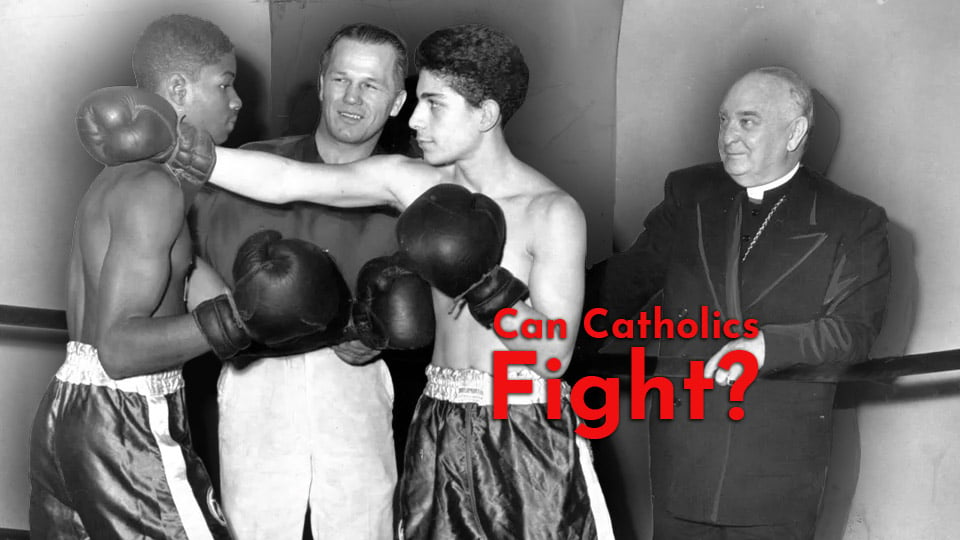
The capability for effective physical protection and righteous violence is developed through training. History and cultures are full of examples of the regimens conducted by boys and men to prepare themselves for such violence. Templars struck wooden poles with blunted swords to condition themselves, Native Americans developed lacrosse, and knights of the Middle Ages competed in jousting tournaments all in an attempt to simulate combat. Some may draw parallels to football as the modern equivalent. However, a discipline ubiquitous throughout time and throughout culture that has been used to curate violence has been hand to hand combat.
Boxing, wrestling, jiu-jitsu, muay thai and karate are all different interpretations of dominating an opponent in unarmed combat. They have been around in various forms since Cain killed his brother Abel. All can be dangerous. All can be harmful. All are violent. One cannot simply just learn techniques and study these arts from an intellectual vantage point. They must be practiced. And the highest form of this “practice” is for a fighter to be matched against an equal opponent, and do the dance “for real”. Then will he be required to execute his techniques against an equally willing foe, and only then will he be truly required to exercise the other hidden, mental art of fighting. This is where courage is displayed, along with tenacity, grit, resolve and the fighting spirit. The stakes are high, so the character of the fighter must match them.
In the realm of male responsibilities, it behooves fathers and husbands to protect those they love by use of force when required.
Now the objection may be brought up that it is not the practice of martial arts that is problematic, but rather the “performance” of them and truly fighting another man in a cage. The author will argue that while intention does matter here, the difference is smaller than it appears. Take, for instance, the training room where two individuals are practice sparring. Can each harm the other, even though it is a “practice” session? Yes. Does each fighter wish to “harm” his opponent and so secure the victory? Yes. In fact, injuries happen very frequently in the training room. Intensity varies, but it is a dangerous game nonetheless. Knockouts, pulled muscles, bruises, concussions, and even broken bones are very real possibilities.
Contrast this with a bona fide fight. The same questions will be asked here: Can each harm the other? Yes. Does each fighter wish to harm his opponent and so secure the victory? Yes. Injuries are the byproduct of fighting; they will happen. That, in and of itself, does not make the sport immoral. As previously stated, intention matters. Is the fighter striving for vainglory and pride, to become the celebrity playboy multimillionaire? His intentions are misplaced. Does the fighter wish to see his opponent seriously, permanently hurt as his purpose for fighting? Is he overcome by bloodlust? Then this crosses the boundary into sin. But if the fighter wishes to fight in order that he may test his mettle, same as any other sport, and try his skill against an equal opponent, then it can be argued that he is displaying virtue and strength in the face of opposition.
Anecdotally, it is fairly rare to see true hatred and ill-will within fight sports. Strange as it may seem, fighting is a strikingly intimate event. Two individuals are exposed, stripped to the waist, in front of a crowd of people. They then engage in physical combat, which carries anticipation, fear, elation, pain, satisfaction and a host of other emotions, supercharged by the most extreme physical exertion. Respect towards one opponent is surely given after such an encounter, for only the fighter knows the courage it takes to even step into the cage. A firm handshake, a nod, a manly embrace from one to the other shows recognition for skill, fortitude and grit.
To be a Christian is to be a fighter. In the realm of male responsibilities, it behooves fathers and husbands to protect those they love by use of force when required. To accomplish this end, training to fight, and subsequently fighting, are both beneficial and virtuous.
