
In his This Tremendous Lover, Dom Eugene Boylan wrote that one pattern of salvation history involves the way in which God permits evils for the sake of bringing forth greater good:
“His original proposal was that we should be happy here below and, after a term of probation, should enter into an eternity of happiness with Him in heaven. This proposal for our happiness here below was rejected, but He has deigned to make the very miseries of our fallen state a means by which we can earn still greater happiness in heaven. In a word, while God’s second proposal — if one may so speak — is more difficult for us, it can also be more profitable for us, for it contains more opportunities of exercising virtues and it gives us a source of more ample strength for its exercise. ‘Where sin abounded, grace did more abound.’ (Rom. 5:20). This point will recur in the discussion of the effects of our own personal sins . . . . For the moment it is sufficient to draw attention to the pattern thus laid down, and to observe that the infinite wisdom of God is such that He would permit His plan to be rejected only if He foresaw that He would achieve a greater good by doing so.” (p. 12)
Our first parents rejected God’s plan, leading to great misery. But if we cooperate with God’s grace to overcome the evils that resulted from Original Sin, “we can earn still greater happiness in heaven.” Dom Boylan saw this as a pattern for how God loves us. In general, this particular pattern ordinarily involves: (a) God’s order or plan, (b) a violation of God’s order or plan, (c) miseries resulting from the violation of God’s order or plan, and (d) an opportunity for faithful souls to please God and “earn still greater happiness in heaven” by cooperating with His grace to overcome those miseries.
God would permit His plan to be rejected only if He foresaw that He would achieve a greater good by doing so.
From repeated experience of this pattern in our own spiritual lives, we can learn to appreciate not only the words of St. Paul quoted above by Dom Boylan but also these from the same Epistle to the Romans: “And we know that to them that love God, all things work together unto good, to such as, according to his purpose, are called to be saints.” (Romans 8:28). This supernatural perspective is especially important in times of crisis and confusion, such as what we have experienced for over six decades. In times of peace, one may simply strive to lead a virtuous life without necessarily needing to ponder why God is permitting certain evils in the Church. But in times of crisis, our default beliefs about certain matters may no longer be accurate and could therefore lead us away from God. Thus, for instance, it is no longer the case that we can simply rely on the Vatican to safely steer us toward truth and away from error. As a result of this tragic situation, we must exert more effort to discern God’s will.
For this reason, it is perhaps useful to ponder the ways in which the pattern described by Dom Boylan would apply to the current crisis in the Catholic Church. Of course, we cannot definitively know the “mind of God” in the sense that we could confidently and accurately explain all of the workings of His Providence as it relates to the current crisis. However, it is surely the case that by observing reality with the eyes of Faith we can discern the ways in which God’s Providence appears to be manifesting His glory and leading souls closer to Him during this crisis. Thus, following the pattern described by Dom Boylan above, we can attempt to comprehend how God has used the current crisis to bring forth good from evil.
The Order for the Church Established by God
For purposes of evaluating the crisis, a few passages from Leo XIII’s 1896 encyclical on the unity of the Church, Satis Cognitum, are especially useful. Section 9 of Satis Cognitum has the subtitle of “Every Revealed Truth, without Exception, Must be Accepted,” and includes the following crucial truths:
- “The Church, founded on these principles and mindful of her office, has done nothing with greater zeal and endeavour than she has displayed in guarding the integrity of the faith. Hence she regarded as rebels and expelled from the ranks of her children all who held beliefs on any point of doctrine different from her own.”
- “The practice of the Church has always been the same, as is shown by the unanimous teaching of the Fathers, who were wont to hold as outside Catholic communion, and alien to the Church, whoever would recede in the least degree from any point of doctrine proposed by her authoritative Magisterium.”
- “For such is the nature of faith that nothing can be more absurd than to accept some things and reject others. Faith, as the Church teaches, is ‘that supernatural virtue by which, through the help of God and through the assistance of His grace, we believe what He has revealed to be true, not on account of the intrinsic truth perceived by the natural light of reason, but because of the authority of God Himself, the Revealer, who can neither deceive nor be deceived’ (Conc. Vat., Sess. iii., cap. 3). If then it be certain that anything is revealed by God, and this is not believed, then nothing whatever is believed by divine Faith . . . .”
- “It is then undoubtedly the office of the Church to guard Christian doctrine and to propagate it in its integrity and purity.”
Unlike the complicated and ambiguous words that have characterized Rome’s documents on the same topic since the Council, these words from Leo XIII’s 1896 encyclical are perfectly clear. God has given the Catholic Church the mission of preserving and defending the integrity and purity of the Faith. Anyone who “would recede in the least degree from any point of doctrine proposed by her authoritative Magisterium” is outside of the Church. Whether we like this or not is irrelevant — this is the order established by God, and it would be offensive to God to try to promote Christian unity by overturning God’s order.
The crisis in the Church is not proof that God has abandoned His people—it may be proof that He is calling them to greater fidelity.
In addition to these passages from Section 9 of Satis Cognitum related to the revealed truth that the Church must always defend, there are passages to consider from Section 11, which has the subtitle of “The Supreme Authority Founded by Christ”:
- “The nature of this supreme authority, which all Christians are bound to obey, can be ascertained only by finding out what was the evident and positive will of Christ. Certainly Christ is a King for ever; and though invisible, He continues unto the end of time to govern and guard His church from Heaven. But since He willed that His kingdom should be visible, He was obliged, when He ascended into Heaven, to designate a vice-gerent on earth. . . . ‘For the same reason, therefore, because He was about to withdraw His visible presence from the Church, it was necessary that He should appoint someone in His place, to have the charge of the Universal Church. Hence before His Ascension He said to Peter: ‘Feed my sheep’’ (St. Thomas, Contra Gentiles, lib. iv., cap. 76).”
- “Jesus Christ, therefore, appointed Peter to be that head of the Church; and He also determined that the authority instituted in perpetuity for the salvation of all should be inherited by His successors, in whom the same permanent authority of Peter himself should continue. And so He made that remarkable promise to Peter and to no one else: ‘Thou art Peter, and upon this rock I will build my church’ (Matt. xvi., 18).”
Christ is the supreme authority forever but has designated a “vice-gerent on earth” to be head of His Church: St. Peter and his successors. The role of the pope is to faithfully safeguard the treasures given to the Church by God. As it relates to our analysis of the crisis, this is the order for the Church willed by God.
The Violation of God’s Order for the Church
God certainly did not provide for St. Peter and his successors to be perfect, so we cannot imagine that every single failing of a pope would constitute a serious violation of God’s order. However, it is undoubtedly the case that the popes cannot perpetuate anti-Catholic errors without violating God’s order for the Church. To evaluate whether the current crisis constitutes a violation of God’s order, we can begin by looking at the last forceful encyclical condemning anti-Catholic errors, which was Pius XII’s Humani Generis from 1950. This encyclical included the following warnings:
- “In theology some want to reduce to a minimum the meaning of dogmas; and to free dogma itself from terminology long established in the Church and from philosophical concepts held by Catholic teachers, to bring about a return in the explanation of Catholic doctrine to the way of speaking used in Holy Scripture and by the Fathers of the Church. They cherish the hope that when dogma is stripped of the elements which they hold to be extrinsic to divine revelation, it will compare advantageously with the dogmatic opinions of those who are separated from the unity of the Church and that in this way they will gradually arrive at a mutual assimilation of Catholic dogma with the tenets of the dissidents.”
- “Moreover, they assert that when Catholic doctrine has been reduced to this condition, a way will be found to satisfy modern needs, that will permit of dogma being expressed also by the concepts of modern philosophy, whether of immanentism or idealism or existentialism or any other system. . . . They add that the history of dogmas consists in the reporting of the various forms in which revealed truth has been clothed, forms that have succeeded one another in accordance with the different teachings and opinions that have arisen over the course of the centuries.”
- “Hence to neglect, or to reject, or to devalue so many and such great resources which have been conceived, expressed, and perfected so often by the age-old work of men endowed with no common talent and holiness, working under the vigilant supervision of the holy magisterium and with the light and leadership of the Holy Ghost in order to state the truths of the faith ever more accurately, to do this so that these things may be replaced by conjectural notions and by some formless and unstable tenets of a new philosophy, tenets which, like the flowers of the field, are in existence today and die tomorrow; this is supreme imprudence and something that would make dogma itself a reed shaken by the wind.”
Here Pius XII was describing precisely the state of theology that has prevailed in Rome since the time of John XXIII. Because, as Pius XII noted, the Holy Ghost had guided the Church to formulate and safeguard the truths of the Faith, any rejection of those truths by men purporting to represent the hierarchy of the Church would be a grave offense against God.
Will we follow those who violate God’s order, or cooperate with God’s grace to preserve it?
Twelve years after Pius XII had published Humani Generis to protect the Catholic Church against certain errors threatening to undermine the foundations of Catholic doctrine, John XXIII’s opening address of the Second Vatican Council announced to the Church and world that there would be a change:
“The Church has always opposed these errors. Frequently she has condemned them with the greatest severity. Nowadays, however, the spouse of Christ prefers to make use of the medicine of mercy rather than that of severity. She considers that she meets the needs of the present day by demonstrating the validity of her teaching rather than by condemnations. Not, certainly, that there is a lack of fallacious teaching, opinions, and dangerous concepts to be guarded against and dissipated.”
The errors threatening the Faith had not receded in the least since Humani Generis, but John XXIII decided that henceforth the Church would no longer condemn them. Yes, Our Lord had charged St. Peter and his successors with defending the flocks against the wolves, but John XXIII knew better and so decided to steer the Church in a different direction.
And, in case anyone missed the implications of his words to open Vatican II, John XXIII put an exclamation point on his decision by appointing as experts to the Council certain theologians whose work had been condemned (albeit without naming names) by Pius XIII in Humani Generis. In his The Second Vatican Council (an unwritten story), Professor Roberto de Mattei wrote of the surprise that many Council participants had when they learned of some of John XXIII’s appointments to the Council’s Preparatory Commission:
“Congar and de Lubac were appointed by John XXIII as consultors of the Preparatory Commission. Their names, it seems, were suggested by several conservatives . . . which surprised many, such as Archbishop Marcel Lefebvre, who wrote to Cardinal Ottaviani: ‘The names of Fathers de Lubac and Congar are with good reason names that conjure up opposition to the Church’s thinking and in particular to [Pius XII’s] Humani generis. How can these modernist-minded theologians have been appointed? We wonder.’” (p. 192)
It was clear then, and even more clear now: John XXIII deliberately and publicly cast aside the protections that God had given the Church through Pius XII and his predecessors. Even if this had ended up working perfectly — such that orthodoxy and devotion increased tremendously — John XXIII’s decision would still have constituted a profound deviation from God’s order. It did not take long to find out if God would bless this offense against His will.
Archbishop Lefebvre understood that the miseries following Vatican II were not a reason to surrender, but a call to fight for Tradition.
The Miseries Resulting from the Violation of God’s Order for the Church
Paul VI had this to say in 1968 about the evident crisis in the Church:
“The Church, today, is going through a moment of disquiet. Some indulge in self-criticism, one would say even self-destruction. It is like an acute and complex inner upheaval, which no one would have expected after the Council. One thought of a flourishing, a serene expansion of the concepts matured in the great conciliar assembly. There is also this aspect in the Church, there is the flourishing, but . . . for the most part one comes to notice the painful aspect. The Church is hit also by he who is part of it.” (December 7, 1968)
A few years later, Paul VI described the crisis with even more alarm:
“Through some cracks, the smoke of Satan has entered the temple of God: there is doubt, uncertainty, problematic anxiety, confrontation. One does not trust the Church anymore; one trusts the first prophet that comes to talk to us from some newspapers or some social movement, and then rush after him and ask him if he held the formula of real life. And we fail to perceive, instead, that we are the masters of life already. Doubt has entered our conscience, and it has entered through windows that were supposed to be opened to the light instead. . . Even in the Church, this state of uncertainty rules. One thought that after the Council, there would come a shiny day for the history of the Church. A cloudy day came instead, a day of tempest, gloom, quest, and uncertainty. We preach ecumenism and drift farther and farther from the others. We attempt to dig abysses instead of filling them.” (June 29, 1972)
Closer to our own time, Benedict XVI said this about the crisis during his final address to the clergy of Rome:
“We know that this Council of the media was accessible to everyone. Therefore, this was the dominant one, the more effective one, and it created so many disasters, so many problems, so much suffering: seminaries closed, convents closed, banal liturgy . . . and the real Council had difficulty establishing itself and taking shape; the virtual Council was stronger than the real Council.” (February 14, 2013)
We could add many other authoritative statements, but these three suffice to demonstrate the scale and gravity of the misery that followed Vatican II.
Importantly, though, relatively few nominal Catholics appear to notice much misery at all. This is the case in large part because many of those who were most alarmed following the Council left the Church. Who remained? Those who were quite pleased with the new order generally remained, without complaint — they saw little reason for misery. A smaller number of Catholics who were deeply aggrieved by the changes also remained, doing their best to resist the anti-Catholic changes.
An Opportunity for Faithful Souls to Overcome Those Miseries
One of the most prominent members of this group of Catholics saddened by the miseries, Archbishop Lefebvre, had this to say about the crisis in 1976:
“Well, surely, it would be far from the truth if I said that I am not suffering from my difficulties with the Vatican or that I do not undergo anxieties. I am not different from other men. Every one, at certain instances in his life, recognizes this moral test. I imagine that our martyred saints knew it when they defended their faith in a hostile world, perhaps even more intensely and painfully. I am trying to follow their example. Recourse to prayer is a great help; it gives one courage not to falter. I do not believe . . . that they can triumph over the Catholic faith, over tradition, in the end.” (Archbishop Lefebvre interview with Jose Hanu, Vatican Encounter, pp. 131-132)
He might have simply acquiesced to the miseries occasioned by the violation of God’s order for the Church, but his faith was too deep for that. And so he fought.
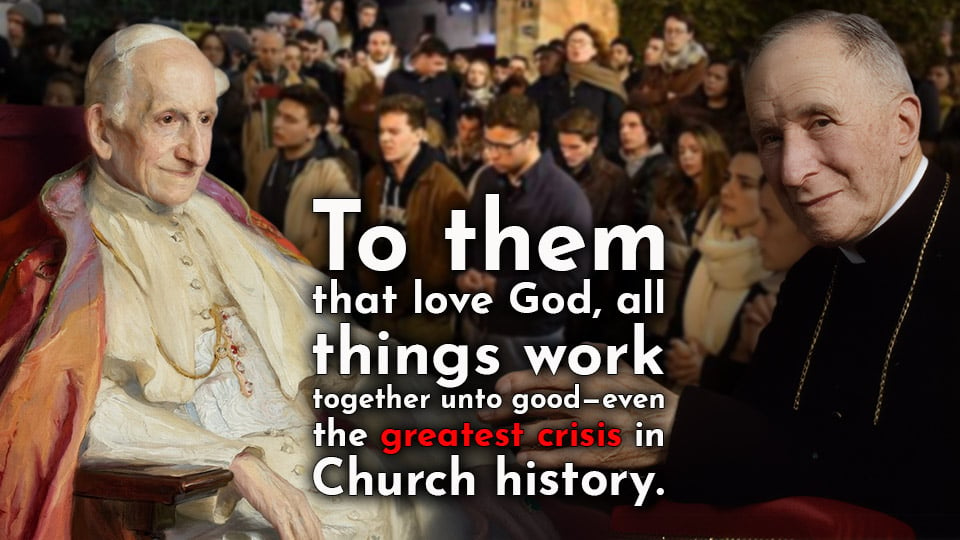
To them that love God, all things work together unto good—even the greatest crisis in Church history.
We sometimes forget that he and his newly formed Society of Saint Pius X (SSPX) were already being persecuted by the Vatican in the early 1970s, over a decade before the 1988 episcopal consecrations that led to the excommunications. Those excommunications merely provided the occasion for the Vatican to do what it had wanted to do even since Archbishop Lefebvre wrote these famous words in his 1974 Declaration:
“The only attitude of faithfulness to the Church and Catholic doctrine, in view of our salvation, is a categorical refusal to accept this Reformation. That is why, without any spirit of rebellion, bitterness, or resentment, we pursue our work of forming priests, with the timeless Magisterium as our guide. We are persuaded that we can render no greater service to the Holy Catholic Church, to the Sovereign Pontiff, and to posterity. That is why we hold fast to all that has been believed and practiced in the faith, morals, liturgy, teaching of the catechism, formation of the priest, and institution of the Church, by the Church of all time; to all these things as codified in those books which saw day before the Modernist influence of the Council. This we shall do until such time that the true light of Tradition dissipates the darkness obscuring the sky of Eternal Rome. By doing this, with the grace of God and the help of the Blessed Virgin Mary, and that of St. Joseph and St. Pius X, we are assured of remaining faithful to the Roman Catholic Church and to all the successors of Peter, and of being the fideles dispensatores mysteriorum Domini Nostri Jesu Christi in Spiritu Sancto. Amen.”
Of course, Archbishop Lefebvre and those Traditional Catholics sympathetic to him were deeply saddened and perplexed by the grave miseries that followed from the violation of God’s order for the Church. However, they knew that these miseries were the fault of those who were trying to get them to stop trying to restore God’s order. In other words, they knew which side they were on and took comfort from the obvious fact that it was the same side as God.
God alone can solve this crisis, which has resulted from Rome’s fundamental rejection of the order that He established for His Church. In the meantime, we have a choice to make in how we will practice the Faith: will we follow those who violate God’s order through their continuous assaults on God’s immutable truth, or will we cooperate with God’s grace to respect His order as best as we can? Even though we may at times disagree on the best way to do this, the small number of Catholics in this latter group are the ones for whom St. Paul’s words apply: “And we know that to them that love God, all things work together unto good, to such as, according to his purpose, are called to be saints” (Romans 8:28). Immaculate Heart of Mary, pray for us!