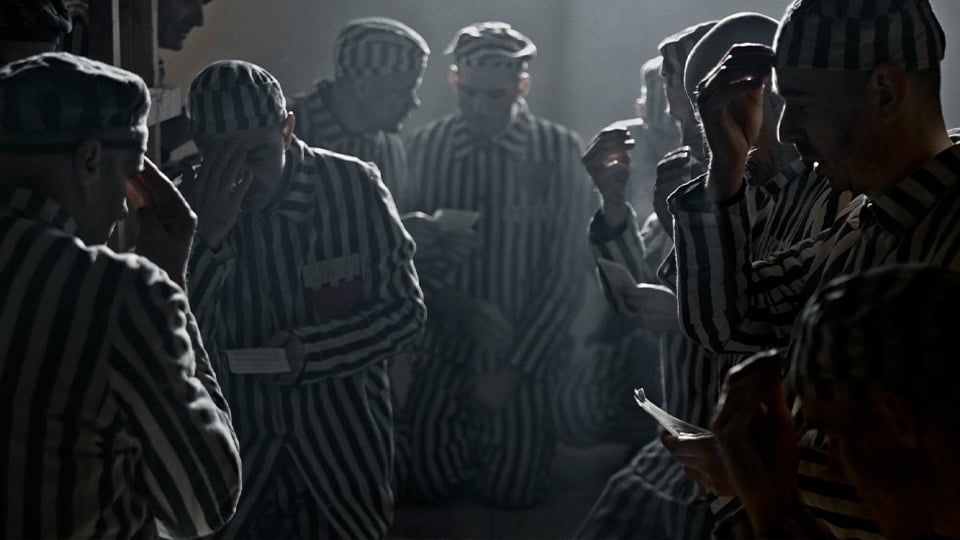

Throughout Dachau’s hellish existence, the one and only refuge for some 2,500 priests and many more Catholic laymen imprisoned there was their Catholic Faith. In this most vile, desperate and foreboding place, what Holy Catholic Mass had the power to unite these fractured men who hailed from nearly a dozen different European nations; each with its own language? It was the only Mass of its day – it was the Mass of the Ages; the Traditional Latin Mass.
2,500 Prisoner-Priests In One Concentration Camp Provides Us A Unifying Lesson – And, It’s In Latin
When 19-year-old American GI James Frank Dorris, Jr. entered the front gate of the infamous Dachau Concentration Camp in April, 1945 during its liberation, he looked around and thought to himself, “This is what hell is like!”
His eyes beheld the dead (and walking dead), his nose assaulted by the odor of the camp crematorium’s outflow – incapable of disposing of the unimaginable volume of dead inmates. PFC Dorris instantly recognized the putrid aroma. After all, he had already fought in the Battle of the Bulge.
A group of survivors stand by a moat in Dauchau
During the horrendous last four months of Dachau’s existence during World War II, an estimated 100 detainees per day died of starvation, disease or a bullet. Some days it was 400. A wartime shortage of coal made it impossible to cremate the growing numbers. Hence, bodies were stacked everywhere throughout what some called a death camp. Holocaust Encyclopedia estimates 40,000 detainees died at Dachau under the most brutal of conditions.
Decades later, Mr. Dorris, himself a Roman Catholic, provided his Dachau recollections to the Library of Congress. He said, “And in my mind I imagined the devil himself coming up out of the ground (at Dachau). And I looked up in the sky and I said, ‘God, get me out of this place!’” When young PFC Dorris walked through the gates of Dachau, he entered a realm of Satanic dystopia; a landscape of mass starvation, of louse-borne typhus epidemic, of sadistic torture and grotesque medical experimentation.
Dachau became the landing spot of all captured priests of the Third Reich. Dachau housed the famous “Priest Barracks” – three barracks buildings where remarkably, 2,579 Catholic priests filtered through Dachau between 1938 and 1945.
Persona Christi
Yet, within this hell-scape of despair, God placed hope.
Dachau became the landing spot of all captured priests of the Third Reich. Dachau housed the famous “Priest Barracks” – three barracks buildings where remarkably, 2,579 Catholic priests filtered through Dachau between 1938 and 1945. Included in that number were a small number of Catholic monks, brothers and seminarians The Priest Barracks also contained another 141 ministers of other faiths; bringing the total to 2,720 souls. In all, 95% were priests.
Except for a few short months, the priests enjoyed no special prisoner privileges. To the contrary, because of the Nazi deep-felt hatred (and fear) of Holy Mother Church, the priests were a constant target of abuse by Dachau authorities. Although dressed the same as other prisoners, the authorities knew which prisoners were priests – and directed their relentless ire toward them.
When the typhus epidemic hit the Dachau camp, the Nazi SS were panicked. They immediately ordered the sick prisoners to several quarantined barracks; leaving them to die on their own without any care. The Dachau priest-prisoners gained permission from the SS to attend to the sick and dying. These brave clerics provided them food and drink. They changed their bedding, washed their bodies, cleaned their barracks – and in the end, provided them with The Last Rites. They were even able to baptize a few.
So inspiring were these priests in this dystopian existence that it prompted many unbaptized prisoners to receive yet another Sacrament; to be covertly baptized by these priests into the Roman Catholic Church using the Latin Rite.
Since typhus does not discriminate between priest and layman, sadly many of these holy priests died along with their patients in the death barracks. In the end, typhus became the greatest killer of both priests and laymen in the prison camp.
Over the years, 314 priests (mostly German) were actually released, but tragically, at least 1,034 were never released from Dachau. These brave, martyred priests would succumbed to death via starvation, disease, bullet – or by the gas chamber of Hartheim Castle in Austria; where Dachau’s “disabled and undesirable” were shipped.
So, when PFC Dorris walked through those Dachau gates, sadly there remained only 1,240 priests to be freed.
An image of Polish priests in Dachau
Throughout Dachau’s hellish existence, the one and only refuge for these priests and the many Catholic laymen imprisoned there was their Catholic Faith. These holy priests kept the flames of faith, hope and charity burning. At great danger to themselves, priests would secretly distribute Holy Communion to Catholics in other barracks within the compound; reciting the “Corpus Domini Nostri” intonation while placing the Sacred Host on their tongue.
Distributing Holy Communion was not the priests’ only dangerous occupation. Priests would secretly hear Confessions of prisoners as they walked together, under the watchful eye of camp guards – the prisoners whispering their sins; the priest reciting the words of absolution in Latin. So inspiring were these priests in this dystopian existence that it prompted many unbaptized prisoners to receive yet another Sacrament; to be covertly baptized by these priests into the Roman Catholic Church using the Latin Rite.
“During the Latin Mass, no longer could I recall the world of the concentration camp. Each prisoner, for those precious moments, was restored to his original, fragile and indestructible dignity. On the way out, in the pale light of the early morning, one felt capable of facing a little better the hunger and fear.”
The Latin ‘Glue’
And then there was the Holy Mass.
As odd as it may seem, there were actually times between 1941 and 1945 that the Holy Mass was offered at Dachau. The camp even had a chapel (of sorts). Even when Mass was allowed by the Nazis, laymen were usually forbidden from attending. Still, that modest little chapel was a fountain of grace and hope for the tortured detainees.
In Guillaume Zeller’s brilliant book, The Priest Barracks, he wrote, “Although the regulations that were imposed upon the chapel may have caused some difficult episodes, this place remained the source of comfort for those who had the chance to get there freely or secretly.”
In this most vile, desperate and foreboding place, what Holy Catholic Mass had the power to unite these fractured men who hailed from nearly a dozen different European nations; each with its own language? It was the only Mass of its day – it was the Mass of the Ages; the Traditional Latin Mass (TLM). It was the Holy Mass all Catholic detainees knew, regardless of language.
German prisoner Joseph Rovan reflected on assisting at Mass in Dachau, “The priest was saying the same Latin words that all his confreres, at the same hour, were repeating in their morning Masses throughout the world. No longer could I recall the world of the concentration camp. Each one, for precious moments, was restored to his original, fragile and indestructible dignity . . . On the way out, in the pale light of the early morning, one felt capable of facing a little better the hunger and fear.”
In addition to the TLM and other Sacraments dispensed in Latin at Dachau, all priests of the early 20th century were well-schooled in Latin; including those imprisoned at Dachau. Mr. Zeller’s book notes, the prisoner-priests would often converse in Latin with each other when there would otherwise be a language barrier.
Latin was a key ingredient to the Traditional Catholic glue that bound the captive priests and laymen to Our Dear Lord in the daily hell that was Dachau.
But the greatest lesson for modern-day Catholics is more basic. It is more universal than this horrific, heart-breaking, yet inspiring Dachau story. The lesson for us is: This WAS the Church of Our Fathers. It is how Catholics felt about their Church; about the Mass of the Ages and about the Traditional Sacraments! They would do anything to obtain graces from them. In the Church of Our Fathers, one did not have to be in a concentration camp to feel this strong bond with the Mass and the Sacraments.
A few years after the war, in 1948 England, renown Jesuit Father Ronald Knox was about to be transferred from his position at Aldenham Catholic School. His final sermon to the students highlights the unity and power of the Mass of the Ages.
In part, Father Knox preached, “ But you won’t find it so easy to remember me; you will grow into your new surroundings. Only one thing is never different: the Holy Mass.” Toward the very end of his sermon that day he said, “But do let’s get it clearly in our heads that there can be no real separation, in life and death, as long as we stick to the Holy Mass. In Christ we are all one; the sacred Host is the focus in which all our rays meet, regardless of time and space.”
It has been 80 years since the liberation of Dachau. Holy Mother Church finds Herself somehow embroiled in a debate about celebrating the TLM, about Catholic Tradition – and even about Latin itself!
And Today?
It has been 80 years since the liberation of Dachau. Holy Mother Church finds Herself somehow embroiled in a debate about celebrating the TLM, about Catholic Tradition – and even about Latin itself!
Some Catholic Bishops have curtailed or even eliminated entirely the TLM in their dioceses. Some have decreed Latin cannot even be used in the Novus Ordo Missa. Even in diocesan churches allowing the TLM, it is forbidden to publicize the TLM in parish bulletins. For others, the TLM has been banished.
Earlier this year, highly-respected Cardinal Robert Sarah commented about the suppression of the TLM, “This project, if it is true, seems to me to be an insult to the history of the Church and to the Sacred Tradition, a diabolical project that seeks to break with the Church of Christ, the apostles and the saints.”
It is indeed a turbulent time within the true Church, but Catholic history records that all persecutions eventually come to an end. And, it will be the same with this internal persecution of Traditional Catholics.
And in June, His Eminence Cardinal Raymond Burke called upon recently-elected Pope Leo XIV to end what the Cardinal called “persecution from within the Church” of Catholics who attend the TLM. So, the question(s) becomes: How long will the persecution of Catholics who yearn for the Catholic Mass continue? How much longer will the Church downplay Her universal Latin language? In short, how long will She deny Her rich patrimony?
It is indeed a turbulent time within the true Church but Catholic history records that all persecutions eventually come to an end. And, it will be the same with this internal persecution of Traditional Catholics.
Since the Dachau Catholic captives knew a thing-or-two about “persecution,” perhaps it is wise to look for solace from their heroic example. Father Andre Morelli, a French Augustinian prisoner-priest advised a Catholic lay prisoner in the midst of this Dachau-Hell, “What supports you is the grace that God sends you in this present moment.” Father Morelli’s succinct, yet profound advice is a Catholic lesson for every age – including this one.
