
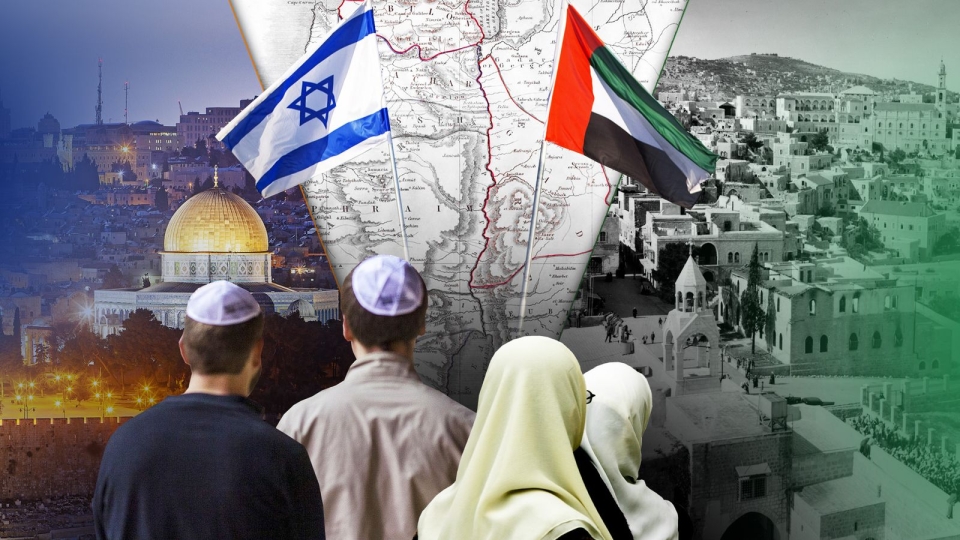

Our blind loyalty to the Israeli state has led us to become complicit in their aggression, both against the Palestinians whose homes they have taken, and against the other states in the region. We will be held accountable for this. We will be judged by God, and our children will continue to suffer the consequences of our participation in unjust wars.
Our US history and our Catholic heritage provide us with a multitude of resources for avoiding unnecessary and unjust wars, such as the one against Iran that seems to be pending. As we look for ways to break the cycle of constant conflict, we have numerous intellectual resources at our disposal, should we choose to use them. As Catholics we should look first to the principles of the Just War given to us by Saint Thomas Aquinas, but we should not overlook the wisdom of the founding fathers of our nation. All that is necessary for us to break the cycle of forever wars is that our political leadership show a bit of courage and try applying these intellectual tools to contemporary circumstances.
The principle of the Just War should be at the center of our foreign policy decisions involving military conflict. In order to apply military force, there must be just cause for the conflict, proportionality must be exercised, the conflict must come as a last resort, it must be declared by competent authority, there must be a reasonable chance of success, and injury or death of noncombatants must be avoided. Saint Thomas gives us these broad guidelines, but he doesn’t deal directly with the question of “entangling alliances.” These could be broadly defined as alliances which pull us into conflicts that have no relationship to our national interests. Obviously, if there is no national interest, then there is no just cause for our involvement and the saintly doctor expects us to use our powers of reason to avoid involvement. Nevertheless, the USA falls into the trap repeatedly, involving ourselves in unjust wars in the most nonsensical ways and in a manner most harmful to our nation and our future. Since St. Thomas doesn’t directly address the question of entangling alliances, we can look to some very practical advice from one of our founding fathers. In his farewell address, George Washington advised against establishing permanent alliances with other countries.
“Taking care always to keep ourselves, by suitable establishments, on a respectably defensive posture, we may safely trust to temporary alliances for extraordinary emergencies.” [1]
He saw alliances as dangerous, and he correctly asserted that they would eventually work against our national interests. Such is the case of our alliance with the Israeli state. There is no reason to treat this particular country any differently than every other country in the world, yet we do so for several reasons, none of which make sense.
First of all, many Americans are afraid of criticizing the policies of Israel out of fear of being labeled “antisemitic.” This fear is ridiculous. Secondly, many Americans are infected with erroneous theology that leads to blind support for Israel, a misunderstanding which leads to assigning a holiness to a contemporary nation state which did not even exist before 1948.
First of all, many Americans are afraid of criticizing the policies of Israel out of fear of being labeled “antisemitic.” This fear is ridiculous, and it should be immediately dismissed with contempt, up front and outright, by any thinking person. Criticizing the policies of China does not equate to holding racial prejudices against Asian people. Criticizing the policies of Chad, Ghana or Nigeria does not equate to holding racial prejudices against Black people. If we cannot at least take the first step of being able to criticize the policies of the Israeli state, with which we are apparently joined at the hip, then we have no national autonomy. We are subject to the whims of this state with which we are entangled, and we must send our armed forces to fight whatever wars they deem necessary, regardless of whether or not they are just.
Secondly, many Americans are infected with erroneous theology that leads to blind support for Israel. Among Catholics, these errors often have their origins in misunderstandings of references to “Israel” in the liturgy and in the scriptures, a misunderstanding which leads to assigning a holiness to a contemporary nation state which did not even exist before 1948. Consider the Introit of the Nuptial Mass: “Deus Israel conjugat vos…” (may the God of Israel join you together). This was the Introit of the Nuptial Mass long before the Israeli state was formed in 1948. What did the reference to “Israel” mean when a young Catholic couple was married in the 1800s if there was no nation at that time calling itself “Israel?”
The answer is simple, and it is Catholicism 101, but unfortunately it is not well known or understood. “Israel” refers to the people of God, those who are baptized into membership of Christ’s Mystical Body, the Catholic Church, which He founded as the means of salvation for all. This is the new Israel. This poorly understood but very basic element of our Faith is explained well by Dr. Harley Price:
For Christians before the Reformation and Catholics thereafter, the Old Law, including its exaltation of the Jews as the “Chosen People” and God’s promise to them of a territorial state in the Holy Land, is understood (as a matter of orthodox doctrine) to have been wholly superseded by the New Dispensation of Christ. Following the Crucifixion, the veil of the Temple was rent in two, and the election of the Jews as the Chosen People was abrogated and volatilized by the New Israel understood as a universal spiritual community of believers in the redemptive Incarnation of the Messiah whom the Jews continue to await. The inauguration of the New Israel of the Church, that is, represents the fulfillment and superannuation of God’s promise to Abraham, and stands in frontal contradiction to the Zionist aspiration for a territorial nation in the Holy Land. [2]
“Israel” is, simply put, the Catholic Church. Some of our Protestant brethren dismiss this as “replacement theology,” but it’s sound, basic Christian theology. God’s chosen people are those who choose to follow the Church established by His Son, Jesus Christ. One cannot simply move a large concentration of Jewish people to some location on the map, even if it an historic homeland, establish a nation state, call it “Israel,” and say “therein we find God’s Chosen People. These people can do no wrong, because they are the chosen of God!” Here is a point at which theological errors among Americans coincide with and exacerbate our disastrous U.S. foreign policy in the Middle East.
The often-repeated slogan “God will bless those who bless Israel and curse those who curse Israel,” is a distortion of scriptures that is used to justify the actions of current nation state of Israel. Where in scriptures is this found? From Genesis 12:3 (Douay-Reims) we have: “And the Lord said to Abram: Go forth out of thy country, and from thy kindred, and out of thy father’s house, and come into the land which I shall shew thee. And I will make of thee a great nation, and I will bless thee, and magnify thy name, and thou shalt be blessed. I will bless them that bless thee, and curse them that curse thee, and in thee shall all the kindred of the earth be blessed.” This is addressed to Abram (Abraham) and his descendants. The word “Israel” has been cleverly inserted into this passage so that it reads: “God will bless those who bless Israel and curse those who curse Israel.” Next the phrase is given a shift in meaning so that it appears to be a mandate from Heaven to look the other way if a nation state born in 1948 does something wrong. Similarly, from Numbers 24:9 (Douay-Reims): “He that blesseth thee, shall also himself be blessed: he that curseth thee shall be reckoned accursed,” we note that there is no direct reference to “Israel.” If that substitution is made in either passage, how would we have interpreted it at any time between 33 AD and the birth of the Israeli state? Who would it have been referring to in 1800, for example? This question has already been answered.
We should also recognize the difference between Judaism and Zionism. Sincere followers of Judaism condemn Zionism in the harshest terms.
So far, our enumerated reasons for which Israel gets special treatment from the US include fear of accusations of “antisemitism” and bad theology. The third reason is that many Americans somehow see Israel as an ally. Many well-meaning US citizens have come to believe in a fantasy in which Israel is our only ally in the Middle East, a bastion of democracy in the heart of rabid Islam. Therefore, we must stand with Israel. Titles such as “our only ally in the region” or “our best ally” are bestowed upon Israel, despite the fact that all benefits of this supposed “alliance” go in one direction. The contempt with which Christians are treated in Israel should give pause to this kind of thinking. The restrictions on 2025 Holy Week celebrations were extreme, with authorities severely limiting the number of “passes” for West Bank Palestinian Christians to celebrate Palm Sunday and Easter in Jerusalem. The hostility is documented in [3]:
The annual report by the Rossing Center, a Jerusalem-based organization dedicated to interfaith coexistence, documented 111 cases of harassment and violence against the Christian community in Israel and East Jerusalem in 2024. The report revealed a climate of hostility that, according to one of the study’s authors, Federica Sasso, only represents “the tip of the iceberg of a much larger phenomenon.” Of the 111 reported cases of assault, 47 were physical assaults primarily through “spitting,” a behavior that has evolved from subtle acts to openly aggressive displays. In several areas, especially in the Old City of Jerusalem, priests, nuns, friars, and monks “being easily identified are exposed to these attacks on a daily basis” with only rare intervention by the Israeli authorities.
Setting aside our ally’s contempt for Christians, and referring again to Washington’s farewell address:
So likewise, a passionate attachment of one nation for another produces a variety of evils. Sympathy for the favorite nation, facilitating the illusion of an imaginary common interest in cases where no real common interest exists and infusing into one the enmities of the other, betrays the former into a participation in the quarrels and wars of the latter, without adequate inducement or justification. It leads also to concessions to the favorite nation of privileges denied to others …
Our First President seems to be speaking to us prophetically about our relationship with Israel. We have the illusion of some common interests where none really exist, and we have erroneously conferred a “favorite nation” status upon this particular state. We imagine that their enemies are our enemies, and we have participated in their wars. Most infuriatingly, young Americans have died in these wars, and we have made future enemies for generations to come by our foolishness in allowing them to manipulate us. Our relationship with the Israeli State is the very essence of an “entangling alliance,” and until we regain our national autonomy this “alliance” will be the source of endless bloody and unjust wars.
In addition to bad theology, fear of accusations of “antisemitism,” and false notions of an “alliance” there’s a clear lack of understanding of the region. The emotional attachment Americans have to Israel is based on this lack of understanding, fertilized with smooth propaganda and restricted access to “the rest of the story.” The founding of the Israeli state and its behavior towards its neighbors up to the present has been a carefully guarded secret history of thuggery, bullying, tyranny, and ethnic cleansing to which no sane Catholic could possibly give consent. The Zionist movement, which advocated mass migration of Jews to Palestine from around the world was denied support from the Catholic Church from the start. In 1904 Pope Saint Pius X was approached by Theodore Herzl, one of the founding fathers of the Zionist movement, who was seeking his support. Saint Pius X responded: “We cannot give approval to this movement. We cannot prevent the Jews from going to Jerusalem – but we could never sanction it.” He went on to add that if large numbers of Jews moved to Palestine, he would ensure that there were sufficient churches there and priests to baptize the newcomers. [4]
The founding myth of the Israeli state is described by Thomas L. Friedman, an American Jewish journalist who documents his experience in the region in “From Beirut to Jerusalem.” He describes the reason behind the myth of the migration to Palestine:
Many Israelis had convinced themselves that there was no such thing as a legitimate Palestinian nation with a legitimate national claim to any part of Palestine. They saw the Palestinians instead as a part of an undifferentiated Arab mass stretching from Morocco to Iraq and with no particular cultural, historical or ethnic identity linked to the land of Palestine. This myth was one of the oldest and most enduring in Zionist history. In the early twentieth century, when the Zionist movement was just taking off, it may have been a necessary myth. To be able to convince Jews to pick up and leave their homes in Moscow, Johannesburg, New York, Mexico City, London and Montreal and come to settle in Palestine, the Zionists had to look through the Arabs to some extent. If the Zionists had come to Jews around the world and said, “Look, we want you to come to Palestine but you had better understand that there is another legitimate nation there, the Palestinians, who claim it as theirs and will fight you to the death,” many Jews might never have come. So the Zionists had to believe, as the saying at the time went, that they were “a people without a land” coming to “a land without a people.” [5]
The “people without a land” coming to a “land without a people” found out that there were, in fact, people already inconveniently living there and many of them were Christians. Something had to be done with them. Jewish inhabitants of Palestine ceased to be a majority in the 5th Century AD. For a period of time the majority were Christians, eventually to be outnumbered up to the present by the Muslim population. During the early 1900s, the Jewish arrivals were initially welcomed by both the few long-time Jewish inhabitants of Palestine and the more numerous Palestinian Muslims and Christians. The table below shows the population in thousands, as the critical time period of the 20th Century approached: [6]
Year
Jews
Christians
Muslims
Total
1800
7
22
246
275
1890
43
57
432
532
1914
94
70
525
689
1922
84
71
589
752
1931
175
89
760
1,033
1947
630
143
1,181
1,970
The Zionist movement promised a Jewish homeland at a time that many saw a homeland as necessary for survival of Jewish people. The only way to do that, however, was to cause the Palestinians to leave. A key step in making this happen came in the form of an official British foreign policy statement, the Balfour Declaration, giving British support for a Jewish national home in Palestine. In addition to a Jewish homeland, this 1917 document guaranteed civil and religious rights to non-Jewish communities in Palestine. That part was ignored, as the homeland guarantee would require the removal of all such communities, Christian and Muslim alike. As Jewish refugees poured in during the 30s and 40s, they continued to acquire property and increase their influence. Property acquisitions often had dire consequences for the inhabitants, who were often forced to leave their homes without understanding why. In 1936 Palestinians revolted over what they considered favoritism toward the Jewish settlers. The uprising was crushed by the British, who began limiting the number of Zionist settlers in order to attempt to defuse the situation. Timing couldn’t have been worse, considering events in Europe. Now it was the Zionists who revolted, armed themselves, and formed militias. They began carrying out attacks against both the Palestinians and the British. In 1947 the British announced that they would be leaving and turning Palestine over to the UN. Before they even left, the now heavily armed Zionists began taking over villages and even major cities, forcing the refugees to flee for their lives. In what would eventually be called the “Nakba” (catastrophe), they committed acts of random violence and murder to force the locals to flee. Israel declared itself a state on May 14, 1948 and shortly thereafter the Arab states declared war for the purpose of liberating Palestine. It was natural that the Israelis would win this conflict, despite being outnumbered, because they had considerable international backing and influence. The UN suggestion for a two-state solution was ignored as the Israelis expanded beyond the lines that had been drawn and continued the campaign of ethnic cleansing.
Periodically it becomes necessary to “mow the lawn,” a term the Israelis use to refer to their military operations in which the ethnically impure are cut down in high tech massacres. In recent years the word “lebensraum” is invoked, even within respectable Israeli circles. This was the German term for expressing the need for national expansion, and its use is associated with the Nazi era.
Many of these refugees ended up in Gaza where there are now third generation refugees. Others fled to Syria, Jordan, and Lebanon and Egypt. The result of this mass migration and replacement of the local population has been predictable: periodic episodes of conflict between an Israeli overlord class and Palestinians, some of them Christians.
For the Israelis, the continued existence of these people is a nuisance. Over the decades the Palestinians have been subject to a campaign of ethnic cleansing and gradual removal. The longstanding project of the Israeli state has been to eliminate the indigenous population of Palestine in pursuit of a “Greater Israel,” an ethnically pure Jewish state. It is not clear what the eventual borders are to be according to this strategic plan.
Periodically it becomes necessary to “mow the lawn,” a term the Israelis use to refer to their military operations in which the ethnically impure are cut down in high tech massacres. In recent years the word “lebensraum” is invoked, even within respectable Israeli circles. This was the German term for expressing the need for national expansion, and its use is associated with the Nazi era. “Suddenly we are short of space here in Israel, which has become full to capacity and needs lebensraum.” [7] This term was repeated just recently on a blog in the Times of Israel that was subsequently deleted. Says Dan Erlich:
“These people need places to live in a nation short of land mass. Compare Israel to its neighbor Jordan, which has a smaller population, yet about five times the land area. If Israel is to maintain its agricultural industry, its exploding population will [need] to grow up, in high-rise apartment complexes, as well as out, possibly into Judea and Samaria.” [8]
The territory referred to here, Judea and Samaria, is what we now call the West Bank, which has been occupied by Israel since 1967.
What does any of this have to do with us? We have been the primary supporters of this project. Over the decades since the founding of Israel the expansion of the Jewish held territories at the expense of the locals has radicalized the Palestinians and others in the region. They now see us, as the primary supporters of those who forced Palestinians from their homes, as equally guilty. This is the source of the radical Islam problem we face as Americans. We have not always had problems with radical Islam. These problems have increased in proportion to the degree to which we allow Israel to direct our foreign policy. That extent to which our foreign policy in the Middle East is influenced by Israel can be debated, but there is no doubt that they exert more control over our actions than any other nation in the world.
Our blind loyalty to the Israeli state has led us to become complicit in their aggression, both against the Palestinians whose homes they have taken, and against the other states in the region. We will be held accountable for this. We will be judged by God, and our children will continue to suffer the consequences of our participation in unjust wars. As a reminder, contemporary civilizations, including ours, reject the notion of monarchy as a form of government and favor representative government in which “We the People” are the decision makers. Therefore, the questions of the morality of our wars, which would have once been the responsibility of the monarch, now fall upon all of us. This means that each of us bears some share of responsibility for our government’s policies. The terrible price people in the region are paying for the failure of our leaders is ultimately our responsibility.
If we are to roll back out involvement in endless conflicts in the Middle East we need to heed our First President’s advice and extract ourselves from this unwritten alliance with Israel.
What can we do?
If we are to roll back out involvement in endless conflicts in the Middle East we need to heed our First President’s advice and extract ourselves from this unwritten alliance with Israel. A reasonable first step would be to remove the influence of AIPAC. AIPAC is the American Israel Public Affairs Committee, a pro-Israel lobbying group that weighs in heavily on our foreign policy decisions. For years we have allowed Israeli lobbyists to have unique access to our government. According to Hon. Thomas Massey, there is an AIPAC lobbyist in the office of just about every Representative and Senator. It’s no secret. Just within the past few weeks AIPAC has launched a series of ads targeting senators who voted in favor of a motion to withhold military aid to Israel [9][10]. Their reach goes right to the center of any presidential administration, whether it is Republican or Democratic:
The Grayzone has obtained audio of an off-the-record session from the 2025 Congressional Summit of AIPAC, the main US lobbying arm of the state of Israel. Recorded by an attendee of the panel discussion, the audio features AIPAC’s new CEO, Elliott Brandt, describing how his organization has cultivated influence with three top national security officials in the Trump administration – Secretary of State Marco Rubio, National Security Director Mike Waltz, and CIA Director John Ratcliffe – and how it believes it can gain “access” to their internal discussions. [11]
No other nation in the world has this level of influence over our foreign policy and our decisions about engaging in war. This is what has been behind our endless involvement in the Middle East all along. On Sept 12, 2002, Benjamin Netanyahu testified before Congress, as an “expert witness,” during which time he pushed the WMD lie and argued, convincingly, that the removal of Saddam Hussein would “have enormous positive reverberations on the region” and cause young people in nearby Iran to decide that the era of despots was over. [12] He was arguing for regime change in Iran then, just as he is to this day. The result of the invasion of Iraq has been catastrophic. It failed in every category of the Just War criteria. Allowing ourselves to be manipulated into participating in Netanyahu’s long-awaited war against Iran will be even more disastrous.
Merely ridding ourselves of AIPAC will not solve our problem. We should also recognize that there is a widespread naivete among our people that stems from our poor relationship with God. This leaves us vulnerable to propaganda. We should pray more and seek to better understand our Faith, through which we can grow in wisdom. Sloppy theology leads many to think that those who inhabit a particular region of the planet are “God’s Chosen People” and therefore they can expand their territory by any bloody deeds necessary. This is a direct result failure to understand God and The Redeemer that He sent to us. None of the states in the region, including Israel, are derived from Christian Civilization. There is no interest in proportionality, limiting civilian casualties, or any other Just War notions handed down to us by St. Thomas. The regional actors consider such restraint to be ridiculous. It’s “an eye for an eye and a tooth for a tooth” in that part of the world. We must recognize that our “ally” does not share our values, particularly those (such as the Just War framework) which are derived from our Christian heritage.
We should also recognize the difference between Judaism and Zionism. Sincere followers of Judaism condemn Zionism in the harshest terms. Neturei Karta International (NKI) is a Jewish organization that promotes traditional Judaism in opposition to the philosophy of Zionism. From their mission statement: [13]
For thousands of years, the Jewish people were self-defined solely as a religious community, the adherents of the religion of Judaism. The essence of Judaism is the wholehearted belief in G-d and the Torah He transmitted to us at Mount Sinai 3,300 years ago, when we made a covenant with G-d to be subservient to Him and adhere to His commandments… In 1897, the Zionist movement was formed by Jews who defected from Judaism. Zionism is a self-proclaimed social engineering project whose goal is to transform the identity of the Jewish people from a religious community to a material, European-style political nationalism, devoid of belief in G-d and fulfillment of His Commandments. This transformation is a fundamental uprooting of Judaism and an erasure of the Jewish people….One of the basics of Judaism is that, since our banishment from the Holy Land by Divine decree, Jews are in exile and are required to be loyal citizens in whichever country we reside, not rebel or wage wars against any people, nation, or country. The Torah forbids Jews from having their own sovereignty. Exile can only end miraculously, by G-d alone, without any human intervention. All mankind will then unite in the brotherly service of the Creator….Therefore, the ideology of Zionism, a recent innovation, which seeks to force the end of exile, is contrary to Jewish belief and millennia of well-accepted Jewish tradition. This is why Zionism was met with Rabbinic opposition from the very beginning of its inception.
Why don’t we hear of Anti-Zionist Jews more often? The organization “Torah Jews” answers the question:
The answer is simple. There are hundreds of thousands of Orthodox Jews in the US and around the world. Their days revolve around Torah learning, and pursuits of … commandments and of course, all have limited internet exposure. Anti-Zionist Jews rely on official organizations such as ours, with the endorsement of a wide range of leading Rabbis, to air the authentic Torah message. The Jews you see at the bully pulpit in the media and on Twitter are not those who actually practice Judaism. (Usually, they exploit it.) [14]
These non-Zionist Jews exist in no small number. We have a right, and sometimes an obligation, to criticize the actions of the Israeli state since it benefits from enormous amounts of our tax dollars, but we must not confuse Judaism with Zionism.
We should be able to discuss the history of this region, the formation of the Israeli state, the consequences to the locals living there, and how it evolved into the current situation.
We should be able to discuss the history of this region, the formation of the Israeli state, the consequences to the locals living there, and how it evolved into the current situation. These conversations should be possible on our universities and colleges, but many of our institutions of higher education have become emotionally charged propaganda centers. After the attack by Hamas on October 7th of last year, instead of an outbreak of intellectual discourse we saw an outbreak of childish “From the river to the sea!” chants, violent protests, and other counterproductive behavior that has led to equally counterproductive directives against “criticizing Israel.” Years of leftist indoctrination on campuses have led to “educated” students holding a world view in which they see the situation in a ridiculously simplified framework: The Israelis are European colonialists who are abusing the local indigenous population, therefore we must protest violently and break things. The violent campus outbursts have limited the opportunities for addressing the situation and helping people to understand the plight of the Palestinians. Equally tragic is the outpouring of hatred toward anyone who discusses the problem on podcasts or in any other alternative media. This anti-intellectual trend in the USA, if allowed to persist, will ultimately prevent us from being able to extract ourselves from constant military involvement in the region.
We need to determine where the loyalties of those who serve in our government are. On March 26 of this year Representative Thomas Massie proposed HR 2356, the Dual Loyalty Disclosure Act. This will require candidates for public office to disclose all countries in which they hold citizenship. Although this is a step in the right direction and we should encourage support for this legislation, it does not go far enough. We should be able to determine the citizenship of every single government employee, since they are all working for us. We have no idea how many of them have Israeli citizenship, but it is clear that there are people in our government who are more concerned about Israel’s well being than ours.
Finally, even if we are able to keep our “ally” from dragging us into war with Iran, that is not enough. An internal war of extermination is being waged. The ongoing genocide in Gaza would not be possible without US support, and therefore we share some responsibility for it. The Israelis have no interest in the wisdom of Thomas Aquinas, and they will not stop until the occupied regions are ethnically purified. The US is in a position to force an end to the conflict and insist on an end to the expansion of the Israeli state and a homeland for the Palestinians. We simply lack the will to make it happen. This conflict will end when enough Americans concern ourselves more with the question of how God will judge us than the question of whether someone on the Internet will call us “antisemitic.”
[1] President George Washington’s Farewell Address
[3] https://www.unz.com/pgiraldi/the-suppression-of-christianity-in-its-birthplace/
[4] https://israeled.org/herzl-meets-pope-pius-x/
[5] Page 141, From Beirut to Jerusalem, Thomas L. Friedman, Farrar Straus Giroux, New York, 1989.
[6] Estimates by Sergio DellaPergola (2001), drawing on the work of Bachi (1975), found at Demographic history of Palestine (region) – Wikipedia
[7] Yossi Sarid, Haaretz, August 26,2011.
[8] https://www.newsweek.com/israel-needs-lebensraum-says-blog-major-national-newspaper-1996635
[9] The Hill, 10 April 2025
[10] The New Arab, 10 April 2025
[11] The Grayzone,·April 9, 2025
[12] https://www.c-span.org/clip/house-committee/user-clip-netanyahus-expert-testimony-on-iraq-in-2002/4529120
[13] https://nkusa.org/
