
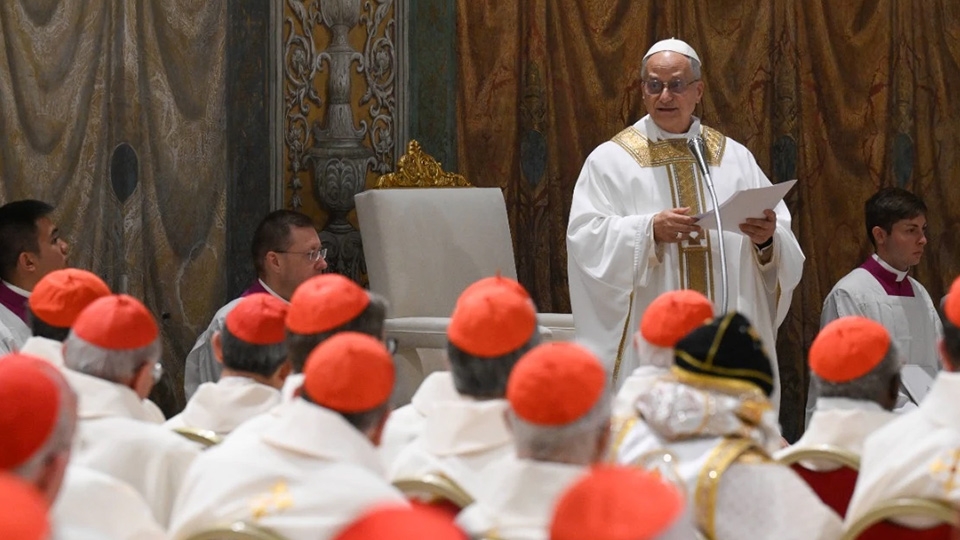

In his May 10th meeting with Cardinals, Pope Leo XIV spoke of how he intended to continue taking the path “that the universal Church has now followed for decades in the wake of the Second Vatican Council.” This comes as no surprise because few Cardinals in the conclave that elected Leo XIV would have had any desire to support a man who intended to entirely abandon the Council.
The more interesting portion of his discussion related to how he might build upon Francis’s 2013 Apostolic Exhortation on the proclamation of the Gospel in today’s world, Evangelii Gaudium:
“In this regard, I would like us to renew together today our complete commitment to the path that the universal Church has now followed for decades in the wake of the Second Vatican Council. Pope Francis masterfully and concretely set it forth in the Apostolic Exhortation Evangelii Gaudium, from which I would like to highlight several fundamental points: the return to the primacy of Christ in proclamation (cf. No. 11); the missionary conversion of the entire Christian community (cf. No. 9); growth in collegiality and synodality (cf. No. 33); attention to the sensus fidei (cf. Nos. 119-120), especially in its most authentic and inclusive forms, such as popular piety (cf. No. 123); loving care for the least and the rejected (cf. No. 53); courageous and trusting dialogue with the contemporary world in its various components and realities (cf. No. 84; Second Vatican Council, Pastoral Constitution Gaudium et Spes, 1-2).”
Of the 288 paragraphs in Evangelii Gaudium, Leo XIV chose eight to highlight. And although some of those eight paragraphs include content that is arguably heterodox, the way in which Leo XIV briefly characterized the themes he wanted to highlight in those paragraphs (above) may suggest that he is focused on the orthodox ideas. Time will tell whether Leo XIV intends to move some of Francis’s initiatives at least somewhat closer to Catholic teaching, but for now we can examine the key themes he mentioned from Evangelii Gaudium. For each of these themes below, the full paragraph from Francis’s Apostolic Exhortation cited by Leo XIV is quoted initially.
The opening ideas in this paragraph are worthwhile, but many Traditional Catholics can easily spot the serious problems with the quotation of John XXIII’s condescending dismissal of the “prophets of doom.” What will it take for the defenders of the Vatican II revolution to learn the painfully obvious lessons of the past sixty years?
The Return to the Primacy of Christ
“11. A renewal of preaching can offer believers, as well as the lukewarm and the non-practising, new joy in the faith and fruitfulness in the work of evangelization. The heart of its message will always be the same: the God who revealed his immense love in the crucified and risen Christ. God constantly renews his faithful ones, whatever their age: ‘They shall mount up with wings like eagles, they shall run and not be weary, they shall walk and not be faint’ (Is 40:31). Christ is the ‘eternal Gospel’ (Rev 14:6); he ‘is the same yesterday and today and forever’ (Heb 13:8), yet his riches and beauty are inexhaustible. He is for ever young and a constant source of newness. The Church never fails to be amazed at ‘the depth of the riches and wisdom and knowledge of God’ (Rom 11:33). Saint John of the Cross says that ‘the thicket of God’s wisdom and knowledge is so deep and so broad that the soul, however much it has come to know of it, can always penetrate deeper within it.’ Or as Saint Irenaeus writes: ‘By his coming, Christ brought with him all newness.’ With this newness he is always able to renew our lives and our communities, and even if the Christian message has known periods of darkness and ecclesial weakness, it will never grow old. Jesus can also break through the dull categories with which we would enclose him and he constantly amazes us by his divine creativity. Whenever we make the effort to return to the source and to recover the original freshness of the Gospel, new avenues arise, new paths of creativity open up, with different forms of expression, more eloquent signs and words with new meaning for today’s world. Every form of authentic evangelization is always ‘new.’”
If Leo XIV truly envisions this paragraph from Francis as a call for the return to the primacy of Christ, that would be a welcome development. However, the last portion of this paragraph foreshadowed so much of Francis’s heterodox innovations that have scandalized countless souls — all of Francis’s “new paths of creativity” amounted to creative ways to accommodate old heresies. We can hope and pray that Leo XIV sees a need to “return to the primacy of Christ” because he recognizes that it has been effectively abandoned for the past six decades.
The missionary conversion of the entire Christian community
“9. Goodness always tends to spread. Every authentic experience of truth and goodness seeks by its very nature to grow within us, and any person who has experienced a profound liberation becomes more sensitive to the needs of others. As it expands, goodness takes root and develops. If we wish to lead a dignified and fulfilling life, we have to reach out to others and seek their good. In this regard, several sayings of Saint Paul will not surprise us: ‘The love of Christ urges us on’ (2 Cor 5:14); ‘Woe to me if I do not proclaim the Gospel’ (1 Cor 9:16).”
This paragraph from Francis is generally benign, but we know from the past twelve years that Leo XIV’s predecessor did not actually seek to proclaim the true Gospel. If Leo XIV truly seeks to urge Catholics to spread the unadulterated Catholic Faith, then we might see wholesome fruits.
If he thinks of Synodality primarily in terms of the ideas in this paragraph from Evangelii Gaudium, he could scale back Synodality so that it develops into nothing more than a process to identity more effective ways to spread the Gospel. If he continues the Synodal Church in its current form, though, it would be devastating for his papacy and the Mystical Body of Christ.
Growth in collegiality and synodality
“33. Pastoral ministry in a missionary key seeks to abandon the complacent attitude that says: ‘We have always done it this way.’ I invite everyone to be bold and creative in this task of rethinking the goals, structures, style and methods of evangelization in their respective communities. A proposal of goals without an adequate communal search for the means of achieving them will inevitably prove illusory. I encourage everyone to apply the guidelines found in this document generously and courageously, without inhibitions or fear. The important thing is to not walk alone, but to rely on each other as brothers and sisters, and especially under the leadership of the bishops, in a wise and realistic pastoral discernment.”
While we know enough about Synodality to condemn it entirely, it is theoretically possible that Leo XIV does not intend to continue it in its most extreme (and anti-Catholic) manifestations. If he thinks of Synodality primarily in terms of the ideas in this paragraph from Evangelii Gaudium, he could scale back Synodality so that it develops into nothing more than a process to identity more effective ways to spread the Gospel. If he continues the Synodal Church in its current form, though, it would be devastating for his papacy and the Mystical Body of Christ.
Attention to the sensus fidei
“119. In all the baptized, from first to last, the sanctifying power of the Spirit is at work, impelling us to evangelization. The people of God is holy thanks to this anointing, which makes it infallible in credendo. This means that it does not err in faith, even though it may not find words to explain that faith. The Spirit guides it in truth and leads it to salvation. As part of his mysterious love for humanity, God furnishes the totality of the faithful with an instinct of faith – sensus fidei – which helps them to discern what is truly of God. The presence of the Spirit gives Christians a certain connaturality with divine realities, and a wisdom which enables them to grasp those realities intuitively, even when they lack the wherewithal to give them precise expression.”
“120. In virtue of their baptism, all the members of the People of God have become missionary disciples (cf. Mt 28:19). All the baptized, whatever their position in the Church or their level of instruction in the faith, are agents of evangelization, and it would be insufficient to envisage a plan of evangelization to be carried out by professionals while the rest of the faithful would simply be passive recipients. The new evangelization calls for personal involvement on the part of each of the baptized. Every Christian is challenged, here and now, to be actively engaged in evangelization; indeed, anyone who has truly experienced God’s saving love does not need much time or lengthy training to go out and proclaim that love. Every Christian is a missionary to the extent that he or she has encountered the love of God in Christ Jesus: we no longer say that we are ‘disciples’ and ‘missionaries,’ but rather that we are always ‘missionary disciples.’ If we are not convinced, let us look at those first disciples, who, immediately after encountering the gaze of Jesus, went forth to proclaim him joyfully: ‘We have found the Messiah!”’(Jn 1:41). The Samaritan woman became a missionary immediately after speaking with Jesus and many Samaritans come to believe in him ‘because of the woman’s testimony’ (Jn 4:39). So too, Saint Paul, after his encounter with Jesus Christ, ‘immediately proclaimed Jesus’ (Acts 9:20; cf. 22:6-21). So what are we waiting for?”
These paragraphs reek of heresy because they treat all baptized souls (Catholics and non-Catholics alike) equally — and, in light of what we have learned from the Synod on Synodality, it is difficult to read these paragraphs without sensing the anti-Catholic way in which they have been used. However, if Leo XIV merely believes that the Church’s hierarchy ought to pay attention to the sensus fidei (instinct of Faith) of faithful Catholics, then perhaps it would be a welcome development. And there is at least some room for giving Leo XIV the benefit of doubt because he spoke of the paragraph that follows as detailing the specific way in which to think about the sensus fidei: “attention to the sensus fidei (cf. Nos. 119-120), especially in its most authentic and inclusive forms, such as popular piety (cf. No. 123).”
At this point, it appears that Leo XIV’s seemingly genuine love for Jesus, and desire to spread the Gospel, conflicts with his respect for the Vatican II revolution. If he is truly sincere in wanting to do God’s will, then it seems that he might eventually realize that what the Catholic Church needs now more than anything is an abandonment of every single innovation of the Council.
Popular piety
“123. Popular piety enables us to see how the faith, once received, becomes embodied in a culture and is constantly passed on. Once looked down upon, popular piety came to be appreciated once more in the decades following the Council. In the Exhortation Evangelii Nuntiandi, Pope Paul VI gave a decisive impulse in this area. There he stated that popular piety ‘manifests a thirst for God which only the poor and the simple can know’ and that ‘it makes people capable of generosity and sacrifice even to the point of heroism, when it is a question of bearing witness to belief.’ Closer to our own time, Benedict XVI, speaking about Latin America, pointed out that popular piety is ‘a precious treasure of the Catholic Church,’ in which ‘we see the soul of the Latin American peoples.’”
Authentic piety, especially if expressed throughout society, would of course be a truly blessed development. Francis relied upon the concepts of Synodality and sensus fidei to advance anti-Catholic initiatives, but it is possible that Leo XIV could attempt to purify Francis’s efforts and use the same concepts to advance truly Catholic initiatives.
Loving care for the least and the rejected
53. Just as the commandment ‘Thou shalt not kill’ sets a clear limit in order to safeguard the value of human life, today we also have to say ‘thou shalt not’ to an economy of exclusion and inequality. Such an economy kills. How can it be that it is not a news item when an elderly homeless person dies of exposure, but it is news when the stock market loses two points? This is a case of exclusion. Can we continue to stand by when food is thrown away while people are starving? This is a case of inequality. Today everything comes under the laws of competition and the survival of the fittest, where the powerful feed upon the powerless. As a consequence, masses of people find themselves excluded and marginalized: without work, without possibilities, without any means of escape. Human beings are themselves considered consumer goods to be used and then discarded. We have created a ‘throw away’ culture which is now spreading. It is no longer simply about exploitation and oppression, but something new. Exclusion ultimately has to do with what it means to be a part of the society in which we live; those excluded are no longer society’s underside or its fringes or its disenfranchised – they are no longer even a part of it. The excluded are not the ‘exploited’ but the outcast, the ‘leftovers.’”
True Christian charity for souls is obviously praiseworthy, but for the past sixty years we have seen this type of message translated solely into material care of the poor. If early indications from Leo XIV hold, we can hope that he will allow these efforts to care for the poor extend to solicitude for their souls as well.
Courageous and trusting dialogue with the contemporary world in its various components and realities
“84. The joy of the Gospel is such that it cannot be taken away from us by anyone or anything (cf. Jn 16:22). The evils of our world – and those of the Church – must not be excuses for diminishing our commitment and our fervour. Let us look upon them as challenges which can help us to grow. With the eyes of faith, we can see the light which the Holy Spirit always radiates in the midst of darkness, never forgetting that ‘where sin increased, grace has abounded all the more’ (Rom 5:20). Our faith is challenged to discern how wine can come from water and how wheat can grow in the midst of weeds. Fifty years after the Second Vatican Council, we are distressed by the troubles of our age and far from naive optimism; yet the fact that we are more realistic must not mean that we are any less trusting in the Spirit or less generous. In this sense, we can once again listen to the words of Blessed John XXIII on the memorable day of 11 October 1962: ‘At times we have to listen, much to our regret, to the voices of people who, though burning with zeal, lack a sense of discretion and measure. In this modern age they can see nothing but prevarication and ruin . . . We feel that we must disagree with those prophets of doom who are always forecasting disaster, as though the end of the world were at hand. In our times, divine Providence is leading us to a new order of human relations which, by human effort and even beyond all expectations, are directed to the fulfilment of God’s superior and inscrutable designs, in which everything, even human setbacks, leads to the greater good of the Church.’”
The opening ideas in this paragraph are worthwhile, but many Traditional Catholics can easily spot the serious problems with the quotation of John XXIII’s condescending dismissal of the “prophets of doom.” What will it take for the defenders of the Vatican II revolution to learn the painfully obvious lessons of the past sixty years? We do not yet have any reliable indication that Leo XIV wants to undo the theological disasters flowing from John XXIII’s Council, but we can pray that God will give him abundant grace to properly judge the fruits of Vatican II.
At this point, it appears that Leo XIV’s seemingly genuine love for Jesus, and desire to spread the Gospel, conflicts with his respect for the Vatican II revolution. If he is truly sincere in wanting to do God’s will, then it seems that he might eventually realize that what the Catholic Church needs now more than anything is an abandonment of every single innovation of the Council. Anything worthwhile from Vatican II was already long accepted by the Church before John XXIII opened his Council. May God grant Leo XIV the grace to learn this lesson sooner rather than later. Immaculate Heart of Mary, pray for us!