
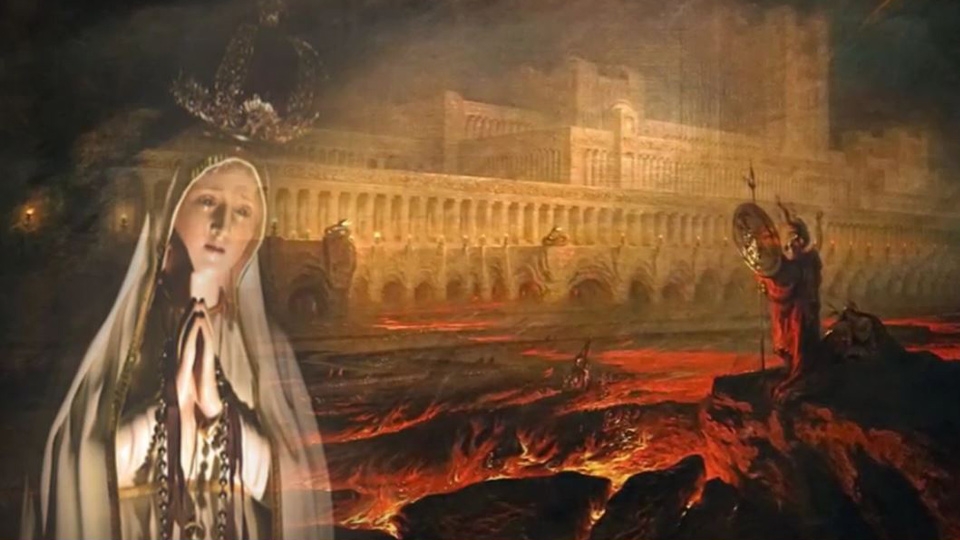

A few years before his election to the papacy, Cardinal Eugenio Pacelli (the future Pius XII) sounded a grave warning based on his understanding of the messages of Our Lady of Fatima:
“I am worried by the Blessed Virgin’s messages to Lucy of Fatima. This persistence of Mary about the dangers which menace the Church is a divine warning against the suicide of altering the Faith, in Her liturgy, Her theology and Her soul. . . . I hear all around me innovators who wish to dismantle the Sacred Chapel, destroy the universal flame of the Church, reject Her ornaments and make Her feel remorse for Her historical past. A day will come when the civilized world will deny its God, when the Church will doubt as Peter doubted. She will be tempted to believe that man has become God. In our churches, Christians will search in vain for the red lamp where God awaits them. Like Mary Magdalene weeping before the empty tomb, they will ask, ‘Where have they taken Him?’”
Clearly Cardinal Pacelli was familiar with the messages of Our Lady of Fatima and considered them credible. If we were able to go back in time and discuss with him what “the suicide of altering the Faith” might look like, it seems entirely plausible that he would describe something very similar to what we see today. As disturbing as the current crisis is, then, there is some consolation in the fact that Pius XII and others understood that there would be a day “when the Church will doubt as Peter doubted,” but they did not despair. Through the Blessed Virgin Mary, God warned us so that we might be strengthened for these times.
The obvious conclusion is that the Third Secret related to changes in the Church that would take place during Vatican II.
Decades later as pope, Pius XII published his 1950 encyclical warning against errors threatening to undermine the foundations of Catholic doctrine, Humani Generis. Humani Generis was the last in a long line of forceful papal encyclicals warning against the errors that have become so prevalent since Vatican II:
- Mirari Vos, Pope Gregory XVI’s 1832 encyclical on liberalism and religious indifferentism
- Qui Pluribus, Blessed Pius IX’s 1846 encyclical on faith and religion
- Quanta Cura, Blessed Pius IX’s 1864 encyclical condemning modern errors (accompanied by the Syllabus of Errors)
- Libertas Praestantissimum, Pope Leo XIII’s 1888 encyclical on human liberty
- Pascendi Dominici Gregis, St. Pius X’s 1907 encyclical on Modernism
- Notre Charge Apostolique, St. Pius X’s 1910 encyclical on the Sillon
- Oath Against Modernism, St. Pius X’s 1910 oath to be sworn by clergy
- Mortalium Animos, Pope Pius XI’s 1928 encyclical on religious unity
- Humani Generis, Pope Pius XII’s 1950 encyclical on false opinions threatening to undermine the foundations of Catholic doctrine
We could add other encyclicals to this list, but these suffice to condemn essentially all of the errors plaguing the Catholic Church today.
In his Humani Generis, Pius XII explained why the condemnations in these encyclicals remain binding:
“Nor must it be thought that what is expounded in Encyclical Letters does not of itself demand consent, since in writing such Letters the Popes do not exercise the supreme power of their Teaching Authority. For these matters are taught with the ordinary teaching authority, of which it is true to say: ‘He who heareth you, heareth Me’; and generally what is expounded and inculcated in Encyclical Letters already for other reasons appertains to Catholic doctrine. But if the Supreme Pontiffs in their official documents purposely pass judgment on a matter up to that time under dispute, it is obvious that that matter, according to the mind and will of the Pontiffs, cannot be any longer considered a question open to discussion among theologians.”
As we can see, Pius XII based his reasoning on the words of Our Lord:
“He that heareth you, heareth Me; and he that despiseth you, despiseth Me; and he that despiseth Me, despiseth Him that sent Me” (Luke 10:16)
It follows naturally from this that anyone who would reject the papal warnings contained in the encyclicals listed above would be rejecting God. If we were to go back in time and ask Pius XII what would happen if his successors attempted to reconcile the Catholic Church with the errors that he and his predecessors had condemned, surely he would tell us that it would amount to the “suicide of altering the Faith.” This is what we have seen since Vatican II.
The Third Secret relates to apostasy at the top of the Church. Why would we expect those overseeing the great apostasy to fully release a secret from the Blessed Virgin Mary that effectively condemned what they are doing?
We know from the words of several witnesses that the Third Secret of Fatima relates to an apostasy that corresponds to what Pius XII described as a the suicide of altering the Faith:
- “In the Third Secret it is foretold, among other things, that the great apostasy in the Church begins at the top.” (Cardinal Luigi Ciappi, quoted in Christopher Ferrara’s The Secret Still Hidden, p. 43)
- “[The Third Secret] has nothing to do with Gorbachev. The Blessed Virgin was alerting us against apostasy in the Church.” (Cardinal Silvio Oddi, The Secret Still Hidden, p. 42)
- “If ‘in Portugal the dogma of the Faith will always be preserved,’ . . . it can be clearly deduced from this that in other parts of the Church these dogmas are going to become obscure or even lost altogether. Thus it is quite possible that in this intermediate period which is in question (after 1960 and before the triumph of the Immaculate Heart of Mary), the text makes concrete references to the crisis of the Faith of the Church and to the negligence of the pastors themselves . . .” (Father Joaquin Alonso, The Secret Still Hidden, p. 35)
As discussed in a previous article, Sister Lucia (the oldest of the Fatima seers) said that the Blessed Virgin Mary wanted the Third Secret to be released in 1960, because the meaning would be more clear then:
“Sister Lucia provided yet another early clue to the content of the Secret when she insisted that the Bishop of Fatima promise that the sealed envelope in which she had sent him the Secret ‘would definitely be opened and read to the world either at her death or in 1960, whichever would come first.’ On the outside of the envelope Sister Lucia had described as ‘a letter,’ she had, accordingly, written: ‘By express order of Our Lady, this envelope can only be opened in 1960 by the Cardinal Patriarch of Lisbon or the Bishop of Leiria.’ Sister Lucia later explained the significance of this date to Cardinal Ottaviani during the 1955 interrogation. As Ottaviani revealed in the aforementioned public address: ‘The message was not to be opened before 1960. I asked Sister Lucia, ‘Why this date?’ She answered, ‘Because then it will be clearer (mais claro).’ In answer to the same question from Canon Barthas in 1946, Lucia replied simply: ‘Because Our Lady wishes it so.’” (p. 24)
By 1960 John XXIII had already announced his plans for Vatican II and had set the wheels in motion for the Council to focus on ecumenism. The obvious conclusion is that the Third Secret related to changes in the Church that would take place during Vatican II.
The fact that this obvious conclusion is contested by members of the hierarchy is hardly surprising given the crisis in the Church and the near certainty that the Third Secret relates to apostasy at the top of the Church. Why, in other words, would we expect those overseeing the great apostasy to fully release a secret from the Blessed Virgin Mary that effectively condemned what they are doing?
Vatican II brought about the “victory of Protestantism within Catholicism.” This is even more the case now with the Synod on Synodality.
For better or worse, though, we actually do not need to know the contents of the Third Secret to confirm that there has been a great apostasy which Pius XII would recognize as the suicide of altering the Faith. We can see this with our own eyes. As one concise demonstration of this we can consider the case of Henri de Lubac. Although Pius XII did not condemn specific individuals in Humani Generis, he nonetheless condemned the ideas that de Lubac championed. Fr. Dominique Bourmaud explained this in a 2012 article about de Lubac, Yves Congar, and Karl Rahner:
“Pius XII had little time for the new theology and its avant-garde teachers. They represented for him the rear guard of the old modernist wave so forcefully condemned by St. Pius X in Pascendi of 1907. The pope again reiterated the condemnation of the new—old—trends in Humani Generis: ‘Others [de Lubac] destroy the gratuity of the supernatural order, since God, they say, cannot create intellectual beings without ordering and calling them to the beatific vision.… Some [de Lubac, Congar] reduce to a meaningless formula the necessity of belonging to the true Church in order to gain eternal salvation. Others finally belittle the reasonable character of the credibility of Christian faith.’”
So, along with Rahner and Congar, de Lubac had been suspected of heresy under Pius XII. This did not stop John XXIII from appointing all three men as experts at the Council. To grasp the prominence of de Lubac’s work at the Council, we can merely consider words from Benedict XVI’s final address to the clergy of Rome:
“And this continued throughout the Council: small-scale meetings with peers from other countries. Thus I came to know great figures like Father de Lubac, Daniélou, Congar, and so on.”
Thus, de Lubac (like Congar) had been held under suspicion of heresy under Pius XII but was praised by Benedict XVI six decades later as being a “great figure” at the Council.
In his One Hundred Years of Modernism, Fr. Bourmaud described de Lubac’s role in developing the concept of “living tradition”:
“De Lubac’s ‘living Tradition,’ which he found in Blondel, is a throwback to Loisy’s ‘law of life’ by which the Church is deformed and transformed to become its own most perfect contradiction. De Lubac’s intellectual heirs, Ratzinger and John Paul II, avidly took to his theory. Once modernism had finally triumphed in St. Peter’s Square, living Tradition became one with the conciliar Church, with no necessary link to any transmission of past Revelation. Living Tradition today labels as false the truth of yesterday, and truth today what was then falsehood. Living Tradition is remarkably convenient, allowing theologians to discount at will twenty centuries of constant and consistent magisterium, and label the infallible condemnation of religious freedom, as well as the anti-modernistic decisions at the beginning of this century, especially the decisions of the Biblical Commission, as ‘provisional dispositions.’ It justifies the excommunication of the few bishops who actually do remain faithful to Tradition. The neo-modernists can take a legitimate pride in this stroke of genius that kills two birds with one stone: protecting modernism and dealing the death blow to apostolic Tradition, both in the name of living Tradition!”
De Lubac’s concept of “living tradition” is a weapon of pure sophistry that has been successfully wielded by villains and dupes alike for six decades to rob souls of the Catholic Faith and replace it with the errors that the pre-Vatican II popes condemned. Those with eyes to see recognize it immediately. Meanwhile, those who are blind or malicious howl that Traditional Catholics are heretical and schismatic for refusing to go along with the errors that Pius XII identified as threatening to undermine the foundations of Catholic doctrine.
Serious Catholics must of course refuse to accept the novelties that were condemned by Pius XII and his predecessors, no matter how loudly and frequently the innovators tell us that de Lubac’s “living tradition” means that error has become truth, and truth has become error.
Finally, we can look to how de Lubac described the Council:
“The drama of Vatican II consists in the fact that instead of having been conducted by saints, as was the Council of Trent, it was monopolized by intellectuals. Above all it was monopolized by certain theologians, whose theology started off with the preconception of updating the faith according to the demands of the world and to emancipate it from a pre-supposed condition of inferiority with respect to modern civilization. The place of theology ceased to be the Christian community; that is, the Church became the interpretation of individuals. In this sense the post-conciliar period represented the victory of Protestantism within Catholicism.” (quoted in Antonio Socci’s The Fourth Secret of Fatima, pp. 202-203)
De Lubac saw that Vatican II brought about the “victory of Protestantism within Catholicism.” This is even more the case now with the Synod on Synodality. Obviously, those who told us that the Third Secret related to apostasy at the highest levels of the Church appear to have been correct.
Returning to Fr. Bourmaud’s One Hundred Years of Modernism, here is how he summarized the crisis:
“Yet it was a springtime that flooded the Church with winter fog. Paul VI spoke of uncertainty, of skepticism, and of the smoke of Satan entering the Church. John Paul II occasionally stepped out of his habitual optimism and ceded before the evidence of a crisis in the Church. Cardinal Ratzinger, John Paul II’s alter ego, has described in great detail the gaping wounds of each of the four Christian continents. Melanie of La Salette and Sr. Lucy of Fatima, the two seers, united in predicting the spiritual disorientation, the loss of the dogma of the Faith, the eclipse of the Church, and the nefarious role of those appointed as shepherds of the flock. In itself, such a crisis is nothing new; the novelty lies in its having appeared so suddenly and with an unprecedented intensity. What is new is that the burial of Catholic tradition in its entirety was performed with official pomp and ceremony, with incense and pontifical high Mass. Disguised as an apotheosis, Vatican II demolished piece by piece the scaffolding constructed by our Lord, and what remained standing would be bulldozed during the subsequent pontificates.”
It is very simple: we are facing the spiritual disorientation foretold by Our Lady of Fatima because “Vatican II demolished piece by piece the scaffolding constructed by our Lord, and what remained standing [was] bulldozed during the subsequent pontificates.” By rejecting the warnings of the pre-Vatican II popes, John XXIII and the Council’s architects brought about the “suicide of altering the Faith” foretold by Pius XII.
Serious Catholics naturally wonder what we can do to combat this situation. We must of course refuse to accept the novelties that were condemned by Pius XII and his predecessors, no matter how loudly and frequently the innovators tell us that de Lubac’s “living tradition” means that error has become truth, and truth has become error. In addition, we surely need to attach ourselves ever more closely to the Traditional Latin Mass and all that the Church taught prior to the Council. Beyond that, though, the most important part of the “solution” that we can perform is to do what Our Lady of Fatima asked us to do: stop offending God through sin, devoutly say the Rosary, and try to become a saint. If we do this, perhaps God will soon grant a pope the grace necessary for him to properly consecrate Russia to the Immaculate Heart of Mary. Immaculate Heart of Mary, pray for us!
