
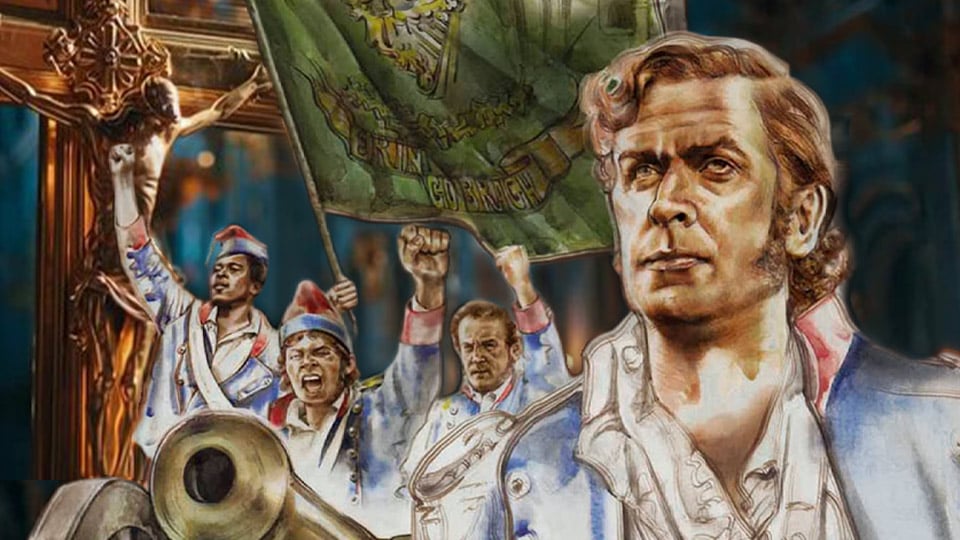

Years ago, I visited a priest friend of mine, John Foley S.J., at St. Mary’s, the Jesuit residence at Boston College. He had just read an article I wrote about John McElroy, S.J., the founder of B.C. and one of the first two (unofficial) Catholic chaplains in the U.S. Army. McElroy and another priest, Anthony Rey, S.J., were sent to Mexico during the American incursion in the 1840s, ostensibly to serve the Catholic soldiers but really to act as “goodwill ambassadors” for President James K. Polk. And goodwill ambassadors, to say the least, were sorely needed. Father Foley was stunned because I described the actions of American troops in the Catholic country- rape, torture and murder of civilians was common and rarely punished. Churches were looted, ransacked and used to stable horses. The Mexican War, for the government, was a colossal land grab, the last step to fulfill America’s “Manifest Destiny” of occupying the continent from coast to coast but to the soldiers, as to much of the American public, it was another jaunt to kill off Catholics and to wipe out that hated institution so opposed to the principles of the glorious democratic republic.
John Riley had survived starvation under British rule only to find anti-Catholic hatred flourishing in America.
Father Foley said, regarding the atrocities committed by the American soldiers “I never heard any of this…what they did to our people…” Now this is a man who at the time was in his 90s, had been a priest and Jesuit for 70 years, highly educated, but thoroughly unaware of, and admittedly shocked by the behavior of the blue jackets. But his incredulity did not surprise me. American Catholics have always been force-fed the standard narrative of the country’s history which was presented as an epic of Protestant triumphalism. To this day Catholics remain shamefully silent and textbooks in public schools as well as problematic “Catholic” schools continue their blackout of the role of the faithful in the story. It’s the little religion that wasn’t there and what mention there is, well, you guessed it: Catholics bad, everyone else good.
Therein lies the tale of John Riley and the San Patricios in the Mexican War and, in a macro sense, the unchanging, unchangeable position of Catholics in American society.
Taking advantage of the disorder in Spain in the wake of the Napoleonic Wars, Mexican rebels in August 1821 convinced Juan O’Donoju, the Spanish envoy, to sign the Treaty of Cordoba which effectively established an independent Mexico. Though the Spanish government rejected the treaty, the separation of Mexico from Spain was a fait accompli.
Meanwhile, during the same period in the Yanqui republic to the north, there was a wellspring of jubilation. After defeating the British Empire for the second time in the War of 1812 (so the story went), there was a massive surge of super patriotism, manifested by songs and folk tales, flags and bunting and people making money, money, money.
This “Era of Good Feelings” revived a wave of bad feelings however, and it isn’t difficult to guess who was on the sharp end of the rage. From colonial times on, whenever the government needed warm bodies to fight the wars, anti-Catholic vitriol was toned down. 1 But with peace and all the “Good Feelings” the convent and church burnings began with fervor. Up until the 1830s immigration to America was limited and primarily from England and other Protestant regions. But by that decade immigration of Catholics from Ireland started to increase, menacing the beloved Calvinist Zion known as the “city upon a hill.” Americans have long been taught that there was some kind of “Great Famine” in the 1840s caused by a freak potato blight and that was just tough luck for the Paddies. In fact, starvation was a constant in Ireland from the time of the English conquest. The British allowed Catholics only the potato to eat and stole all the other food produced to fill English bellies. Consequently, mass die-offs were perpetual and the dead bodies of Catholics lay scattered everywhere, often with grass or seaweed in their mouths; a grim testament to the victims’ last feeble attempt to find food. Wealthy English and other European elites enjoyed a form of “death tourism” in which they rode around the countryside observing the suffering peasants, routinely publishing their giddy accounts of gazing at the poorest, most degraded people in Europe, perhaps the world.
The officers made it clear that this was a Protestant crusade against the Church in Mexico.
Into this moldering charnel house was born John Riley at Clifden in Galway. His boyhood was typical-he witnessed the evictions and the tearing down of peasants’ hovels and he became well acquainted with the trademarks of the English occupiers-the whip, the gun, the hangman’s noose and gibbet. But the Irish, to their misfortune then and now had no guns and Riley did what many other starving Irish did, just to stay alive. He joined the beast itself, the British Army. It is unclear where Riley served wearing the despised red coat, but he evidently earned Sargeant’s stripes; an indication that his English masters must have considered him a good soldier.
Mustered out right in the middle of the latest starvation in 1843, Riley followed the countless others who fled the dying fields by boarding a coffin ship for the “New World.” To his sorrow, he found little variation from the miserable old world. As it turned out the streets were not paved with the promised gold. Irishmen were made familiar with paving bricks all right, as they quickly became the primary laborers in the dirtiest of jobs and, unlike slaves in the sun-drenched South, if they didn’t work, they didn’t eat. They also frequently received paving bricks bounced off their heads, hurled by the welcoming Protestant mobs who ruled the streets of urban America. Riley did not settle in one of these jungles but instead went to Mackinac Island, Michigan, at a small Irish colony. There he might have stayed in obscurity for the rest of his days, but great events changed his plans.
By the 1840s the Democrats were desperate to add more slave states to the Union but had been blocked from moving northward since the Missouri Compromise of 1820. The alternative was expanding westward, however that last great section of the continent was Mexican, formerly Spanish territory and, unlike the Louisiana Purchase, acquiring this lot would not be done with cash. In 1836 American slavers managed to tear away Texas from Mexico and declared themselves an independent republic, though the desire was to be annexed as a new slave state. Northerners effectively stalled annexation for some years, fearing that Texas would be further divided into several new slave states.
As the politicians squabbled over Texas, Protestant terrorists in Philadelphia, a city well-known for anti-Catholic violence, began a rampage more extreme than any that had yet occurred. Lewis Levin was the Jewish editor of an anti-Catholic newspaper who knew his readership well. Spouting hatred and spurring violence against Catholics sold papers and made him a celebrity and in 1842 he helped found the American “Nativist” party, dedicated to the extirpation of papists. Levin’s big chance came when the plight of Catholics in government schools came up, as it had in New York and Boston. “Public” schools in America were really run by Protestant Associations where Catholic children were forced to read from the King James Bible and recite doggerel damning the Pope. Those who refused to apostatize were beaten bloody.
The saga of the San Patricios does not fit comfortably within the standard narrative of American history.
When Bishop Francis Kenrick meekly asked the Board of Controllers to allow Catholic children to read their own Bible, the denizens of the “City of Brotherly Love” rose as a body to carry out the final solution to the Catholic problem. Politicians made public speeches, damning the “Bible-haters.” Heretical preachers each week inveighed against the idolaters and commanded their flocks to finish off the minions of Rome. Beginning in early May 1844, Protestant mobs descended upon the Kensington neighborhood, mostly populated by Irish Catholic workers. By the third day of rioting, entire blocks of Irish lodgings were ablaze. To save their skins, Protestants who lived in the area posted signs reading “Native American” and the thugs moved on to burn the next Catholic home. To assuage the old fantasy that Catholic churches were used as arms depots, Mayor Peter McCall convinced the rioters that the Catholics were unarmed. Now assured that their victims could not defend themselves, the arsonists joyfully burned down two Catholic parishes; St. Michael’s and St. Augustine’s, as well as a seminary. Arson and murder continued, the city government prevaricated, and the press naturally blamed the victims. Even the Quakers, traditionally ballyhooed as “tolerant” reveled in the slaughter. One member of the Society of “Friends” croaked “the Papists deserve all this and much more,” and “It were well if every Popish church in the world were leveled with the ground.”2 It is a certainty that John Riley and most Irish in America heard of the Nativist bloodletting in Philadelphia as the level of violence made national headlines.
Yet even as the ashes of Kensington smoldered, state affairs went on as usual. 1844 was a presidential election year with the Whigs nominating Henry Clay, former Speaker of the House and for decades one of the most high-profile politicians in the country. The Democrats selected James K. Polk of Tennessee, lesser-known but an advocate of American expansionism, labeled “Manifest Destiny” and meaning, with a wink and a nod, the seizing of the Mexican-owned West. Polk’s unexpected victory marked him as the first “dark horse” presidential victor and practically guaranteed an assault against Mexico. It was also a catalyst for the annexation of Texas, which occurred in December 1845.3It was in 1845 as well when all these disparate elements fell into place- anti-Catholic hatred, greed for western land, and John Riley’s desire to escape the societal ghetto of the Irish in America- all manifested in the Mexican War, this nation’s first imperial land seizure.
Riley joined up with the U.S. Army in the fall of 1845 and soon enough his unit was transported with others to Texas. This “Observation Force” was under the command of General Zachary Taylor, who had been in the army since 1808 and known as “Old Ruff n’ Ready.” As soon as Riley enlisted, he got a taste of what soldiering was going to be like in the American forces. Though he was well-acquainted with military discipline from his hitch in the British Army, even he was shocked by the arbitrary cruelty of the Protestant officers. In the 19th century European armies began to move away from corporal punishment and officers were eventually forbidden from striking enlisted men.
But America lagged behind and officers, particularly West Pointers, had to “prove” their authority through relentless acts of violence. It mattered little how minor the infraction, such as yawning or an unbuttoned button, penalties were severe. A standard was the “buck and gag,” in which the victim was sat on the ground with hands and feet tied and a cloth in the mouth. Then a stick was rammed between the arms and bent knees, causing excruciating cramps and eventually circulation stoppage, sometimes resulting in death. For variety there was also whipping, branding, standing on a barrel for hours, “riding the wooden horse” and a perennial favorite, the “water cure.”4
Most Catholics have assimilated so well they have sashayed themselves right out of Christianity.
Though these punishments were meted out to many unfortunates, it was obvious that the officers’ particular targets were Irish and German immigrant Catholics. They were also free to slap, punch and kick subordinates with impunity and these acts were typically accompanied by bigoted epithets regarding the Church. Few immigrants had any idea that this was what they were signing up for. Recruiters had promised them nutritious food, good pay, quick citizenship and the opportunity to own land. Relentless torture and vile bigotry were never mentioned. The irony is these despised foreigners made up half of the enlisted ranks in the army. While Protestants wanted Catholics driven from the land, few natives wanted to serve the colors themselves. That was better left to the Micks and Dutchies.
President Polk’s intentions were obvious and as the army advanced southward, conditions for the soldiers became even worse. Protestant officers forced Catholic soldiers to attend heretical services and if they refused, they got the buck and gag or some other agony. Taylor’s forces rested at Corpus Christie over the winter of 1845-46, and in the spring, after crossing into Mexico, the looting and killing of civilians commenced. The officers made it clear that this was a Protestant Crusade against the Church in Mexico and the “Catholic scum” whom they shot with relish. To be accurate, not every officer was a fanatic and Zachary Taylor himself showed no partisan animus, ordering that Catholic churches be respected and civilians left unmolested. However, orders from the commander and what happens on the ground with soldiers are two different things. Despite “Old Ruff n’ Ready’s” orders, atrocities continued to be committed from the first day of American occupation to the last.
After months of this, John Riley had enough. He had lived through the enforced starvation in his homeland by the English alien only to find America an even more unholy pit of arsonists and murderers. In the army he experienced more of the same, with the blue-coated devils committing the vilest acts against both the Catholic soldiers and the Mexican peasants. It was in April 1846 when Riley made a fateful decision that would alter his life permanently and which would lead some to brand him a traitor; others to recognize him as a man of indominable courage, who defied a powerful oppressor. He later wrote “listening only to the advice of my conscience for the liberty of a people which had war brought on them by the most unjust aggression, I separated myself from the North American forces.”5
Captured by Mexican troops after swimming the Rio Grande, he was brought to Matamoros, explained his appearance to an officer and rather than being executed, was welcomed into the Mexican Army with officer’s rank. The Mexicans were no fools. They were well aware of the horrific treatment of Catholics in the gringo army and appealed to them as fellow believers to leave the invaders and join in defense of the faith. Riley was not alone in his decision and over the next few months, droves of soldiers, most, but not all of them Catholic, deserted the blue coat forces. Riley, tall, red-haired and authoritative, was allowed to form an artillery unit with others who had crossed the Rubicon, all vowing to bring to justice their former tormentors.
Though war was not yet officially declared, Taylor’s forces attacked Matamoros and to their regret, ran smack into the mouths of Riley’s guns. Back in the states, the war was controversial, but Congress made it official in May. Riley’s defection and the fact that he and others were now aligned with the Mexicans was at first kept from the American public, but Polk was informed that because of the hatred and abuse, the American Army was hemorrhaging indispensable immigrant troops. A wily politician and more interested in staying in office than carrying out an ethnic cleansing, he called three bishops to the White House, and they agreed to send two priests, the aforementioned Fathers McElroy and Rey, to the front.
The Mexican War ended officially with the Treaty of Guadalupe Hidalgo, signed in March 1848, with the Americans taking almost all the western third of the continent as a prize.
The idea was to let the two say Mass for the soldiers but more importantly to show them and the Mexicans that the Americans weren’t really doing exactly what every Catholic saw them doing. The situation was very delicate because if the news got out that reviled papist priests-Jesuits, to boot- had been assigned as army chaplains there would be blood in the streets and Polk would likely be hanged in effigy, if not for real. Instead, he simply avoided the word “chaplain” and employed them as what would now be called “contractors.” The two met up with the army and began tending to the soldiers, including sick Protestants. Taylor ordered that the priests be treated with respect and that went over as expected.
The next attack was at Monterey but Riley and most of the Mexican troops evacuated, itching to fight another day. The Americans ran riot in the city, with Taylor struggling to maintain control over the human locusts. Polk now faced another political quandary. Taylor was promoted as a folk hero in the newspapers and that was bad. Though not overtly political, he was reckoned a Whig and Polk had no desire to run against a popular war leader in the next election. The president then undercut Taylor by sending “Old Fuss n’ Feathers,” General Winfield Scott, south in early 1847, dividing command. Ultimately, Polk’s plan failed, as Scott did end up drawing attention from Taylor, but both generals would later run as Whigs.
By this time Riley had whipped his team into a crack artillery unit and were known by the Mexicans as the San Patricios. Not all were Irish, but all shared the esprit de corps of desperate men fighting for a noble cause. A green flag was sewn, and it would be a spectacular marker for Riley’s former comrades, engendering rage in many but without question a symbol of inspiration for the Catholics who were still being abused in the American Army. Ironically, Scott’s forces contained a large component of freshly- recruited Irish immigrants, poor fools who hadn’t gotten the word. For Riley and the others, the dream ended on August 2, 1847. At the Battle of Churubusco near Mexico City Scott’s forces overwhelmed Riley’s fighters, who were defending a convent. Many were killed and more than 80 were captured, including the wounded Riley.
Two court martials were quickly convened and death sentences were meted out to almost all the men, including Riley. The rest of the condemned San Patricios scarcely mattered to the army, but Riley presented a dilemma. In America he was publicized as the notorious Riley by anti-Catholics but was seen as a legendary warrior to victimized immigrants. Scott viewed him as a political liability and though it caused an uproar, “Old Fuss n’ Feathers” reduced Riley’s sentence to 50 lashes and branding on the cheek. This was not motivated by a delayed sense of mercy but was actually in accordance with regulations. As a young man Scott trained as a lawyer and knew that since Riley deserted before war was declared, the death penalty was off the table. Still, there was always the hope that the Irishman would die due to the whipping, a not uncommon occurrence, and Riley’s flogging would be particularly drawn-out for the pleasure of the onlookers and particularly for the officer in charge, General David Twiggs. But despite the sadist’s best efforts, Riley did not succumb under the lash. Twiggs gleefully ordered that he be branded twice on the face and then made to watch the mass hanging. A second group were forced to sit atop horses with nooses around their necks for hours in the blazing sun, facing an attack on Chapultepec castle before being swung into eternity.6
The Mexican War ended officially with the Treaty of Guadalupe Hidalgo, signed in March 1848, with the Americans taking almost all the western third of the continent as a prize. Zachary Taylor, “Old Ruff n’ Ready” successfully ran for president as a Whig in 1848 but died in office.
For many years the U.S. Army tried to cover up the affair of the San Patricios. The whole tawdry story doesn’t fit with the standardized narrative of Yankee Doodle Dandies liberating the benighted campesinos from the clutches of Rome.
His rival, Winfield Scott, ran as the last Whig presidential candidate in 1852 but was defeated. Father McElroy returned to the United States and in 1858 founded Boston College which long ago was a “streetcar school” serving working-class Catholics, but no longer. Father Rey was murdered in Mexico, presumably by banditos. Riley himself and the few surviving San Patricios were released soon after Scott was relieved. He returned to the Mexican Army but was soon invalided out. Some Americanos traveling through Mexico in the following years claimed they saw a White man with flowing red hair hanging around cantinas, but Riley was not known to be a drinker and a fighter who had endured what he had would not likely squander the rest of his life in dissipation. He may have returned to Ireland, but death records are ambiguous. The uncertainty of his fate is fortunate. It is best that he passed into legend.
For many years the U.S. Army tried to cover up the affair of the San Patricios. The whole tawdry story doesn’t fit with the standardized narrative of Yankee Doodle Dandies liberating the benighted campesinos from the clutches of Rome. Indeed, any inquiring mind would have to wonder why droves of soldiers risked life and limb to escape the military of the blessed republic. In recent decades there have been a few monographs produced as well as a Hollywood movie and documentary videos but the saga of the San Patricios and the overall experience of Catholics in America continues to be kept under wraps. The bishops in the 19th century demanded that Catholics “fully assimilate” to fit in and unfortunately the bishops got their wish. Most Catholics have assimilated so well they have sashayed themselves right out of Christianity. As for their non-Catholic neighbors and the government, things have never improved overly much. Today the sacrament of confession is assailed by the state while F.B.I. gunmen persecute Latin Mass parishioners, smash into pro-lifers’ homes and threaten Catholic children with automatic weapons. In response the bishops keep up their tried-and-true Marcel Marceau act and fully assimilated pew Catholics doze contentedly. They have concerns of much greater import, such as last night’s basketball scores and those awfully long lines at Disney.
1 During the revolution George Washington himself forbade the troops in Boston from joining in the city’s appalling “Pope Night” so as not to further offend French Canadians, whom the Americans sought as allies. The ploy failed.
2 Ray Allen Billington, The Protestant Crusade 1800-1860: A Study of the Origins of American Nativism (New York: Rinehart & Company, 1952), 230, passim. As for the perfidious Levin, hatemongering paid rich dividends. In the wake of the riots this “elder brother in the faith” was elected to the U.S. House of Representatives, reputedly the first Jew in Congress, and was reelected for several terms. After leaving the House he continued a career of anti-Catholic agitation but died in an insane asylum.
3 Ironically it was an assimilated Irish American magazine editor and Democrat loyalist, John Louis Sullivan, who coined the phrase. He later became a hysterical Confederate sympathizer.
4 In “Theodore Roosevelt’s Catholic Dilemma” in the Spring 2025 issue of the Latin Mass I described the techniques of the water cure and how it was still being employed during the occupation of the Philippines in the early 20th century and that the practice has continued in recent American wars.
5 Peter F. Stevens, The Rogue’s March: John Riley and the St. Patrick’s Battalion (Washington, D.C.:Brassey’s, 1999), 94.
6 Twiggs was later branded a traitor himself when he surrendered his command to the rebels at the beginning of the Civil War. His reward for this treachery was a generalship in the Confederate Army.
