

Historians define France as the “eldest daughter of the Church” because the Frankish people were the first among the Germanic populations to embrace the Nicene Catholic faith, while the others had converted to Arianism.
Today, that glorious history appears as a very distant memory. The aggressive secularization and anti-Christian hatred that permeate French political institutions, aggravated by the hostility coming from the growing Islamic components of society, do not, however, constitute the only mortal danger for the Catholic Church in France.
The real tragedy is the inertia, the culpable indolence of a clergy now diminished and of an episcopate which, as in Italy, is largely progressive. Today it is led by Cardinal Jean-Marc Aveline, Archbishop of Marseille, standard-bearer of the Community of Sant’Egidio and considered by many to be the “Bergoglio of France.”
A church is not profaned only when vandals attack it. It is also profaned when those entrusted to protect it cease to believe it is the house of God.
An emblematic episode, dating back to October 2021, reveals the moral fragility of the French episcopate. After the publication of the CIASE report, an “independent” commission on sexual abuse in the Church, among the recommendations was the obligation for priests to violate the sacramental seal of Confession whenever necessary to investigate cases of abuse.
As had already happened in Germany and Spain, the scandals are instrumentalized by the media, progressive governments, and neo-modernist currents to further weaken the European Catholic fabric and push toward structural reforms of the Church.
The then president of the French bishops, Éric de Moulins-Beaufort, reacted by declaring that “the seal of Confession is binding” on the clergy and therefore “stronger than the laws of the Republic”: a most legitimate statement, in defense of the rights of the Church. Sexual abuse is certainly not fought by forcing the clergy to act against conscience and against religion.
But the French government, offspring of the deicidal Revolution, was outraged. At Macron’s request, Interior Minister Gérald Darmanin summoned the prelate, and spokesman Gabriel Attal clarified: “The reaction to these statements is very clear: in our country there is nothing stronger than the laws of the Republic.”
Faced with pressure from the State, Moulins-Beaufort bowed his head. Instead of reaffirming the superiority of divine law over civil power, the bishop published an apology:
“I ask forgiveness from the victims and from all those who may have been saddened or shocked by the fact that the debate sparked by my words on the subject of Confession has taken precedence over the reception of the contents of the CIASE report.”
Incidentally, the debate over the seal of Confession has by no means ended. Only on June 3 of this year, the French Parliament narrowly rejected an amendment that would have required Catholic priests to violate it.
When Eucharistic adoration can be suspended to make room for an artistic performance, something far deeper than vandalism has gone wrong.
The inertia of the French clergy today shows its most rotten fruit in a phenomenon that has now become ordinary, so frequent that it no longer provokes scandal or newsworthy: profanation.
For a Catholic, profaning a church, a sacred image, or—worse still—the Eucharist is one of the gravest acts that can be committed against God and against the community of believers.
From a theological and canonical point of view, a church is a sacred place, destined exclusively for divine worship. The new Code of Canon Law (can. 1211) establishes that a sacred place is profaned if actions that are gravely scandalous and contrary to its holiness are carried out there; in such a case, it may not lawfully be used for worship until it has been purified by a penitential rite. The same Code (can. 1212) specifies that if the place is destroyed or permanently assigned to profane uses, it even loses its dedication or blessing, ceasing to be a consecrated building.
From a moral point of view, profanation is a form of sacrilege, a direct offense against God because it strikes what has been consecrated to His glory. It is a very serious sin.
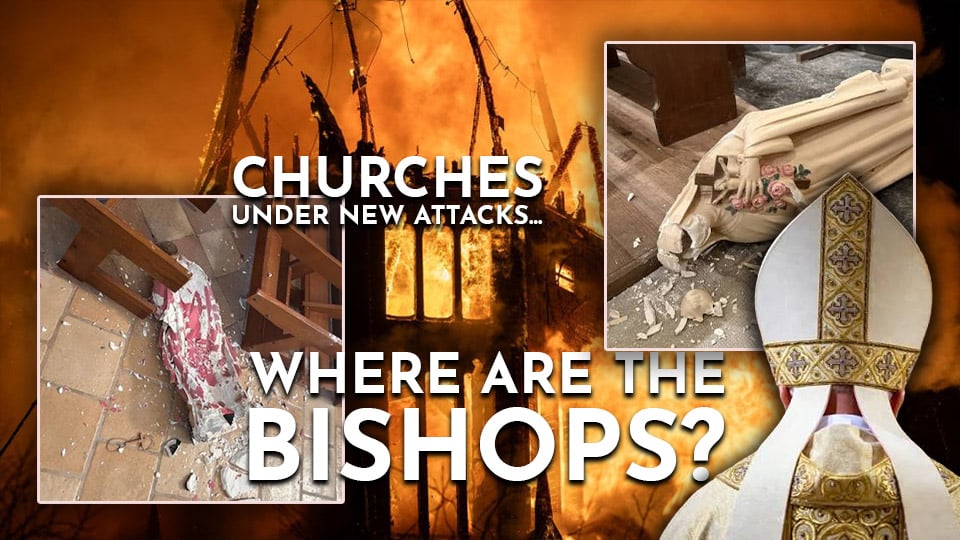
In recent months, dozens—perhaps hundreds—of profanations against Catholic churches have been recorded in France. On May 25, Pentecost Monday, the church of Saint-Pierre-ès-Liens in Mérens, in the department of Lot-et-Garonne, was found vandalized. One or more persons are believed to have entered the building, damaging statues, liturgical and devotional objects, and even a stained-glass window, leaving the church in a state of disorder and devastation.
Almost simultaneously, in Comps, in the department of Gard, a metal cross placed on a rocky outcrop became the object of a formal complaint by an “antifascist” group, which requested the intervention of the League of Human Rights, arguing that the presence of the cross violated the principles of State secularism.
The greatest danger facing the Church in France is not only anti-Christian hatred—but a clergy unwilling to defend what is sacred.
During the same period, a cross installed on the summit of Aneto, in the Pyrenees, was targeted by unknown troublemakers, removed, and thrown down shortly after its installation. The episode, which also occurred in the last days of May, ended with the recovery and reinstallation of the cross by Spanish mountaineers.
On June 5, an individual entered the church of Saint-Martin in Roques-sur-Garonne, near Toulouse, and started a fire in front of the altar using sheets of liturgical hymns. The flames went out before spreading, limiting the damage.
On June 9, the Diocese of Fréjus-Toulon reported the desecration of the sanctuary of Notre-Dame du Faron, one of the most frequented Marian sites in the region. The priest responsible for the sanctuary had discovered in the preceding days that the statue of the Virgin had been seriously damaged: the pedestal had been overturned and broken, while the wooden statue showed a crack in one foot and damage to the head, requiring restoration work.
On June 12, Feast of the Sacred Heart of Jesus, two separate fires struck two important Catholic sites in France within a few hours of each other: the chapel of Sainte-Anne-des-Rochers in Trégastel, Brittany, and the former cloister of the cathedral of Condom, in the department of Gers. Both buildings suffered extremely serious damage, with the destruction of large portions of the historic structures and the loss of archival material. The causes of the two fires remain under investigation by the competent authorities.
Between June 14 and June 17, the parish church of Mugron, in the department of Landes, was struck by a sacrilegious theft that led to the disappearance of several liturgical objects and, above all, of the Blessed Sacrament.
According to reports, numerous chalices and all the consecrated hosts kept in the tabernacle were stolen. The Diocese of Aire and Dax, led by Bishop Nicolas Souchu, announced that a formal complaint would be filed with the authorities.
Without pastors willing to defend the honor due to God, profanation becomes the new normal.
The parish priest, deeply shaken by the event, is awaiting the formalization of the report so that the disappearance of the Eucharist may be fully taken into account in the investigation. Something evidently not to be taken for granted.
However, these are only some examples of a first type of ordinary profanation. There is a second type which, in truth, is even more serious, not because the object of the profanation is graver, but because those responsible for the profanation are priests and even bishops.
In France, in fact, it is unfortunately very common for consecrated churches to be used as venues for performances or other representations that have nothing to do with Catholic sensibilities. The most scandalous case occurred recently in Paris.
Between June 6 and June 7, several historic churches in Paris were used to host artistic installations inspired by voodoo symbolism and blasphemous content, as part of the Nuit Blanche 2026 festival, directed by LGBT activist Barbara Butch, already known for the opening ceremony of the Paris 2024 Olympics during which a parody of Our Lord’s Last Supper was displayed.
The installations, approved by the Archdiocese of Paris, provoked strong indignation among the faithful. During the events, some Catholics gathered in front of the church of Saint-Laurent to pray and protest peacefully. Despite the non-violent nature of the demonstration, the police intervened to disperse those present, also using force against men and women of all ages who were kneeling with rosaries in their hands.
The most discussed installation, entitled Sous la peau du ciel (“Under the Skin of the Sky”), was in fact located precisely in the church of Saint-Laurent. Visitors had previously been invited by the organizers to record personal wishes by telephone; the voices were then mixed with environmental sounds and played through loudspeakers placed throughout the church, including chapels, altars, the baptistery, and confessionals. The overall effect, described by witnesses as deeply unsettling, created a sound environment in sharp contrast with the liturgical purpose of the building.
Another installation, Jungle haletante, was set up in the chapel of Tenon Hospital by Stéphane Blanquet. The work included voodoo masks and objects, accompanied by whispers, breathing sounds, metallic noises, and creaking. The artist described the project as an exploration of an “unstable” and almost “hypnotic” perception of reality.
On June 11, as if that were not enough, Fr. Paul Dollié, parish priest of the Parisian church of Saint-Laurent, publicly defended his decision to host the sound installation in the church entrusted to him. In a statement given to the French publication Tribune Chrétienne, the priest asserted that the work “respected the place” and contained nothing contrary to the Catholic faith, according to him.
His words came after criticism from numerous faithful who considered the event a profanation, especially because the church is the site of perpetual Eucharistic adoration. This understandably concerned the faithful, who wondered what had become of the adoration during the “performance.”
Subsequently, however, the same priest clarified that the Blessed Sacrament had not been exposed during the event, but only during the installation phase, thus confirming that perpetual adoration had been interrupted to allow the performance. To summarize, therefore: the “show” was judged by the parish priest to be more important than Eucharistic adoration. Is this what the Church has been reduced to?
The publication of the parish priest’s statement thus generated further indignation. Meanwhile, the Archdiocese of Paris remained silent. Only the heroic Dominique Rey, Bishop Emeritus of Fréjus–Toulon, publicly criticized, on June 13, the reckless and sacrilegious use of French churches to host artistic installations inspired by the occult during Nuit Blanche.
The profanations that strike French churches today are therefore not only the fruit of the anti-Christian hatred of vandals, secularist militants, or Islamists. They are also the symptom of a deeper and more multifaceted crisis, one that implies the loss of the sense of the sacred within the Church itself.
A church is not profaned only when someone sets fire to its altars, destroys its statues, or steals the Blessed Sacrament. It is also profaned when those who have the duty to safeguard it cease to consider it first and foremost as the house of God and treat it as a cultural space, a neutral container open to any use so long as it is socially acceptable.
When Eucharistic adoration can be suspended to make room for an “artistic” performance of dubious taste, the problem is no longer merely the external aggression against the Church, but the weakening of conscience.
For this reason, the episodes recalled here should not be read as isolated facts. They reveal the same dynamic: on the one hand, a society increasingly alien, if not openly hostile, to Christianity; on the other, a portion of the clergy and episcopate incapable and unwilling to defend firmly that which has been consecrated to God.
France, the eldest daughter of the Church, continues to witness conversions, vocations, and admirable testimonies of faith. But for precisely this reason, the contrast appears even more dramatic.
A Catholic revival will be possible only where people once again recognize that the sacred is not negotiable, that divine worship cannot be subordinated to the demands of the world or the state, and that the first duty of pastors remains that of safeguarding the deposit of faith and the honor due to God. Without this awareness, profanation will continue to be the norm not only in France, but throughout the world.