
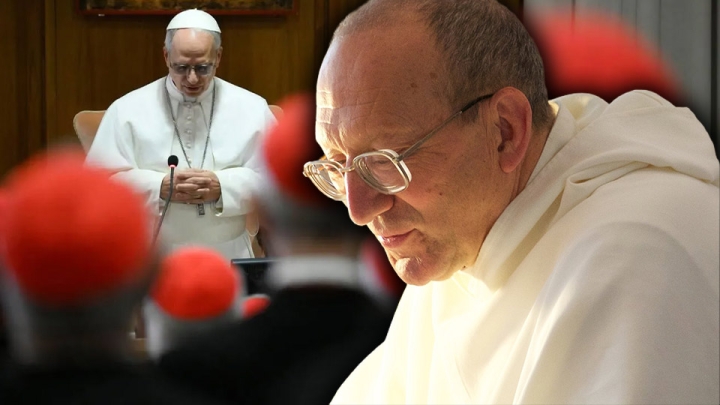

On the eve of Pope Leo XIV’s extraordinary consistory of cardinals on 7 and 8 January 2026, Father Louis-Marie de Blignières, founder of the Fraternity of Saint Vincent Ferrer, a priestly community that originated from France in communion with the Holy See, penned a missive dated December 24, 2025, to “provide a stable pastoral framework for communities and faithful devoted to the traditional Roman liturgy”, as Rome-based journalist Diane Montagna stated.
The essence of the letter is a suggestion to set up an “ecclesiastical jurisdiction (a personal apostolic administration or an ordinariate)” structured along the lines of Military Ordinariates. Such a framework would be dedicated to “the ancient Latin rite that is “fully in communion with the Catholic hierarchy”.
Father de Blignières’ suggestion came as a response to “legal uncertainty, recurrent tensions, and pastoral conflicts in various dioceses” due to the release of the contentious and divisive motu proprio Traditionis custodes.
“Lay faithful and priests who have a strong attachment to the ancient Latin rite and who are in full communion with the Holy See and the other components of the Church constitute a group sufficiently numerous and distinctive for the solution of a dedicated ecclesiastical jurisdiction to be appropriate,” Father de Blignières declared in his letter, originally written in French.
According to InfoVaticana, “the missive presents itself as a working proposal addressed to the cardinals, not as a demand or a direct request to the Pope, with the aim of opening a serene dialogue before the consistory.”
“The proposed jurisdiction would not have a territorial character, but personal, and could adopt canonical forms already existing in the Church, such as a Personal Apostolic Administration or an Ordinariate, inspired by the model of military ordinariates,” InfoVaticana added.
Strikingly, Father de Blignières’ use of language reflects past church efforts to integrate adherents of the Vetus Ordo into the broader ecclesial life — such asEcclesia Dei (1988) and Summorum Pontificum (2007). Yet what makes Father de Blignières’s proposal unique is its focus on institutional stability and the importance of delineated canonical boundaries and pastoral assurances.
Father de Blignières’ suggestion came as a response to “legal uncertainty, recurrent tensions, and pastoral conflicts in various dioceses” due to the release of the contentious and divisive motu proprio Traditionis custodes in 2021 which placed severe restrictions on the Traditional Latin Mass (TLM) in various dioceses worldwide during the pontificate of Pope Francis.
A Military Ordinariate is a personal ecclesiastical jurisdiction, defined not by territory but by the persons who belong to it due to a particular pastoral need. In the present case, this need would consist in a free and voluntary attachment to the traditional liturgy.
In comments cited by Montagna on her Substack page, Father Matthieu Raffray (MR), Superior of the European District of the Institute of the Good Shepherd, pointed out that Father de Blignières’ letter was not a demand or request addressed directly to the Holy Father, but rather “a working hypothesis addressed to cardinals” to be evaluated and developed more with the help of canonists.
“In this perspective, it proposes the erection of a dedicated ecclesiastical jurisdiction—such as a personal apostolic administration or an ordinariate—providing a stable canonical framework for priests and faithful who are fully in communion with the Holy See and attached to the ancient Latin rite. Far from presenting this liturgy as a threat or as a nostalgic retreat into an idealized past, the text emphasizes its present fruitfulness as a genuine means of sanctification and evangelization, particularly in highly secularized societies. Thus, the letter does not seek to revive a liturgical controversy, but to offer a pragmatic institutional response, in continuity with the Church’s living tradition, which has repeatedly devised juridical structures to safeguard unity while respecting legitimate diversity. Its distinctive merit lies in proposing a constructive way out of an impasse, rather than entering into a new phase of internal confrontation,” Father Raffray added.
Elaborating on how Father de Blignières’ suggested jurisdiction would function, Father Raffray stated:
“A Military Ordinariate is a personal ecclesiastical jurisdiction, defined not by territory but by the persons who belong to it due to a particular pastoral need. In the present case, this need would consist in a free and voluntary attachment to the traditional liturgy. The proposed jurisdiction would therefore overlap with territorial dioceses without replacing them, within a framework of complementarity and communion. The bishop entrusted with this structure—at the level of a country or a linguistic area—would work in coordination with diocesan bishops in order to discern, according to local contexts, the most appropriate pastoral arrangements.”
Notably, Father de Blignières’ letter came within the first year of Pope Leo XIV’s pontificate, where the pontiff has indicated some degree of openness towards the TLM amid hostile actions from some bishops worldwide against TLM Mass goers. If enacted, Father de Blignières’ proposal tries to empower TLM-devoted Catholics in their attachment to the Vetus Ordo, without the need to fear any more diocesan bans.
For Catholics devoted to the TLM, Father de Blignières’ letter offers a glimmer of hope, if it is seriously considered by the Pope. After all, this missive reinforces the reality that advocating for the Vetus Ordo and Traditional Catholic doctrine is not an act of rebellion but of fidelity to the Catholic Church.
Having said that, if such a proposed personal ordinariate or jurisdiction is set up, care must be taken to emphasize the sacrificial emphasis of the TLM, an emphasis that is unfortunately glossed over or neglected altogether in many Novus Ordo parishes exclusively offering the New Mass and pandering to ecumenical/Protestant tastes.
Cardinal Castrillón Hoyos, President of the Pontifical Commission, Ecclesia Dei from 2000 to 2009 rightfully stated about the importance of the TLM in transmitting true Catholic teaching and devotion:
“I do not like approaches that seek to reduce the “traditionalist phenomenon” to the mere celebration of the ancient rite, as if it were a matter of nostalgic and obstinate attachment to the past. […] We are often dealing here with a Christian vision of the life of faith and devotion—shared by many Catholic families, often blessed with numerous children— which possesses its own particular features; this vision includes, for example, a strong sense of belonging to the Mystical Body of Christ, a desire firmly to maintain ties with the past—understood not in opposition to the present but in continuity with the Church— in order to preserve the strongest points of anchorage of Christianity, a deep desire for spirituality and sacredness, and so forth.”
For Catholics devoted to the TLM, Father de Blignières’ letter offers a glimmer of hope, if it is seriously considered by the Pope. After all, this missive reinforces the reality that advocating for the Vetus Ordo and Traditional Catholic doctrine is not an act of rebellion but of fidelity to the Catholic Church. Rather than merely being an administrative suggestion or worse still, the proposal of setting up a “parallel church”, Father de Blignières’ letter showcases that Church unity is enriched — not undermined — when the Vatican does not clamp down on the TLM but supports its flourishing. Importantly, the letter shows that Catholics’ love for the TLM and their fidelity to the Papacy are not mutually exclusive.
As the Jubilee Year has already drawn to a close , all eyes will be on Pope Leo XIV as he is currently in a markedly stronger position to make decisive choices (in his own name and not under Pope Francis’) for the future of the Catholic Church. It seems thus far that Pope Leo XIV may likely follow in the footsteps of his predecessor Pope Benedict XVI with regard to the TLM, trying to place the ancient Latin rite on par with the post-Vatican 2 conciliar Novus Ordo rite. Yet only time will tell if the pontiff will give his stamp of approval for the TLM to flourish in dioceses worldwide, or become Pope Francis 2.0. Until then, Traditional Catholics can only pray for better days ahead.
Maria, Mater Ecclesiae, ora pro nobis.