
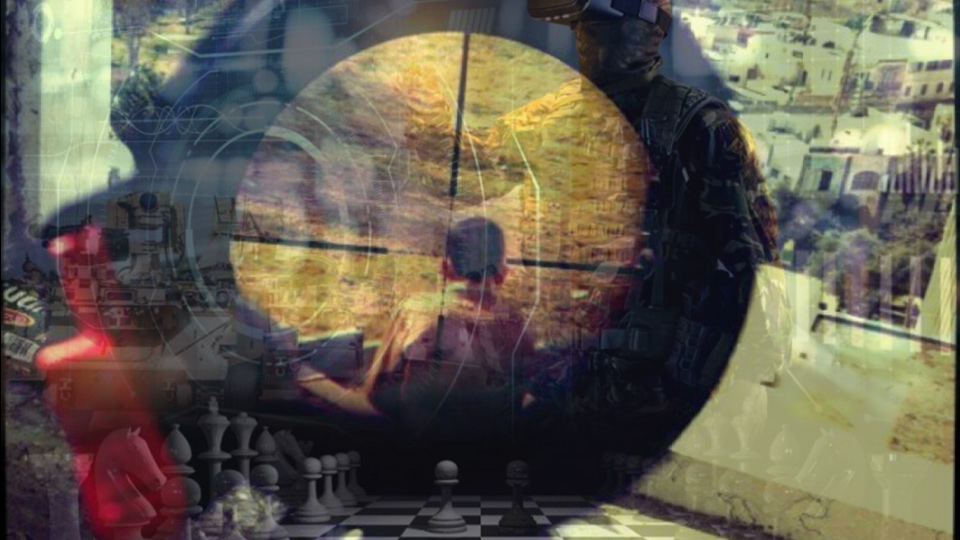

- The Israeli-Iranian war, which broke out with the attack on June 13, 2025, marks the first high-intensity conflict in history where AI plays a primary and direct operational role—not merely as a data analysis support tool, but as a decision-making and tactical instrument.
- Iran lost this race partly because it remained anchored to an increasingly obsolete model of deterrence—namely, nuclear deterrence—while the real game has been playing out elsewhere for years, and both the United States and China are well aware of it.
- The implications are unsettling: algorithmic superiority can drive actors to strike preemptively, following a logic of instantaneous decision-making, drastically shortening reflection time but increasing the risk of automated escalation.
- What influence can the Church bring to bear on this increasingly oppressive reality?
Artificial Intelligence is revolutionizing every aspect of human life, and warfare is no exception. Even advanced technologies, which could undoubtedly serve the common good, end up being bent to the logic of destruction.
The Israeli-Iranian war, which broke out with the attack on June 13, 2025, marks the first high-intensity conflict in history where AI plays a primary and direct operational role—not merely as a data analysis support tool, but as a decision-making and tactical instrument.
Israel made extensive use of AI, both in the preparatory phase and during the actual attacks against strategic targets in Iran. Artificial intelligence was employed primarily to analyze intelligence data and identify high-priority targets, coordinate simultaneous strikes using drones and fighter jets, optimize flight paths to evade Iranian air defenses, and even anticipate Iranian countermeasures, thereby reducing their ability to respond. The use of AI enabled Israel to precisely strike nuclear infrastructure and military bases, inflicting significant damage before Iran could mount an effective reaction.
“AI is fundamentally a military technology.” If this is true, then AI is by its very nature more inclined to safeguard national security than to promote détente or even peace among nations. In fact, throughout history, the two great engines of technological progress have always been conflict and profit.
On the very night of the first strike, the IDF was able to carry out surgical attacks that eliminated Gholamali Rashid, who was effectively the commander-in-chief of all Iranian wartime operations (his successor, Ali Shadmani, was also killed a few days later in a similar strike), and Hossein Salami, the most prominent figure in Iranian propaganda and anti-Israeli psychological warfare, as well as a key proponent of an aggressively offensive military doctrine. In addition, the three leading nuclear scientists were intercepted and killed.
When people talk about Artificial Intelligence, most think of ChatGPT and similar tools. Yet this innovative and revolutionary technology goes far beyond language models trained on vast amounts of text to generate more or less coherent and articulate responses.
Peter Thiel, founder of Palantir—arguably the most important company specializing in large-scale data analysis—and a major investor in Anduril, one of the leading players in autonomous defense and military AI applications, stated in 2019 that “AI is fundamentally a military technology.” If this is true, then AI is by its very nature more inclined to safeguard national security than to promote détente or even peace among nations. In fact, throughout history, the two great engines of technological progress have always been conflict and profit. It is precisely thanks to these forces that human needs, combined with available resources, are perceived as urgent—thus driving ideas to evolve into concrete solutions.
AI is no exception. In the realm of warfare, it has redefined the very concept of deterrence, which until now was based on the possession and implicit threat of nuclear weapons. The Israeli-Iranian war marks a paradigm shift: the transition from the era of nuclear deterrence to that of digital deterrence. In this new landscape, the advantage lies not so much in destructive capability, but in the speed of processing and anticipation. Those who can predict, neutralize, and strike first—without dramatic bloodshed—wield a more subtle and pervasive form of deterrent power.
Iran lost this race partly because it remained anchored to an increasingly obsolete model of deterrence—namely, nuclear deterrence—while the real game has been playing out elsewhere for years, and both the United States and China are well aware of it. The implications are unsettling: algorithmic superiority can drive actors to strike preemptively, following a logic of instantaneous decision-making, drastically shortening reflection time but increasing the risk of automated escalation.
Atomic power made conflicts less likely, because the greater the firepower, the stronger the awareness of war’s destructive and irreversible consequences. Artificial intelligence in warfare, by contrast, produces a kind of “active deterrence,” because as the precision of weapons increases, the number of collateral victims decreases and the conflict becomes more manageable—at least tactically.
This was not the case during the Cold War: paradoxically, atomic power made conflicts less likely, because the greater the firepower, the stronger the awareness of war’s destructive and irreversible consequences. Conflict, after all, is the flip side of profit—but in a thermonuclear war, there is no profit left for anyone.
Artificial intelligence in warfare, by contrast, produces a kind of “active deterrence,” because as the precision of weapons increases, the number of collateral victims decreases and the conflict becomes more manageable—at least tactically. As weapons become more “intelligent,” there is a tangible trend toward reducing human losses among soldiers, especially in technologically advanced countries. Just consider that the Korean War (1950–1953) caused over 36,000 American deaths, while the Gulf War (1990–1991), despite the massive deployment of forces and equipment, resulted in fewer than 300 U.S. casualties. In short, there is a general trend showing that the number of victims declines as the technological sophistication of weaponry increases.
Already in the early 2000s, prominent figures in American military research—such as Ray Kurzweil and John A. Parmentola—outlined five foundational characteristics of future warfare. These can be summarized in five key words that define today’s war paradigm.
It is remote: combat takes place at a distance, through drones, satellites, and automated systems, without direct involvement of troops on the ground. It is robotic: there is a growing tendency to use machines with autonomous or assisted intelligence in hostile environments, equipped with offensive and defensive capabilities. It is robust: systems are designed to withstand extreme conditions, cyberattacks, and malfunctions, ensuring continuous reliability. It is reduced: equipment is increasingly miniaturized, agile, and precise, involving fewer personnel, fewer resources, and fewer casualties (experimental devices now exist that are the size of birds—or even bees). It is virtual: a growing portion of conflict now takes place in cyberspace, involving viruses, hacking, and information manipulation.
A war conducted with sophisticated technologies risks being perceived as less serious by the public. This happens despite the greater abundance of realistic detail in media coverage, which risks normalizing it, as it is consumed daily like any other content. There is indeed a real danger, as Pope Leo warned, of getting “used to war.”
It is precisely this apparent sterilization of war that makes it far more likely today than in the atomic era. The reduction in human cost—at least on the side of combat troops—does not necessarily mean a lower overall impact of conflict. On the contrary, because the risk to one’s own soldiers appears more contained, political decision-makers may be more inclined to resort to force, even for limited or controversial objectives.
A war conducted with sophisticated technologies risks being perceived as less serious by the public, even though it increases strategic instability and reliance on opaque decision-making processes that are often beyond human control. This happens despite the greater abundance of realistic detail in media coverage, which—rather than amplifying the visual and emotional impact of war—risks normalizing it, as it is consumed daily like any other content. There is indeed a real danger, as Pope Leo warned, of getting “used to war.”
The Church itself cannot remain silent in the face of this transformation. The great challenge for the next magisterium will be to articulate an ethics of technology that places the human person back at the center and protects their dignity—even in the extreme moment of armed conflict. No war can be called just if it is dehumanized, automated, or reduced to computation.
Leo XIV is already forcefully reaffirming that peace is the work of justice. No artificial intelligence, no matter how sophisticated, can ever replace the moral conscience of humanity. The Church’s mission, then, will be to safeguard this truth against the oblivion brought by technology: no algorithm can discern good from evil.